Validating Critical Market Assumptions via MVP
The conference room phone vibrates. It is the Chief Product Officer, and the tone of her voice instantly hollows out your stomach.
“The board just looked at the churn metrics for the new enterprise platform,” she says, bypassing any pleasantries. “We are down 14% this quarter. The users are saying the core automation feature is too complex, and they do not care about the predictive analytics module we spent nine months building. How did we miss this?”
As a senior project manager or product leader, this is the ultimate corporate nightmare. You delivered the project on time. You managed the budget flawlessly. You cleared every sprint roadblock. Yet, the product is dead on arrival because the fundamental assumption driving the entire investment was dead wrong.
For decades, the standard corporate playbook dictated that enterprise products required grand, all-encompassing rollouts. Executives assumed that corporate customers demanded flawless aesthetics, massive feature lists, and absolute completeness from day one. This is a dangerous, capital-destroying corporate myth.
The reality of the modern B2B market is brutal. The greatest risk to your capital pool is not a delayed schedule or a technical bug: it is the systematic building of something that nobody actually wants. To protect your resources and mitigate investment risk, you must shift away from the grand reveal and embrace a strategy rooted in Lean Product Strategy. You must construct the bare functional baseline of a minimum viable product to collect immediate ecosystem feedback.
The Core Philosophy of Assumption Validation
To lead an elite project management team, you must first reframe your definition of a Minimum Viable Product. An MVP is not a broken, low-quality product rushed out the door to meet a superficial deadline. Rather, it is the sharpest, most targeted instrument designed to answer a single question: Are our core value propositions true or false?
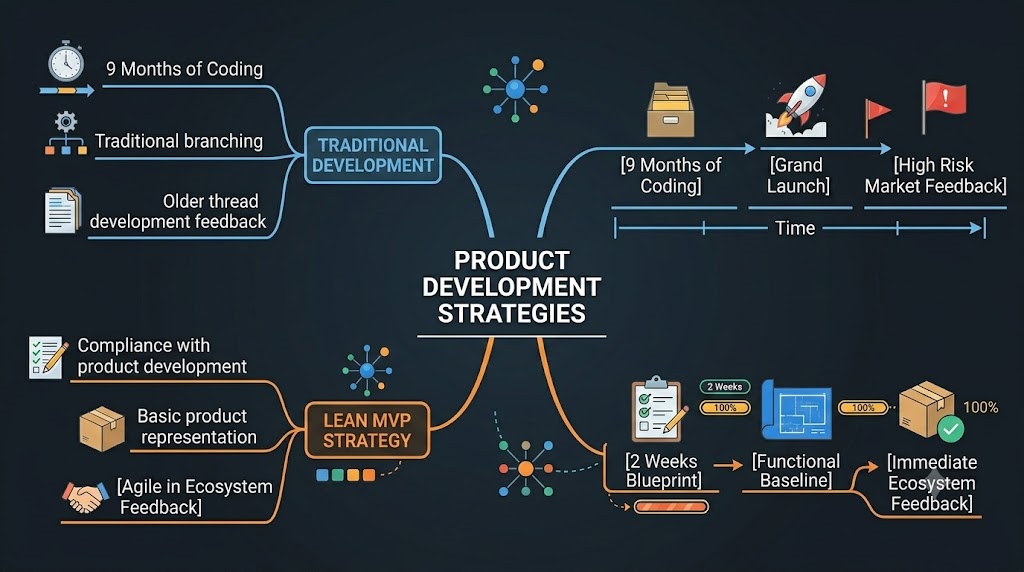
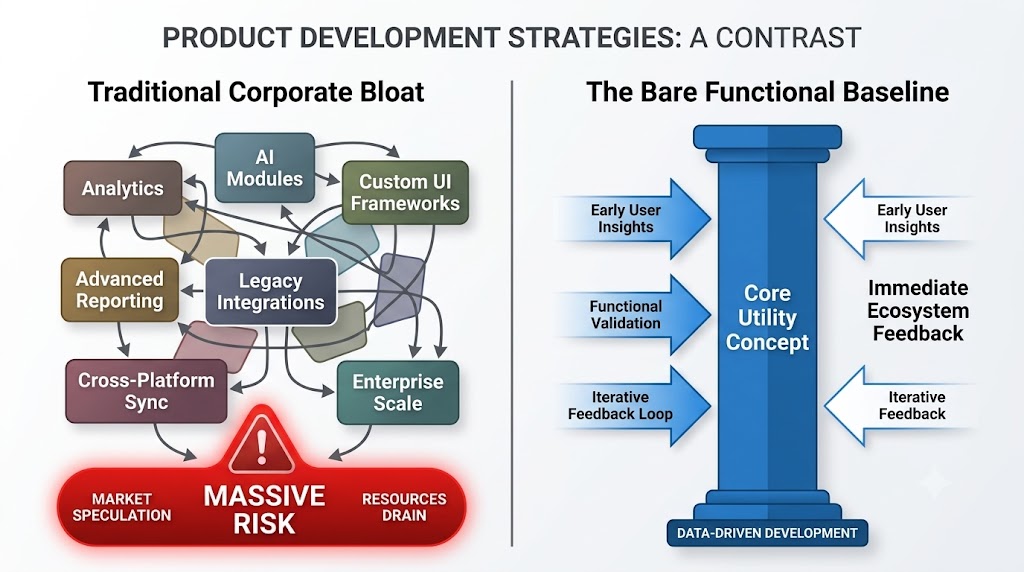
When managing a Lean Product Strategy, your primary enemy is over-engineering. Teams frequently fall victim to gold plating, adding advanced bells and whistles that customers never requested, which bloats timelines and obscures reality. By stripping a product down to its bare operational essence, you create an unadulterated loop between the user and the system architect.
This approach minimizes market speculation. Instead of relying on focus groups or theoretical feedback, you observe how a live corporate ecosystem interacts with a working piece of software. The capital saved by omitting unnecessary components remains in your resource pool, ready to be deployed when real data highlights the true path to scalability.
The Elite Project Manager's Implementation Framework
Transforming a massive corporate roadmap into a lean, data-gathering MVP requires a rigorous operational framework. You cannot rely on guesswork. You must execute a step-by-step strategy that translates vague leadership visions into concrete, testable baselines.
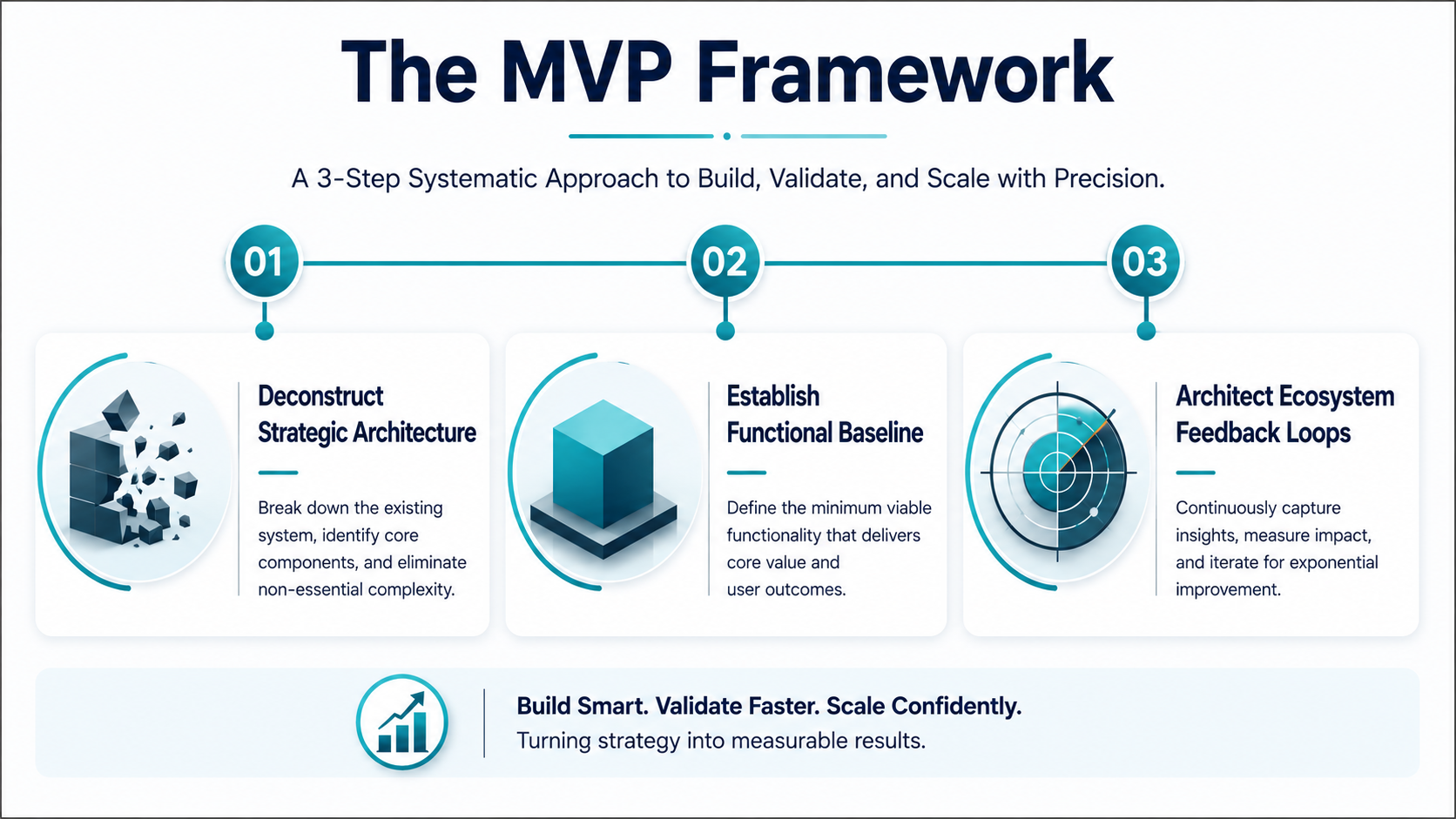
Step 1: Deconstruct the Strategic Architecture
Every new initiative begins with a vision, but a project manager must immediately break down that high-level statement into specific assumptions. Create an explicit log separating established internal knowledge from untested market hypotheses.
Use a standardized evaluation matrix to isolate the highest-impact assumptions:
| Assumption Type | Strategic Impact | Current Data Support | Risk Profile |
| Value Hypothesis | Critical to core utility | Anecdotal statements only | High Risk |
| Usability Hypothesis | Moderately critical | Past application patterns | Medium Risk |
| Scalability Hypothesis | Deferred to late stages | Infrastructural models | Low Risk |
Prioritize testing the assumptions that present the highest risk with the lowest factual support. If the value hypothesis is false, no amount of usability tuning or infrastructure scaling will save the venture.
Step 2: Establish the Minimum Functional Baseline
Work directly with your system architects and product owners to determine the absolute minimum code required to test the priority assumptions. Define the strict boundaries of the baseline using clear guardrails:
Eliminate any automated secondary flows: utilize manual workarounds behind the user interface if necessary.
Strip out custom visual frameworks: leverage out-of-the-box UI libraries to expedite delivery.
Enforce rigid scope parameters: if a proposed feature does not actively prove or disprove the core assumption, ban it from the immediate sprint backlog.
Step 3: Architect the Ecosystem Feedback Loops
An MVP without an embedded telemetry strategy is a waste of capital. Before deploying a single line of code to a staging or production environment, you must build the data acquisition framework.
Quantitative Telemetry: Integrate precise event tracking directly into the core user paths to monitor actual utility drop-off points.
Qualitative Intercepts: Systematically plant targeted operational feedback triggers immediately following the user’s interaction with the main functional feature.
Direct Observation: Coordinate structured sessions where your delivery team observes the user navigating the software in real time, capturing friction points that telemetry might miss.
Step 4: Execute Fast-Cycle Sprints and Analyze
Run compressed, time-boxed development windows to bring the baseline to life rapidly. Avoid the trap of extended preparation: your goal is to push a workable product iteration to a select user group within weeks.
Once the user base interacts with the software, compile the ecosystem metrics immediately against your baseline success criteria:
[Ecosystem Metric: Feature Adoption Rate > 75%] ⟶ Trigger Core Iteration Protocol
If the telemetry shows that users completely avoid the core feature, you have successfully mitigated investment risk. You can pivot your strategy immediately without having liquidated your main resource pool.
Shifting from Project Chaos to Predictable Delivery
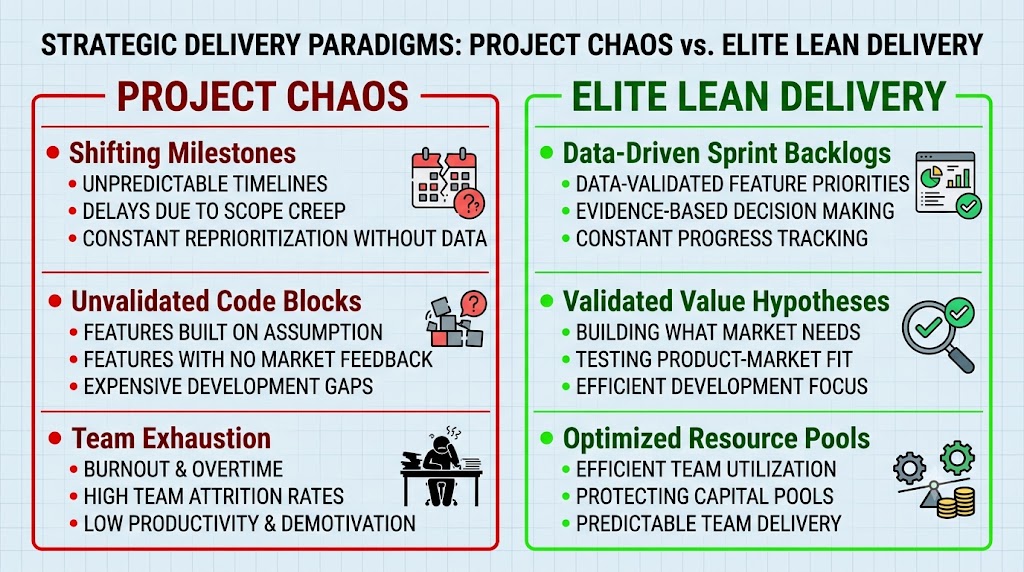
When you learn to execute project management the right way, your daily professional life undergoes a profound transformation. Consider the stark contrast between standard corporate execution and elite lean delivery:
The Path of Structural Chaos: Teams operate inside a perpetual echo chamber, writing code based on outdated documentation and executive whims. Scope creep runs rampant as every department demands its pet features. Burnout spikes, timelines slide, and the eventual product launch feels less like a triumph and more like a relief before the inevitable commercial drop.
The Elite Delivery Model: Your project parameters are sharp and predictable. The team remains highly motivated because they know every sprint delivers immediate, measurable utility to a live market ecosystem. Scope discussions are no longer emotional arguments: they are objective decisions governed strictly by data gathered from real user interactions.
By mastering the art of the bare functional baseline, you position yourself as a strategic protector of corporate capital. You cease to be a passive taskmaster tracking arbitrary milestones on a Gantt chart. Instead, you become the definitive filter that separates profitable market realities from expensive corporate illusions.
Elevate Your Strategic Career Growth Trajectory
The corporate world is filled with project managers who can track a budget or update a ticket status. But organizations do not promote individuals merely for maintaining the status quo. The executive suite looks for leaders who can navigate ambiguous market dynamics, eliminate operational waste, and protect capital from high-risk speculation.
If you are ready to stop guessing, move up the corporate ladder, and learn project management the right way, reach out to Skillsetify.
We do not just teach frameworks: we show you your exact career growth trajectory. Through deep, hands-on masterclasses and elite industry guidance, we equip you with the advanced tactical skills required to command complex product strategies and deliver massive value to the world’s leading enterprise ecosystems.
Key Takeaways for Immediate Action
Audit Your Current Scope: Look at your project management timeline today and ruthlessly identify features that are driven by internal assumptions rather than empirical market feedback.
Define Your Baseline: Collaborate with your system architects to map out what a bare functional baseline version of your product looks like if you stripped away 60% of the planned components.
Embed Telemetry Early: Ensure that feedback loops and usage data tracking are treated as primary requirements, not as elements added at the end of a product lifecycle.