Scaling Shared Services Without Killing Your Unique Selling Points
One Template to Rule Them All? The True Cost of Blind Technology Standardization
It is Monday morning at 8:00 AM, and an international conglomerates automotive software manufacturing division has just been brought to a sudden, catastrophic standstill. Following an executive directive to slash software overhead and maximize cost efficiencies, the corporate IT department has successfully executed an “application rationalization” mandate. Across twenty individual operating entities, a localized web tool chain was stripped away and consolidated into a centralized, single shared electric ERP platform.
Inside the engineering division, the real-world impact is immediate. A specialized field specialist attempting to modify a configuration for a premium electric vehicle client discovers that the standard enterprise template does not support custom local adjustments. The centralized platform, built for standard compliance tracking, lacks the technical elasticity required for localized modifications. Production lines halt, client delivery SLA thresholds break, and a multi-million-dollar rollout slips into reactive chaos.
The delivery director sits staring at the mounting delay metrics, watching the immediate revenue losses completely negate the paper savings promised by the consolidation exercise.
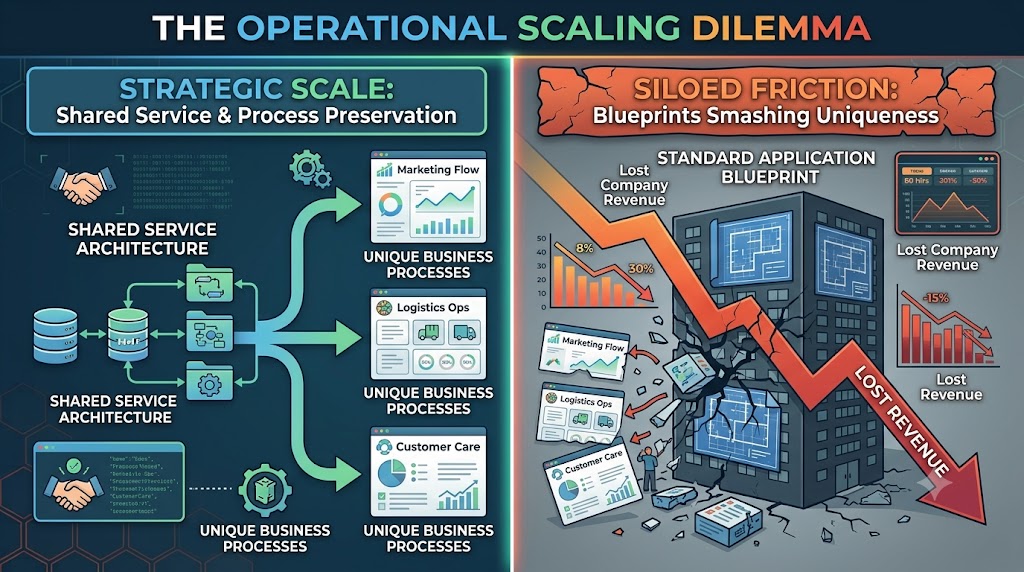
This nightmare scenario highlights a dangerous corporate myth: Standardizing application suites and consolidating engineering infrastructure under a singular shared services model will automatically lower costs and improve enterprise scalability.
When executed without a clear understanding of systemic value tracks, standardization acts as a blunt instrument that destroys core business value. Blind application consolidation often fails because it prioritizes basic administration cost reductions over the preservation of unique operational capabilities.
Elite project leaders recognize that scalable operational architecture requires a balanced approach. True organizational excellence demands standardizing general core infrastructure blocks, while intentionally protecting the specialized, unique configurations that drive your enterprise’s distinct value proposition.
Deconstructing Operational Scaling Architectures: The Shared Services Continuum
To scale a business effectively without sacrificing unique product capabilities, project professionals must master the core mechanics of shared services alignment. Operational design cannot be handled through top-down mandates, it must be planned dynamically based on how different business segments create value.
The Structural Shift: Moving Beyond Inefficient Silos
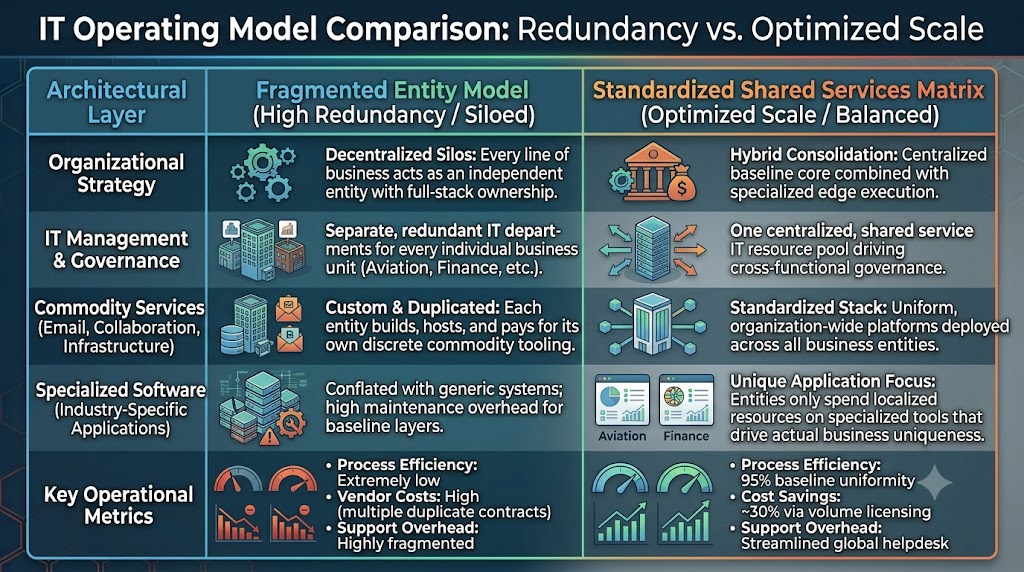
In a fragmented enterprise model, individual departments maintain completely separate software tools, independent procurement pipelines, and isolated budgets. This siloed layout creates significant complexity, introduces redundant vendor licensing costs, and dilutes the company’s shared engineering capacity.
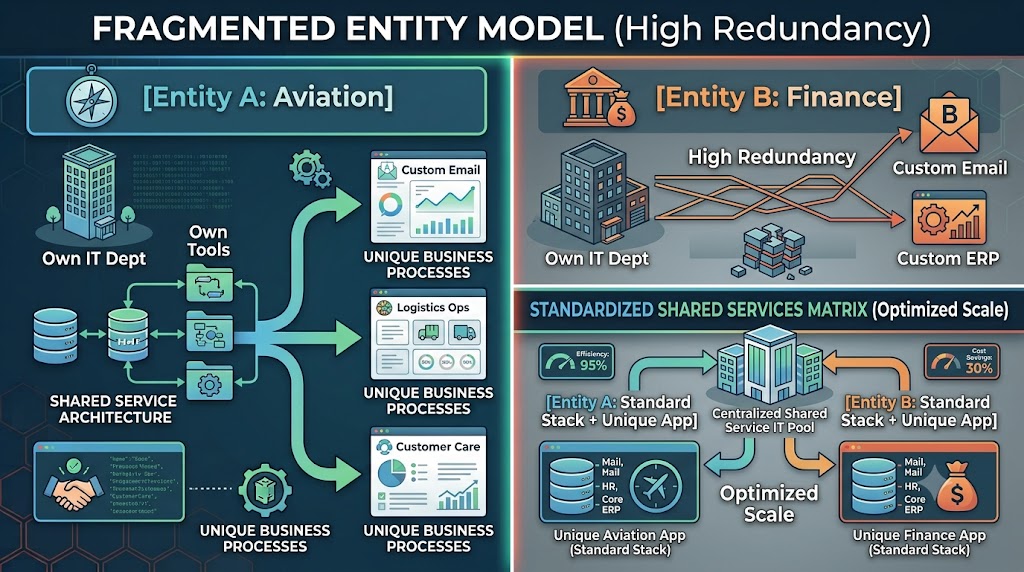
By transitioning to a centralized shared services model, an organization consolidates duplicate core operational processes into a single utility hub. This structural transformation changes how resources move:
Application Rationalization: Enterprise leaders evaluate the global software ecosystem to strip away redundant application licenses that perform identical business functions.
Infrastructure Consolidation: Fragmented data layers and disparate localized tools are brought under a single management channel, unlocking major corporate scale economies.
Shared Pool Allocation: Specialized talent functions, such as system architects and project resource managers, are organized into a central shared pool to support multiple corporate tracks simultaneously, driving down localized staffing overhead.
The Risk Matrix of Application Consolidation
Standardization delivers major cost-reduction benefits for basic administrative tools. Consolidating baseline communication applications into a single global deployment reduces overhead and simplifies cross-departmental operations.
However, applying this exact same consolidation playbook to custom engineering suites creates severe delivery risks:
The Step-by-Step Technology Standardization and Protection Blueprint
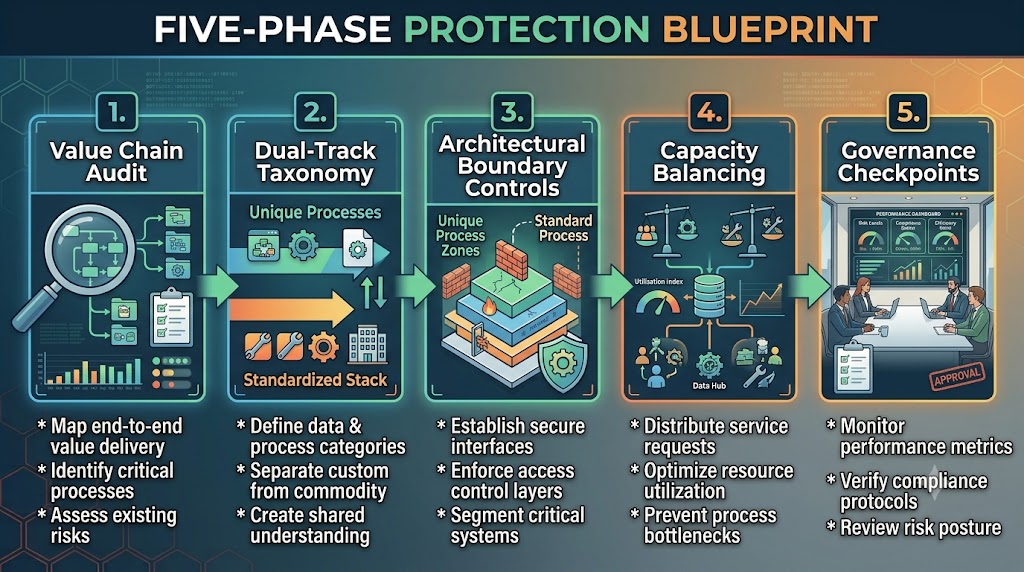
This repeatable, five-phase framework allows project leaders to optimize enterprise shared service models while fiercely protecting specialized production configurations.
Phase 1: Conduct a Cross-Functional Value Chain Audit
Before consolidating a single system dependency, the project manager must host deep-dive alignment sessions with product owners and system architects across all operating entities. The team maps out the entire corporate architecture, itemizing every software application, custom configuration layer, and localized engineering pipeline.
The focus of this phase is to evaluate whether an application is a standard commodity platform or a high-value system configuration directly tied to a unique product capability.
Phase 2: Establish a Dual-Track Technology Architecture
Using data from the audit, the system architect classifies the technology ecosystem into two distinct development tracks:
The Standard Infrastructure Layer: Commodity platform applications (such as universal email architecture, basic accounting tools, or foundational infrastructure layers) are selected for rapid consolidation under a single shared services hub.
The Protected Core Product Layer: Highly customized toolchains, deep technical frameworks, and unique product configurations are explicitly isolated from global consolidation, remaining under localized engineering control.
Phase 3: Implement Rigid Architectural Boundary Controls
To secure the protected core track while utilizing central scale efficiencies, system architects configure clear integration layers and API management channels. This architectural layout ensures that the localized engineering teams can continuously build out custom value adjustments on top of the shared foundation, without risk of global configuration wipes during central application updates.
Phase 4: Balance Shared Matrix Capacity Limits
When deploying a shared services model, project leaders must manage the allocation mechanics of the central resource pools. Transitioning from dedicated project teams to a shared matrix pool can introduce capacity bottlenecks if multiple divisions request support simultaneously.
The project manager must negotiate clear service level agreements and deploy real-time visual tracking boards to balance resource consumption, ensuring that critical engineering paths maintain steady delivery velocity.
Phase 5: Enforce Continuous Value Stream Governance
The final phase establishes automated governance checkpoints across the shared ecosystem. The team deploys clear visual metrics to measure process efficiency gains, track infrastructure cost reductions, and monitor delivery timelines across all entities.
Crucially, the team conducts continuous validation checks to verify that ongoing central consolidation efforts never compromise localized system configurations, ensuring that scaling the organization never comes at the cost of product differentiation.
Driving the Transformation: From Fractured Operations to Optimized Scale
When an organization successfully balances shared service integration with targeted technical protection, it moves beyond localized execution bottlenecks and establishes true operational scale. The daily friction of maintaining duplicate vendor platforms and tracking disconnected workflows disappears.
Instead, the corporate structure transitions into a highly efficient delivery engine characterized by optimized license costs, clear cross-functional resource visibility, and protected product velocity.
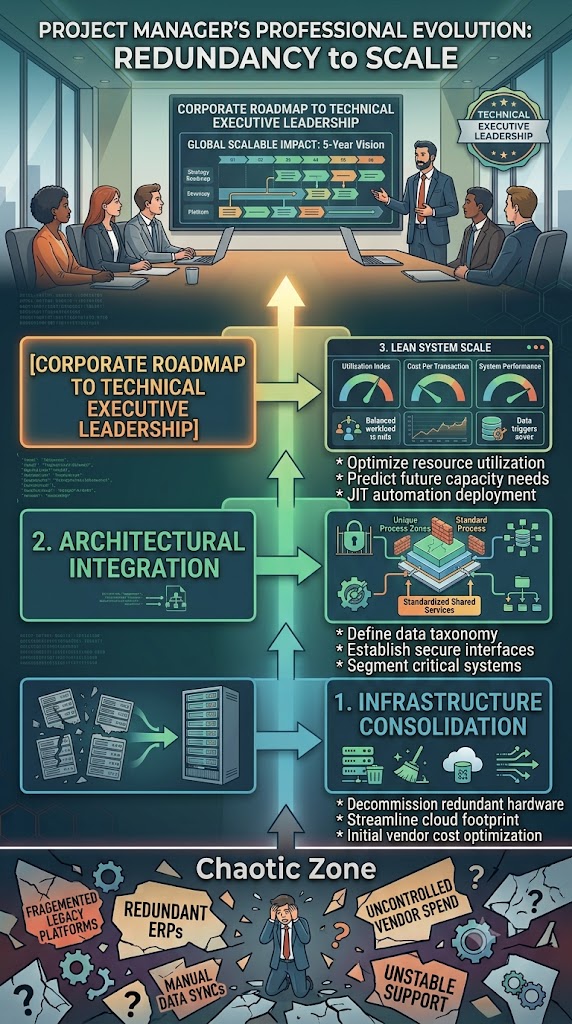
For the ambitious project professional, mastering these advanced architectural scaling mechanics completely shifts your career path. Moving past basic task coordination, leaders who can successfully optimize corporate shared service structures while protecting custom product pipelines become vital corporate assets. You step into a clear trajectory toward technical executive management, positioning yourself for high-profile operations officer and organizational design roles.
Reclaiming Enterprise Efficiency
Optimizing corporate shared service architectures is not a basic data management update, it is a high-value process enhancement that protects product configurations, reduces redundant overhead costs, and unlocks true corporate agility. By integrating disciplined infrastructure controls with targeted localized freedom, you build a scalable enterprise engine prepared for predictable execution.
If you are ready to stop guessing, move up the corporate ladder, and learn project management the right way, reach out to Skillsetify. We do not just teach abstract theoretical frameworks, we show you your exact career growth trajectory. Convert operational fragmentation into predictive enterprise value today.