How Uncapped Kanban Boards Are Quietly Killing Corporate Throughput
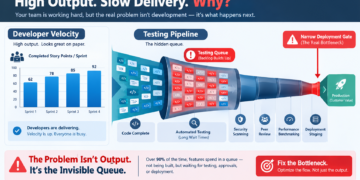
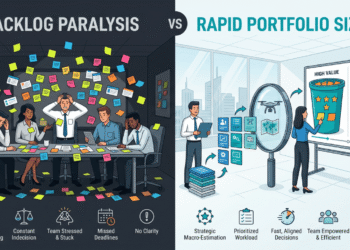
It is 4:45 PM on a critical Q3 release Friday. The product roadmap dictates that four major feature epics must go live to satisfy an enterprise client contract. Instead of celebrating a smooth deployment, you are staring at a project management tool where fourteen distinct development tickets are jammed into the In-Progress column. The engineering team is exhausted, having spent the week bouncing between half-finished tasks, while the quality assurance team sits completely idle, waiting for code that never arrives. The deployment window closes in fifteen minutes, the milestone is missed, and the executive team demands answers.
This stressful corporate crisis is repeated daily across thousands of global organizations. The root cause is almost always the same: a profound misunderstanding of visual workflow mechanics.
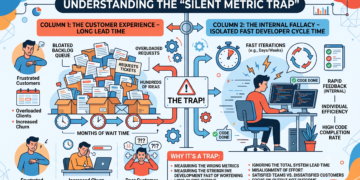
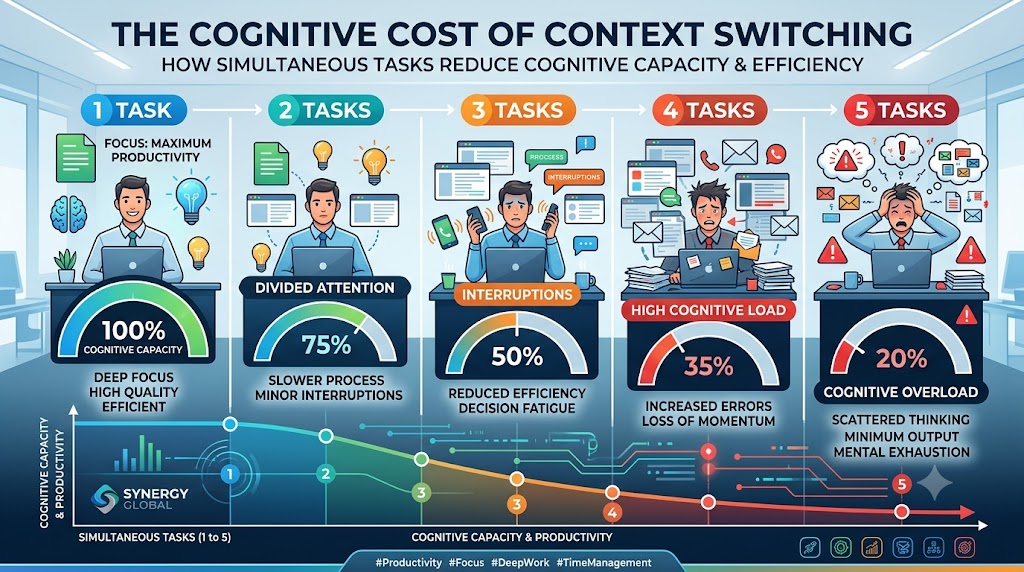
Many corporate executives and project managers still subscribe to a highly damaging productivity myth: the belief that the more items a team has in progress simultaneously, the more work they are completing. This is an operational lie. In knowledge work, multi-tasking is nothing more than a recipe for systemic delay.
When a developer jumps between disjointed tasks, they experience an operational penalty known as context switching. Research shows that juggling multiple projects simultaneously can destroy up to 80% of an individual’s cognitive capacity due to cognitive residue, which is the mental drag carried over from a previous task. To fix this, elite organizations must move away from pushing work onto teams and instead build a strict pull system governed by rigorous Work in Progress (WIP) caps.
The Core Mechanics of Visual Workflow Tracking
To transform a chaotic development environment into a highly predictable delivery engine, you must first understand the true purpose of a Kanban board. A visual workflow tracking system is not a passive digital filing cabinet for status reports. It is a dynamic model of an organization’s operational capacity.
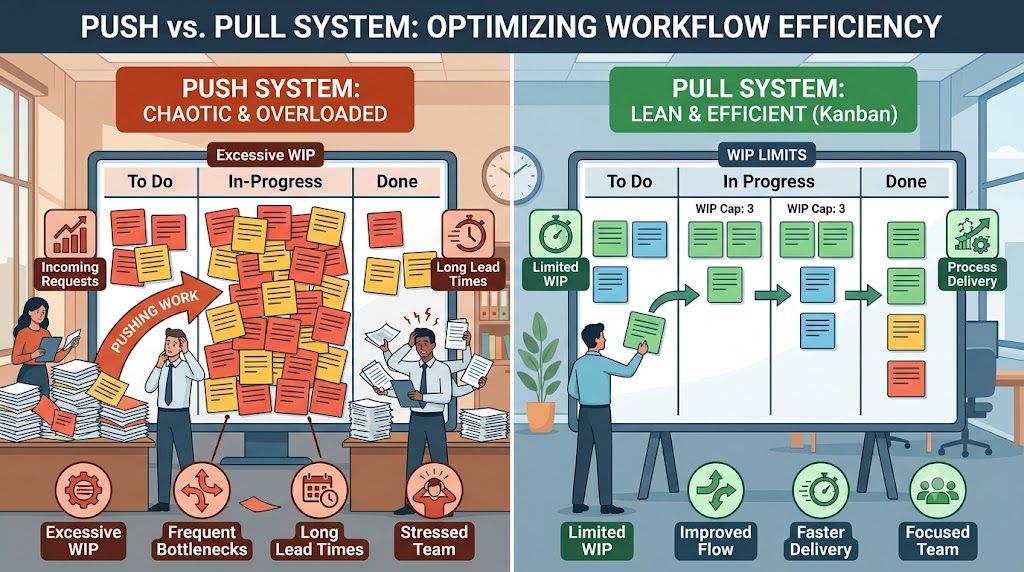
At its most fundamental level, a Kanban system maps development phases into visible columns: To-Do, In-Progress, and Done. However, the magic does not lie in the columns themselves, but in the strict regulation of systemic flow between them.
Decoding the Three Fundamental Pillars
The To-Do Column (The Options Backlog): This column holds unstarted work items that have been fully refined, prioritized, and accepted as ready for execution. It represents the immediate future of the product pipeline.
The In-Progress Column (The System Engine): This is where design, architecture, coding, and testing actively take place. In an unregulated environment, this column expands indefinitely, transforming into a graveyard of half-finished initiatives.
The Done Column (The Realized Value): An item only enters this column when it meets a strict, uncompromised Definition of Done, meaning it is thoroughly tested, fully integrated, and immediately deployable to production.
The Governing Law of Workflow Physics
The primary mechanism utilized to control this pipeline is the implementation of strict WIP limits. A WIP limit is a tactical cap placed on a specific column of a Kanban board, explicitly stating the maximum number of work items allowed inside that column at any given moment.
The mathematical foundation of this mechanism is governed by Little’s Law, an operational principle from queuing theory. Expressed formally:
In this equation, WIP (Work in Progress) represents the number of active work items currently in the system, λ (Lambda) represents the throughput rate—the average speed at which work items reach the Done column—and W represents the average lead time, or the total duration an item spends in the system from start to finish.
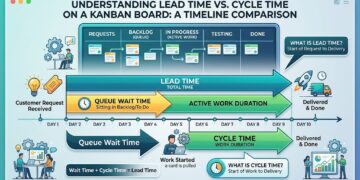
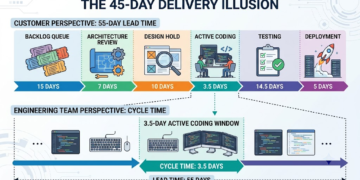
When a project manager leaves the WIP variable completely uncapped, the average lead time (W) naturally expands while throughput (λ) declines because the team experiences increasing context switching, bottlenecks, and systemic friction. As more work enters the system than can realistically be completed, overall flow efficiency deteriorates.
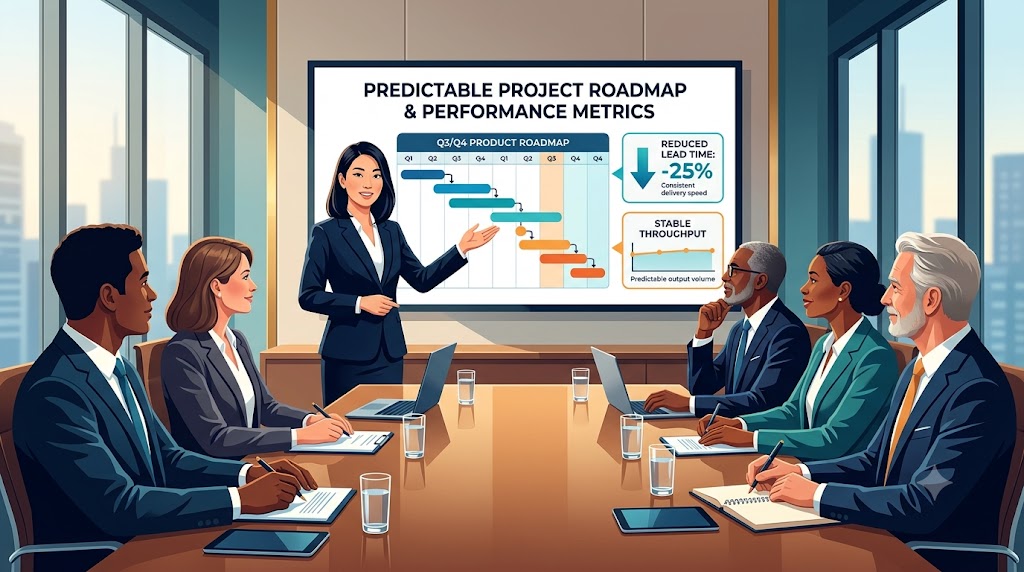
Conversely, by enforcing a strict Work-in-Progress limit, the team significantly reduces the time required for each feature to move from inception to delivery. This transforms the workflow from a push system—where stakeholders continually introduce new work regardless of capacity—to a pull system, where new work begins only after an existing item has been completed. The result is shorter lead times, improved predictability, and higher overall throughput.
The Step-by-Step WIP Cap Implementation Framework
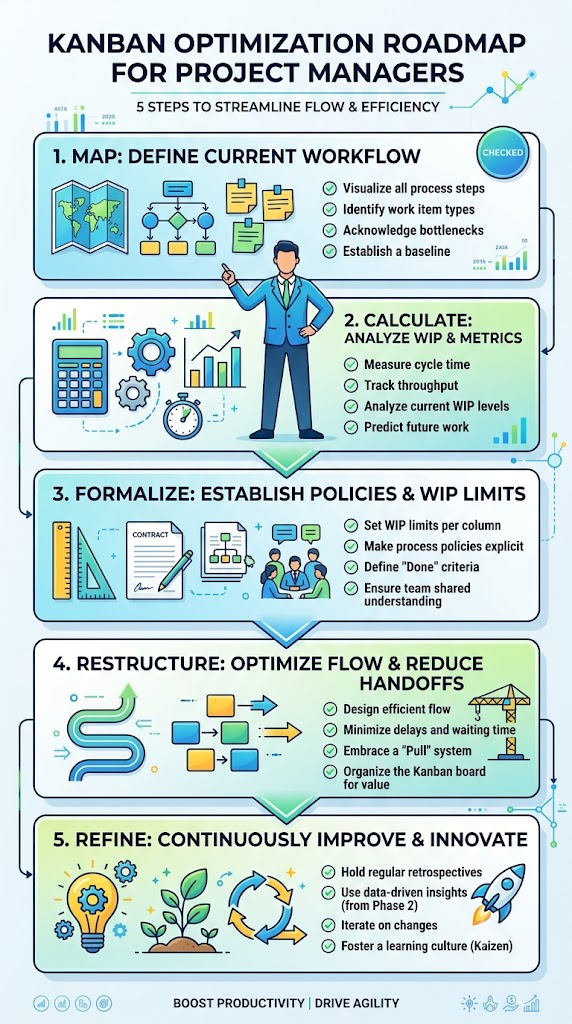
Deploying an elite Kanban board mechanic requires moving past simple columns and building an explicit operational framework. Project managers can immediately copy and use the following five-step architecture to stabilize their delivery pipelines.
Step 1: Map the True Value Stream
Do not combine all active work into a single, generic In-Progress column. Break the active phase down into its actual, distinct sub-steps. A highly effective enterprise software value stream map typically features separate columns for User Experience Design, Development, Code Review, and Quality Assurance Testing. Visualizing the exact hand-off points makes it impossible for operational bottlenecks to hide.
Step 2: Calculate Heuristic WIP Caps
Setting a Work in Progress (WIP) limit too high changes nothing, while setting it too low leaves team members starving for work. To calculate the optimal initial constraint for your sub-columns, utilize the standard team capacity heuristic:
Where N represents the number of full-time operators assigned exclusively to that specific column. For instance, if a column features three Quality Assurance (QA) engineers, the initial WIP limit for the Testing column should be set to 5 items.
This formula provides enough flexibility to accommodate natural workflow dependencies without allowing excessive multitasking. By maintaining an appropriate WIP limit, teams improve focus, reduce context switching, shorten cycle times, and achieve a smoother, more predictable flow of work across the value stream.
Step 3: Formalize Explicit Column Policies
A card must never move across columns based on a developer’s gut feeling. Every boundary on the board requires explicit exit and entry criteria. Write these policies directly onto the digital headers of your board columns.
For example, a card should only transition from Development to Code Review if the unit tests pass at 100%, the documentation is fully updated, and the branch has been pushed to the staging environment.
Step 4: Restructure Daily Stand-ups Around Flow, Not Status
Traditional project managers run daily meetings by asking each team member to list what they did yesterday and what they are doing today. This approach shifts focus away from systemic efficiency and onto individual performative busyness.
Instead, flip the script and read the Kanban board from right to left, focusing exclusively on moving active cards closer to the Done column. Start with the columns closest to completion. Identify the cards that are blocked, allocate immediate resources to clear those impediments, and prohibit the team from pulling new work from the left until the right-hand bottlenecks are broken.
Step 5: Continuously Refine the System via Cumulative Flow Diagrams
Track your operational maturity using a Cumulative Flow Diagram, which tracks the total quantity of work items within each board state over time. If the bands on your diagram begin to diverge dramatically, it means your WIP limits are too loose, and work is accumulating in the system. When the bands remain narrow and parallel, your workflow is perfectly optimized.
Shifting from Operational Chaos to Elite Delivery
When you implement Kanban board mechanics and strict WIP regulation correctly, the operational transformation inside an enterprise environment is profound. The immediate result is a dramatic drop in scope creep and a stabilization of team velocity. Because team members are no longer forced to split their cognitive energy across multiple competing priorities, the structural quality of the output increases substantially, causing post-release software bugs to plummet.
For the project manager, this methodology changes the nature of your job. You no longer function as a reactive fire-fighter, spending your days chasing updates, resolving frantic scheduling conflicts, and managing team burnout. Instead, you evolve into a strategic systems designer.
You gain the ability to look at a visual metrics dashboard and predict exactly when an epic will ship to the market with absolute, data-backed certainty. When executive stakeholders ask if the team can handle a sudden, high-priority marketplace request, you do not guess. You look at your WIP caps, calculate your current lead time metrics, and give an objective decision based on system capacity.
Mastering the mechanics of systemic flow completely alters your professional trajectory. In modern corporate ecosystems, execution-level project managers who merely log status updates are rapidly being automated or marginalized. However, professionals who understand how to design highly efficient operational value streams, eliminate waste, and maximize corporate throughput are aggressively fast-tracked into senior leadership roles. Learning how to manage complex project portfolios the right way is the single fastest mechanism to elevate your status from a tactical team administrator to a critical operational asset.
Mastering the Metrics of Enterprise Throughput
Visual tracking is only as powerful as the operational discipline behind it. Stripping away the excess noise from your pipeline, enforcing strict column-level WIP constraints, and reading your system dynamics from right to left will fundamentally transform your delivery capabilities. You will stop measuring success by how busy your team looks and start measuring it by how much value they actively deliver to production.
If you are ready to stop guessing, move up the corporate ladder, and learn project management the right way, reach out to Skillsetify. We do not just teach frameworks: we show you your exact career growth trajectory.
Key Takeaways for Immediate Execution
Stop Starting, Start Finishing: Enforce hard WIP caps across all active columns using the 2N – 1 or N + 1 capacity heuristic to crush context-switching overhead.
Manage the Flow, Not the People: Shift the focus of daily team syncs away from individual status monologues and onto breaking systemic bottlenecks from right to left.
Anchor Transitions in Objectivity: Build clear, uncompromised policies for column hand-offs to eliminate scope creep and maintain absolute quality standards.