Re-Engineering Root Cause Analysis for Psychological Safety and Systemic Scale
1. The Finger-Pointing Trap and the Anatomy of a Post-Mortem Crisis
It is Thursday afternoon, exactly 2:14 PM. Inside the primary operations center of a high-growth tech company, an emergency red alert fills the screens. The enterprise core database architecture has collapsed, throwing thousands of active clients out of the platform. For forty-eight minutes, the infrastructure stays completely frozen. Revenue margins drop, and support desks are overwhelmed by escalation metrics. The incident command center is crowded, and tension fills the room.
When the recovery patches are deployed and system availability returns, senior leadership immediately opens an organizational post-mortem meeting. The discussion quickly focuses on specific individuals: Who pushed the deployment branch to production? Which infrastructure specialist signed off on the environment configurations? Why did the database engineer on call fail to catch the error in real time?
By focusing heavily on individual blame, the true systemic defect is completely overlooked: an undocumented environment sync mismatch that bypassed the staging servers. The engineer who executed the production merge is placed on a formal performance tracking plan. Fearing career damage, the rest of the development team pulls back, avoiding process transparency and keeping software errors hidden to protect themselves. Within three months, an identical system dependency failure causes another catastrophic outage.
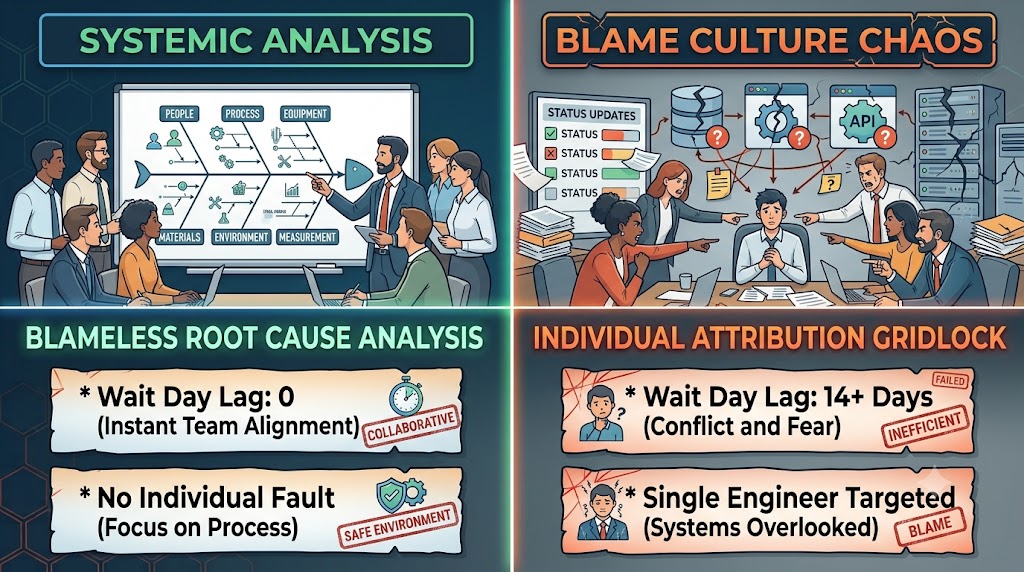
This common failure exposes a critical corporate myth: Root Cause Analysis is an administrative troubleshooting mechanism designed to locate and discipline the individual who committed the error.
When handled as a hunt for a scapegoat, Root Cause Analysis fails completely. Instead of eliminating errors, a blame-heavy review creates toxic operational silos, causes team burnout, and compromises long-term delivery timelines. Elite project professionals know that technical failures are almost always symptoms of underlying, broken system architectures. To build a highly predictable delivery engine, project managers must remove personal finger-pointing entirely and implement the objective frameworks of Root Cause Analysis (RCA).
2. Deconstructing the Technical Mechanics of Blameless Diagnostics
To transition an organization away from reactive crisis management, project leaders must master the precise formatting models that separate human performance from system architecture. True operational order requires a disciplined focus on objective tracking structures, using structured diagnostic protocols to separate individual human actions from systemic structural defects.
The Five Whys Isolation Protocol: Divergence vs. System Realities
The Five Whys methodology is one of the most popular diagnostic frameworks used to investigate complex system failures. By repeatedly asking why a problem occurred, teams can peel away surface-level symptoms and uncover the true root cause. However, traditional execution often fails when questions are not framed objectively, turning into a personal interrogation that targets individuals.
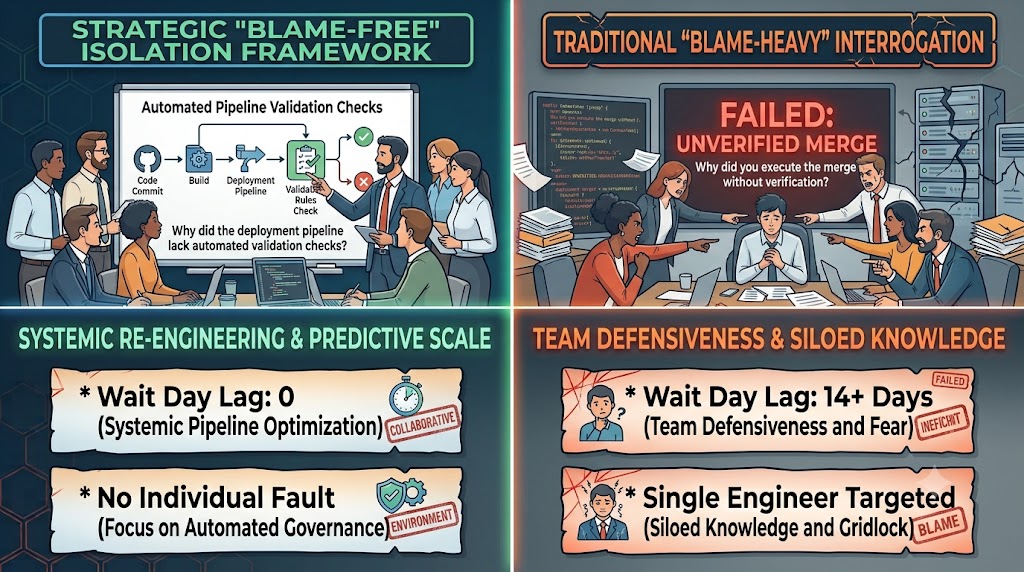
The Five Whys Isolation Protocol operates under strict operational guardrails:
Enforce System-Centric Phrasing: The word “you” must be strictly banned from every stage of the diagnostic protocol. Instead of asking, “Why did the developer execute the code merge without checking the verification dashboard?”, frame the analysis around the system: “Why did the deployment pipeline permit a code branch merge without an automated validation check?”
The Termination Threshold: It is a common misconception that teams must ask “why” exactly five times for every single issue. If the team uncovers the foundational systemic defect on the second or third iteration, stop the diagnostic path there. Forcing further questions when the actionable root cause is already visible causes unnecessary strain and distracts the team.
The Divergence Constraint: If the team’s answers start moving away from process mechanics and toward individual human behaviors, the Scrum Master or project manager must step in. Keep the analysis focused strictly on technical capabilities, process designs, and environmental tools.
The Architecture of Ishikawa Formatting and Structural Categorization
Once the individual streams of the Five Whys protocol are compiled, they must be organized into a structural matrix to map complex, intersecting dependencies. The Ishikawa diagram, also known as a Fishbone diagram, provides a clear visual framework to organize systemic defects.
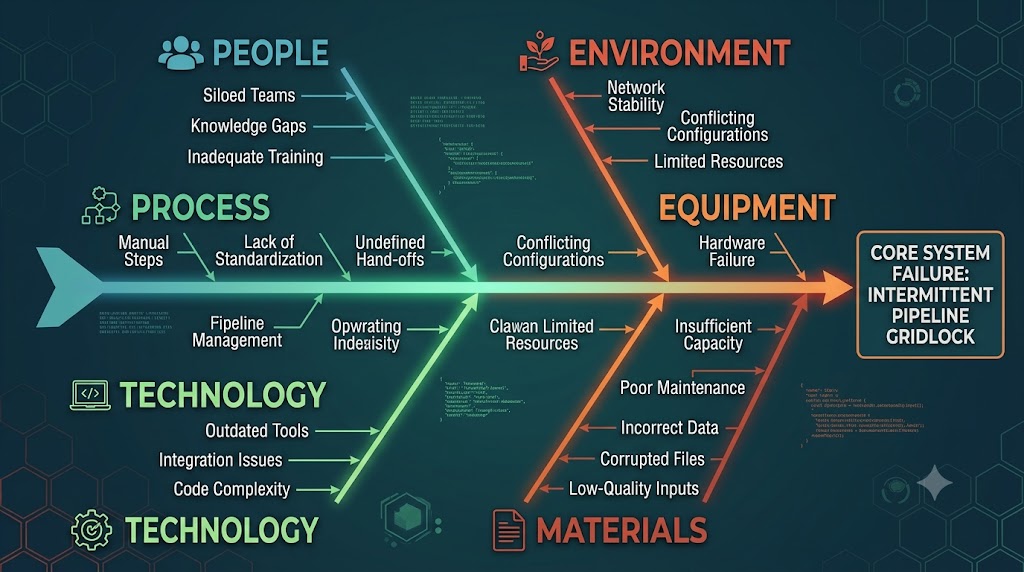
To maximize scannability, the compiled diagnostic data points are organized into clear, functional structural dimensions:
Process Dynamics: Break down the specific process gaps that led to the incident. Were the entry criteria for the development cycle unclear? Was the definition of ready or done missing from the iteration playbook?
People and Capability Building: Evaluate the team’s skill development, systemic training, and cross-functional support structures. Avoid tracking individual errors; instead, focus on whether the onboarding documentation or specialized mentoring tracks failed to prepare the team.
Technology and Infrastructure Enablers: Analyze the specific limitations within your development tools and software architecture. Did the environment lack automated testing suites, automated continuous integration triggers, or clear system error signaling systems?
Environmental Constraints: Document external project variables, cross-functional dependencies, and matrix resource Pool pressures. Were timeline constraints unachievable due to a shared services pool bottleneck?
The Step-by-Step RCA Operational Framework
For project professionals looking to integrate a blameless diagnostic setup into their active operations, this actionable framework can be deployed immediately.
Step 1: Secure a Psychological Safety Guardrail
The moment an incident occurs, the project manager must establish an unshakeable environment of psychological safety. Send a clear, written update to all cross-functional stakeholder channels: The upcoming post-mortem review is designed to analyze system vulnerabilities, not human mistakes. No individual will be blamed, penalized, or disciplined for process blind spots uncovered during this diagnostic loop.
Step 2: Assemble the Cross-Functional Team Room
An effective root cause analysis requires firsthand, cross-functional visibility. Gather representatives from every operational track that touches the system: software developers, infrastructure architects, quality checkers, product managers, and security officers. This diverse setup ensures that the resulting process model reflects true system realities, rather than incomplete corporate documentation.
Step 3: Execute Objectively Formatted Five Whys
Run the iterative diagnostic session using strict system-centric rules. Map the sequence on a centralized, shared visual board so the entire group can watch the progression. Frame each diagnostic query around process infrastructure and automated controls. Track the flow until the team reaches an actionable process update, ensuring you do not slip into finger-pointing.
Step 4: Map Sub-Causes onto the Ishikawa Framework
Transfer every uncovered sub-cause from the diagnostic session into its correct category on the visual Fishbone diagram. This step helps the team spot repeating thematic patterns across the organization. For example, if multiple sub-causes cluster under the “Technology” and “Process” categories, leadership can immediately identify where strategic continuous improvement budgets need to be directed.
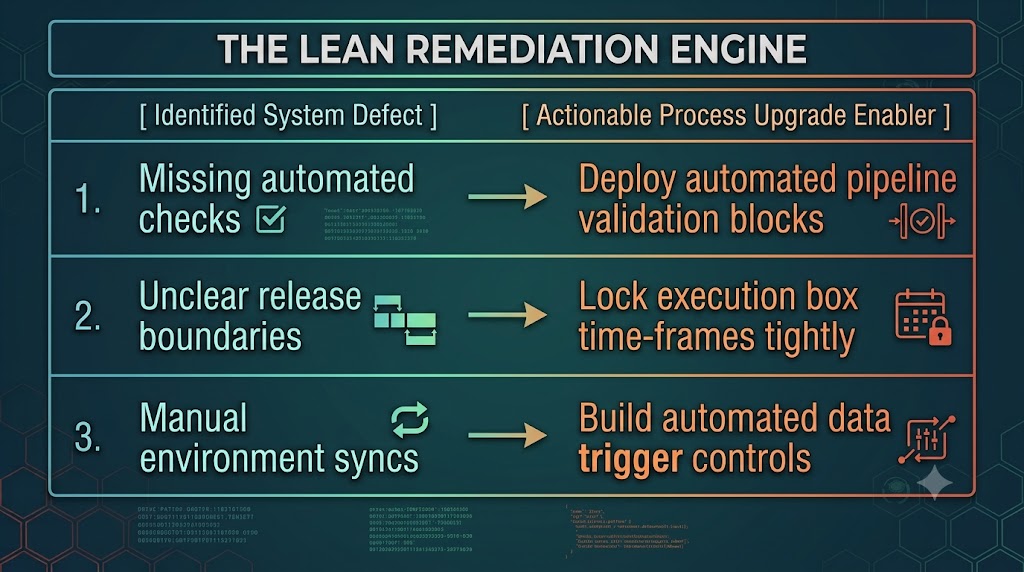
Step 5: Enforce Actionable Lean Remediation Tracks
A root cause analysis provides zero long-term value if the findings remain buried in static corporate documentation. Every root cause mapped on the Ishikawa spine must be linked to a clear, actionable process upgrade enabler. Assign explicit ownership and target completion dates for each remediation item, tracking progress openly on team governance dashboards to confirm the vulnerability is permanently resolved.
3. Shifting to High-Velocity Trust and Predictive Delivery
When an organization successfully moves from blame-heavy troubleshooting to blameless root cause analysis foundations, the operational benefits are immediate. The stressful daily reality of team defensiveness, unexpected late-stage bottlenecks, and employee burnout transforms into a model of highly predictable, automated velocity. Project leaders move beyond chasing random task statuses and establish total operational visibility over their product release tracks.
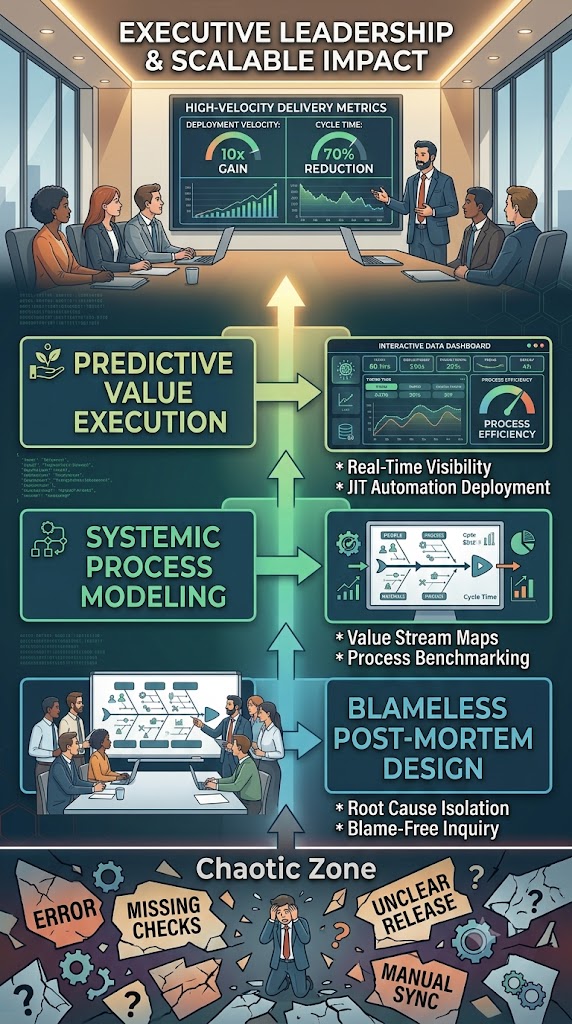
For the ambitious project professional, mastering these strategic diagnostic protocols completely changes your career path. By learning how to build psychologically safe team cultures and automate process engineering loops, you separate yourself from typical task coordinators. Project professionals who possess documented expertise in reducing corporate risk and driving systemic operational scale are highly sought after by enterprise leaders. You position yourself as a crucial cross-functional leader, clearing a direct path to high-profile technical leadership and corporate operational officer roles.
4. The Skillsetify Operational Advantage
Deploying blameless root cause analysis foundations is not a minor administrative update: it is a high-value process upgrade that protects your project margins, optimizes human capacity, and secures systemic reliability across your entire corporate architecture. By embedding objective time and motion analytics directly within an inclusive, system-focused framework, you build an resilient delivery engine capable of predictable enterprise execution at scale.
If you are ready to stop guessing, move up the corporate ladder, and learn project management the right way, reach out to Skillsetify. We do not just teach abstract theoretical frameworks: we show you your exact career growth trajectory. Transform your troubleshooting cycles into automated engines of predictive velocity today.