Harmonizing Kaizen Evolution with Poka-Yoke Safeguards
It is 2:00 AM on a Friday, and your premier enterprise product deployment has just crashed. The culprit is not a massive infrastructure failure or a sophisticated cyberattack. Instead, a well-meaning developer accidentally modified a core backend variable configuration directly in the staging environment, bypassing standard validation gates. The downstream impact is instantaneous: billing calculations skew by 180%, customer checkout arrays fail, and the incident response channel instantly explodes with frantic alerts.
By 3:00 AM, the leadership team is demanding an immediate retrospective. The defensive, exhausted team promises to “be more careful next time” and drafts a dense new documentation policy that everyone knows will be forgotten within a week.
This is the classic corporate operational trap. Organizations facing quality degradation typically respond by adding layers of bureaucratic sign-offs or demanding flawless human vigilance. Both approaches are fundamentally flawed.
A persistent myth in modern B2B project management suggests that accelerating delivery speed naturally requires sacrificing quality, or that enforcing mistake-proof safeguards suffocates continuous operational agility. This is a false dichotomy.
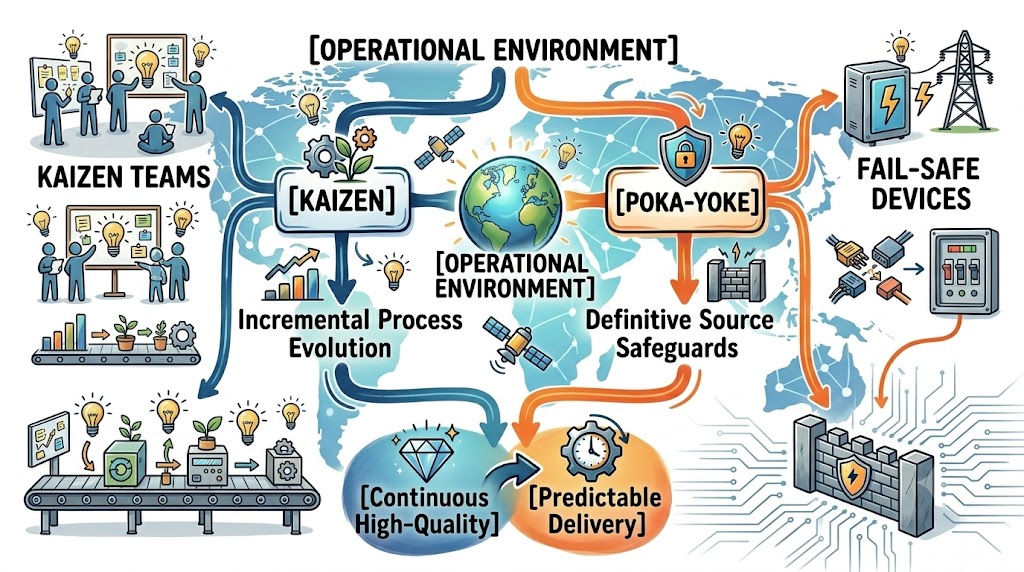
True operational excellence does not rely on human perfection. Instead, it relies on building intelligent systems that optimize for both organic growth and structural safety. By integrating the micro-evolutionary power of Kaizen with the definitive source-level protections of Poka-Yoke, delivery teams can build a self-healing operational model where small improvements are systematically locked in and critical human errors become mechanically impossible.
Deconstructing the Mechanics of Lean Quality Systems
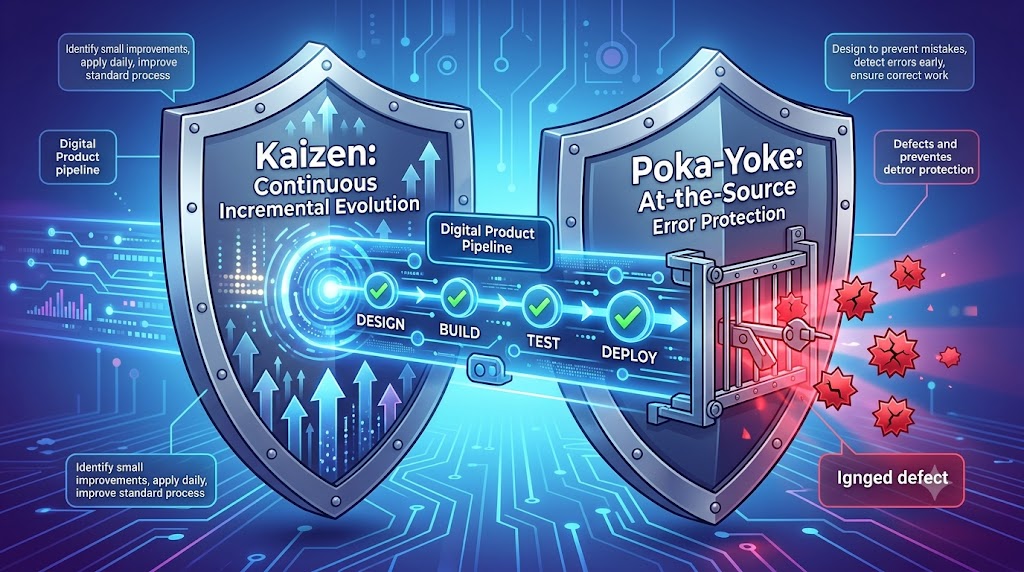
To effectively blend continuous evolution with definitive error protection, project leaders must shift from generic management buzzwords to concrete operational engineering. Lean quality systems are structurally anchored by two distinct, highly synergistic dynamics: Kaizen and Poka-Yoke.
What is Kaizen?
Kaizen is a Japanese philosophy translating directly to “change for the better.” In an enterprise project delivery framework, Kaizen represents an ongoing, daily commitment to incremental evolution. It rejects the disruptive, high-risk mandate of macro-overhauls in favor of small, continuous process improvements executed by the workers closest to the actual execution layer.
The core power of Kaizen rests on compounding: tiny upgrades in code standards, meeting structures, automated tooling, or communication documentation yield massive, systemic performance gains over a multiple-month timeline.
What is Poka-Yoke?
Poka-Yoke means “mistake-proofing.” It is an engineering and operational design approach focused on preventing human errors from turning into actual systemic defects at the immediate source of work.
While Kaizen focuses on how a system can incrementally evolve over time, Poka-Yoke focuses on setting up definitive boundary constraints that make errors physically, digitally, or structurally impossible to execute. It acknowledges that human fatigue, distraction, and cognitive overload are unavoidable realities, and shifts the burden of quality from human memory to structural design.
The Architecture of Synthesis
When deployed in absolute isolation, both concepts develop distinct operational blind spots:
Kaizen without Poka-Yoke: Teams continuously optimize a process flow, yet remain highly vulnerable to catastrophic human typos or critical configuration slip-ups that invalidate their incremental progress.
Poka-Yoke without Kaizen: The system becomes highly rigid. Mistake-proof constraints remain frozen in time, failing to adapt to shifting project parameters, changing tech stacks, and evolving market needs.
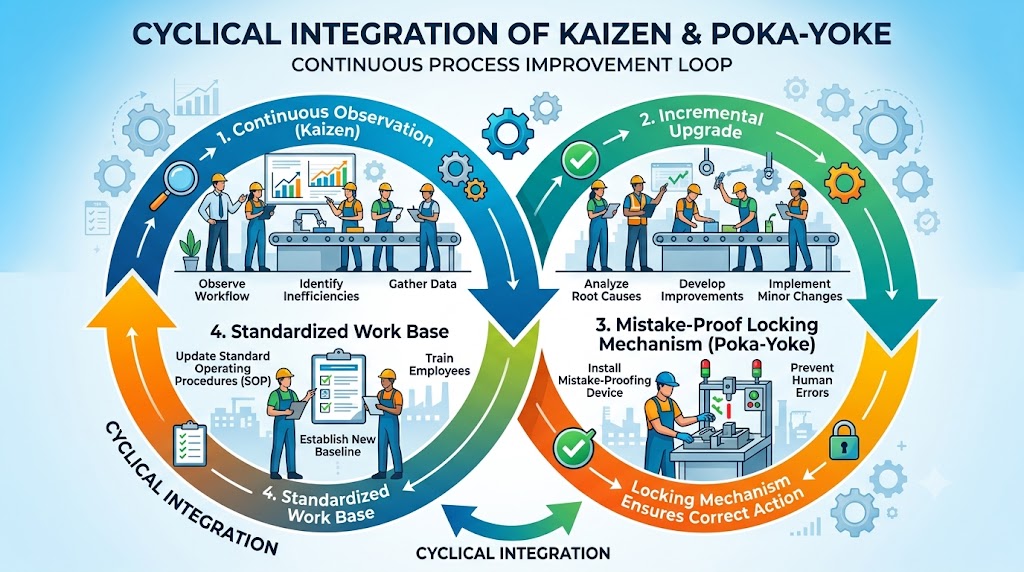
Integrating the two methodologies creates a resilient loop. Kaizen encourages the delivery team to frequently evaluate the workflow, isolate inefficiencies, and conceptualize smarter ways to operate. The moment the team identifies an optimal method or highlights a persistent point of failure, they design a Poka-Yoke mechanism to structurally secure that specific node.
The Strategic Blueprints for Error Protection
Implementing Poka-Yoke requires mapping out your workflow vulnerabilities and applying targeted mistake-proofing archetypes directly to those nodes. In software development, technical operations, and B2B project deployment, Poka-Yoke implementations generally fall into three core structural archetypes.
1. The Contact Method
This method identifies errors based on structural, physical, or absolute digital boundaries. If a specific condition or configuration criteria is not precisely met, the next step in the delivery pipeline is blocked.
B2B Project Management Example: Automated pull request templates that physically reject a code merge if the developer has not linked a valid issue tracking ID and verified automated test pass rates.
Operational Reality: A developer cannot push code into the main branch because the continuous integration pipeline programmatically blocks the migration, completely eliminating the human variable of “forgetting the deployment checklist.”
2. The Fixed-Value Method
This strategy ensures that a exact, predetermined number of movements, fields, or operations are fully executed before a task can transition to status done.
B2B Project Management Example: Setting up automated infrastructure deployments where API payload schemas reject data collections unless all mandatory data elements are present.
Operational Reality: This eliminates structural omissions, guaranteeing that missing fields are caught by system logic before entering live application databases.
3. The Motion-Step Method
This principle mandates that a person execute a specific sequence of actions in a predefined order. If the worker attempts to skip step two to perform step three, the system suspends execution.
B2B Project Management Example: Multi-stage release management strategies where production database migrations are locked out until pre-production sanity tests are fully completed and cryptographically signed off by the QA system.
Operational Reality: The project manager no longer needs to send desperate messages reminding the team to test before launching: the environment itself enforces the proper operational sequence.
The Step-by-Step Implementation Framework
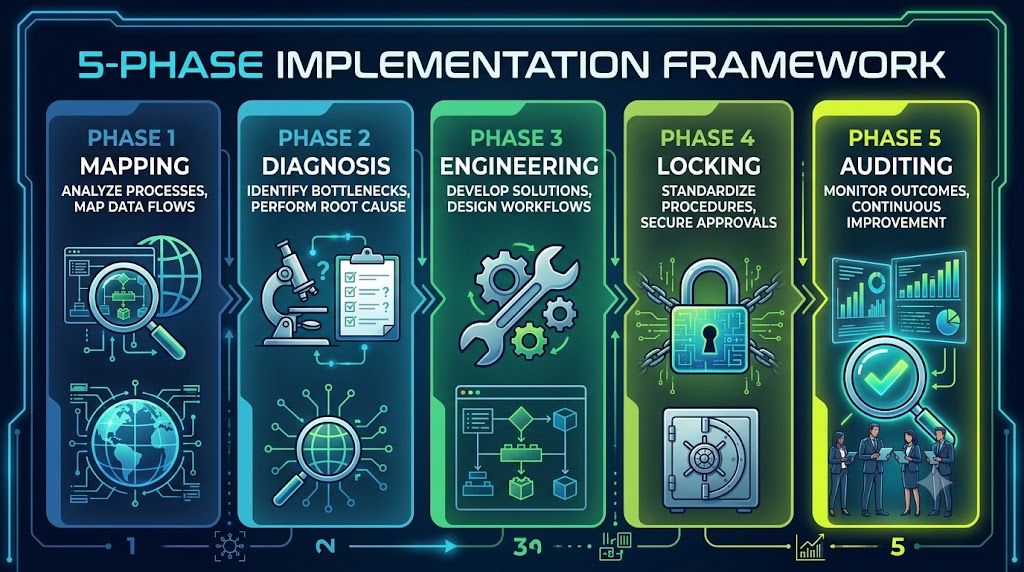
To deploy this integrated system within an active project environment, Project Managers can follow this actionable blueprint:
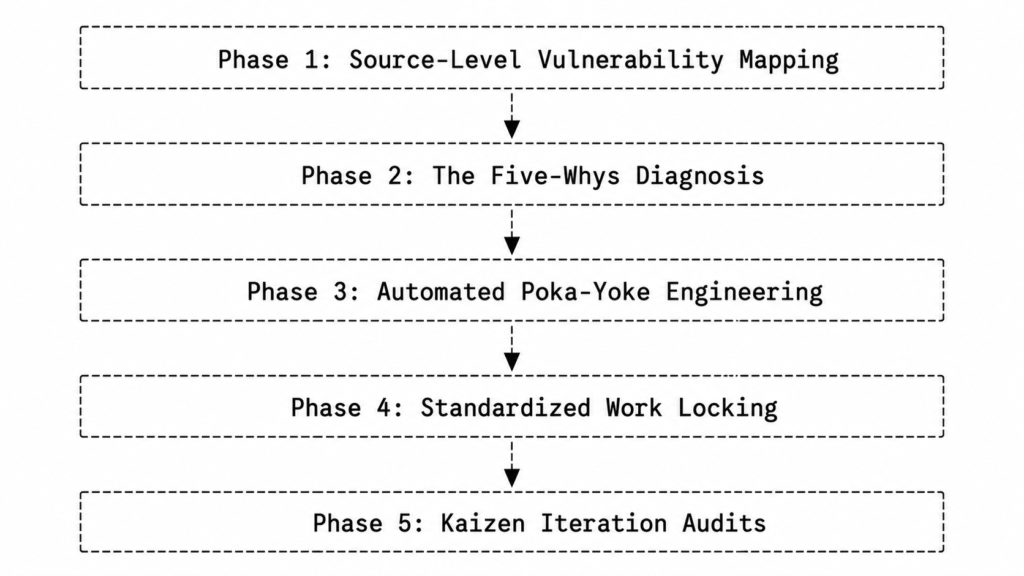
Phase 1: Source-Level Vulnerability Mapping
egin by reviewing your project data from the past two quarters. Isolate recurring pain points: missed testing criteria, delayed environment configurations, or miscommunicated requirements scope. Identify the exact direct source of work where these mistakes occur.
Phase 2: The Five-Whys Diagnosis
Run a root cause analysis on your most severe delivery failure without assigning human blame. Ask “Why did this happen?” repeatedly until you reveal the underlying process gap.
If a production configuration failed, don’t stop at “the engineer entered the wrong values.” Dig deeper until you uncover that the configuration values are managed via manual text inputs without input masks or schema validators.
Phase 3: Automated Poka-Yoke Engineering
Design an automated check at that specific failure node. If your team frequently misses code coverage criteria during tight sprint updates, configure your automated build tool to instantly fail updates that fall below a set test threshold. The goal is to make the error visible instantly, rather than downstream in production.
Phase 4: Standardized Work Locking
Update your operational baseline documents to reflect the new system constraint. This ensures that mistake-proof guards are treated as fundamental requirements, rather than temporary patches.
Phase 5: Kaizen Iteration Audits
Dedicate the final fifteen minutes of your sprint retrospectives to process evolution. Ask the team: “Where did we rely entirely on memory this sprint, and how can we design a system check to protect ourselves next time?” This turns your retro from an administrative exercise into an active optimization engine.
The Transformation: From Chaos to Elite Delivery
When you shift from a culture of human blame to an ecosystem protected by systematic safeguards, the entire operational environment transforms.
| Attribute | Legacy System (Vigilance-Driven) | Modern Lean System (Kaizen & Poka-Yoke) |
| Quality Control | QA teams catch bugs downstream, causing frequent patch cycles. | System design prevents defects at the source, maximizing pipeline velocity. |
| Operational Culture | High blame, high stress, and constant team burnout during production runs. | Psychological safety, high trust, and collective focus on system optimization. |
| Delivery Trajectory | Variable, unpredictable, and highly dependent on individual developer heroics. | Predictable, scalable, and continuously improving with each sprint run. |
Implementing this system changes the nature of delivery management. Project leaders shift from playing the role of defensive process enforcers to operating as strategic architects. Instead of wasting energy tracking down compliance tracking failures, chasing missing updates, or managing midnight rollbacks, you build an environment where quality is maintained automatically.
This operational resilience directly accelerates professional career growth. Leaders who deploy these systems become known for delivering high-impact, low-defect initiatives on time and on budget. Organizations notice when a leader replaces systemic fire fighting with stable, predictable project execution.
Mastering Strategic Execution with Skillsetify
Building a high-performing project delivery ecosystem requires more than just reading about foundational frameworks: it requires mastering real-world application. True professional advancement belongs to project leaders who can step into chaotic project environments, systematically decouple performance from human error, and engineer resilient operational architectures that ensure scalable growth.
If you are ready to stop guessing, move up the corporate ladder, and learn project management the right way, reach out to Skillsetify. We do not just teach frameworks: we show you your exact career growth trajectory. Through expert-led coaching, deep-dive methodology training, and real-world tactical case studies, we provide you with the exact systems engineering mastery required to run elite enterprise project environments.
Turn your delivery pipeline into a competitive asset. Connect with Skillsetify today, and take command of your professional career trajectory.