Why Your Technical Requirements Are Trashing Sprints and How Autonomous Estimation Fixes It
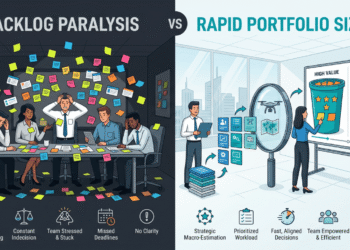
It is 9:00 AM on a Monday morning, and the conference room is thick with palpable tension. The project manager stands before a digital board cluttered with ambiguous, monolithic technical requirements. Tasks like “Optimize database index distribution routines” and “Configure microservices cross-origin resource sharing headers” look more like an infrastructure log than a strategic plan. The development team sits in defensive silence, eyes fixed on their laptops. The stakeholders are demanding a hard delivery date for the entire product lifecycle, while the engineering leads are retroactively trying to map these complex backend scripts to arbitrary calendar dates.
Faced with an approaching meeting deadline, the project manager makes a fateful mistake. They interpret the engineering team’s exhausted silence as consensus, arbitrarily assign a two-week estimate to each task, and lock in the sprint commitment.
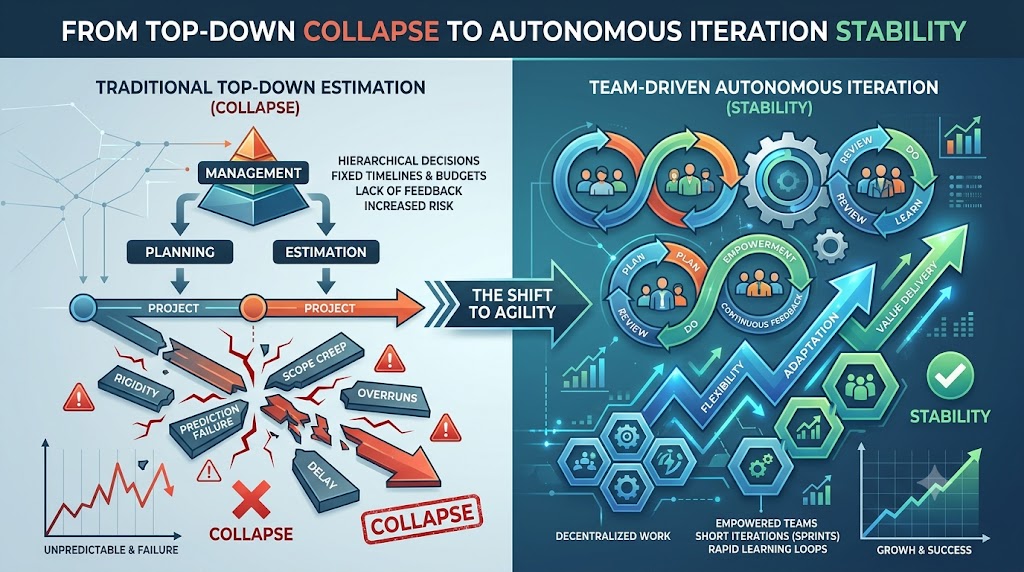
Ten days later, the predictable collapse occurs. The sprint boundary bursts under the weight of unforeseen technical dependencies, scope creep runs rampant, and the team delivers less than 35% of the committed work. The retrospective turns into a finger-pointing exercise, trust with the business evaporates, and the cycle of team burnout accelerates.
This crisis stems from a pervasive corporate myth: the belief that project managers, product owners, or technical architects should heavily influence or dictate the estimation of development tasks based on absolute hours. For years, organizations have treated estimation as a top-down micro-scheduling exercise. This approach ignores a core truth of modern delivery: execution certainty is entirely dependent on the autonomy of the people writing the code. When management forces absolute time estimations onto baseline requirements, they create an illusion of control that destroys predictability.
Deconstructing User Story Modeling: From Monolithic Specs to Value-Driven Slices
To break free from this cycle of failure, organizations must fundamentally restructure how requirements enter the delivery pipeline. Traditional project management relies heavily on exhaustive technical specifications that describe how a system works internally, rather than what value it delivers to the user. User story modeling shifts the focus by translating complex technical baselines into distinct, user-centric outcomes.
A user story is not a requirement document under a different name. It is an intentional tool designed to bridge the gap between business intent and technical execution. Elite delivery leaders use the classic 3Cs model to govern this transformation process:
The Card: A brief, high-level statement written from the user’s perspective, capturing the core intent of the feature.
The Conversation: A collaborative dialogue between developers, product owners, and business stakeholders to uncover edge cases and dependencies.
The Confirmation: The strict acceptance criteria that define exactly what features must be verified for the story to be considered complete.
To ensure these stories are ready for the production pipeline, they must pass the rigorous validation checks of the INVEST framework. If a requirement cannot meet these six criteria, it must be rejected and refined before entering sprint planning:
Independent: The story should be structurally isolated, allowing it to be developed and delivered without tightly coupled blocks on other tasks.
Negotiable: It must leave room for technical flexibility and collaborative refinement, avoiding overly rigid implementation dictates.
Valuable: Every story must deliver a verifiable operational advantage or improvement to the end user or business buyer.
Estimable: The development team must have sufficient clarity regarding the objective to determine its relative size and effort accurately.
Small: The scope must be narrow enough to be comfortably completed within a single sprint iteration, minimizing drag.
Testable: The acceptance criteria must provide clear, binary outcomes that allow quality assurance teams to run explicit validation loops.
The Core Mechanics of Autonomous Relative Estimation
Once requirements are accurately modeled into clean vertical slices of value, the focus shifts to establishing size and effort. Traditional estimation models consistently fail because human brains are structurally ineffective at predicting absolute hours for complex, creative engineering tasks. When a developer is asked how many hours an integration task will take, they typically guess based on an idealized environment, completely ignoring architectural friction, context switching, and hidden legacy dependencies.
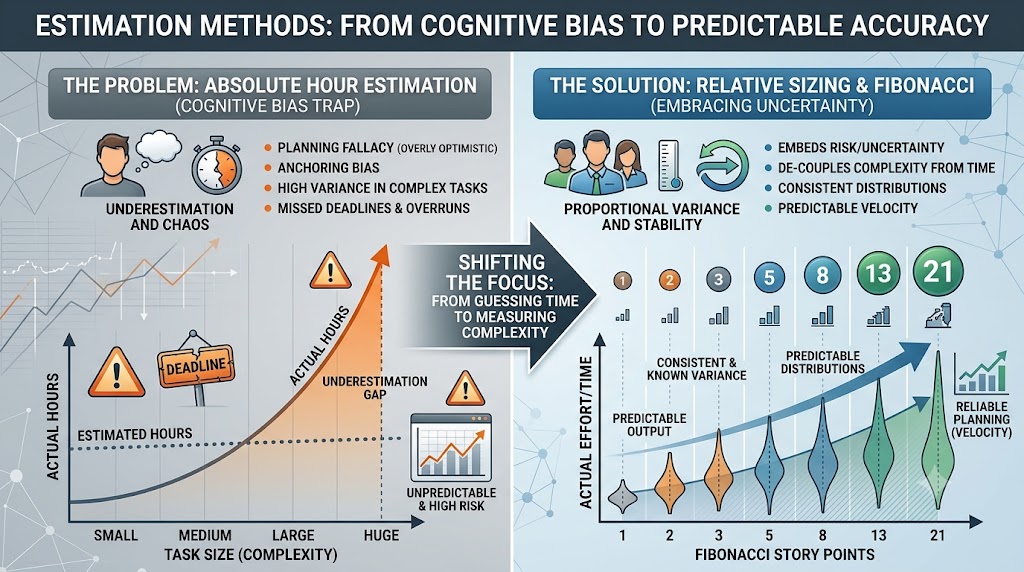
Autonomous estimation solves this issue by substituting absolute hours with relative sizing, measured in story points. Instead of predicting time, the team evaluates each item against three distinct dimensions:
Complexity: The structural difficulty of the programming logic, data flows, and architectural paths required to build the feature.
Effort: The sheer volume of mechanical work, testing documentation, and configuration steps needed to move the story to completion.
Uncertainty: The amount of unknown variables, unverified legacy codebases, and third-party dependencies that could disrupt execution.
To capture this non-linear growth of uncertainty, teams use the modified Fibonacci sequence: $1, 2, 3, 5, 8, 13, 21$. This scale recognizes that as a task grows larger, our capacity to understand its finer details decreases. An 8-point story is not simply a task that takes twice as long as a 4-point story. Rather, it represents an objective with significantly more structural complexity and unknown technical risks.
True precision relies entirely on the autonomy of the development team. Management must step back from this process. Project managers do not estimate code, and business stakeholders do not determine technical complexity. The team members who write the code own the estimation process entirely, free from external influence or managerial pressure.
The Enterprise Step-by-Step Implementation Framework
For project managers ready to deploy this methodology within their teams, this framework provides a highly repeatable blueprint to transition from technical requirement documents to autonomous delivery structures.
| Implementation Phase | Strategic Objective | Key Action Items |
| Phase 1: Deconstruction | Requirements Transformation | Convert systemic technical specs into thin vertical user stories via the 3Cs model. |
| Phase 2: Baseline Calibration | Anchor Identification | Define reference points for small, medium, and large tasks across the historical backlog. |
| Phase 3: Execution | Consensus Gathering | Run anonymous estimation cycles using Planning Poker to eliminate peer alignment bias. |
| Phase 4: Boundary Mapping | Capacity Planning | Establish clear sprint capacity limits based strictly on the team’s historical velocity metrics. |
Step 1: User Story Modeling Workshops
Before any estimation takes place, the project manager must host collaborative backlog refinement sessions. The product owner presents the overarching business goals, while the engineers systematically break down monolithic architectures into independent components. Each story must be formatted using the standard narrative structure:
This statement must be supported by strict, binary acceptance criteria that clearly delineate the boundaries of what is included in the task.
Step 2: Calibrating the Anchor Backlog
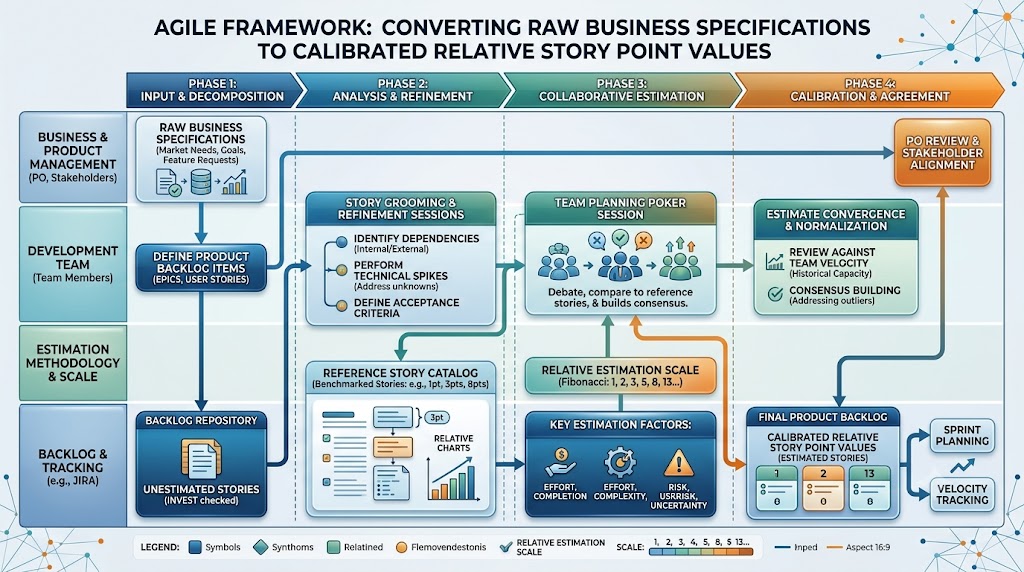
The team must identify a set of historical stories to serve as shared baselines for relative sizing. For example, the team might collectively agree that building a basic text-based email notification template represents a 2-point story, while implementing a multi-factor authentication flow with custom biometric overrides serves as an 8-point anchor. These reference points remain fixed, allowing all incoming requirements to be sized relative to these known standards.
Step 3: Conducting Anonymous Planning Poker Cycles
To eliminate alignment biases and prevent dominant voices from driving the narrative, estimation must be conducted through an anonymous voting process.
The product owner reads a user story and clarifies the target acceptance criteria.
Every engineer privately selects a Fibonacci card representing their estimated size, keeping their choice hidden.
On the facilitator’s signal, all cards are revealed simultaneously.
If the estimates match, the value is locked in. If a divergence occurs, such as one developer voting a 2 and another voting a 13, the facilitator opens the floor to discussion.
The conversation focuses specifically on the outiers. The high voter explains hidden complexities they foresee, while the low voter highlights potential shortcuts or existing reusable code assets.
The team revotes anonymously. This loop repeats until consensus naturally emerges, ensuring all voices contribute equally to the final size.
Step 4: Structuring Strict Sprint Planning Boundaries
Once the backlog is estimated, the project manager defines the boundaries for the upcoming sprint. This capacity cap is calculated by tracking historical velocity, which is the total number of story points the team successfully delivers as “Done” per iteration over time.
If a team’s rolling velocity average over the past four sprints is 50 story points, the sprint capacity limit for the next iteration is capped at 50 points. Management cannot arbitrarily add a 13-point critical feature without removing stories of equivalent weight from the plan. This creates a data-driven boundary that protects the team from over-committing and keeps delivery predictable.
The Professional Transformation: Shifting from Chaos to Predictable Delivery
Successfully implementing user story modeling and autonomous estimation changes the fundamental culture of software delivery. The operational benefits are clear and immediate: project environments shift away from high churn, unpredictable tracking metrics, and defensive stand-ups. Instead, teams establish an environment characterized by highly consistent delivery cadences and balanced workloads
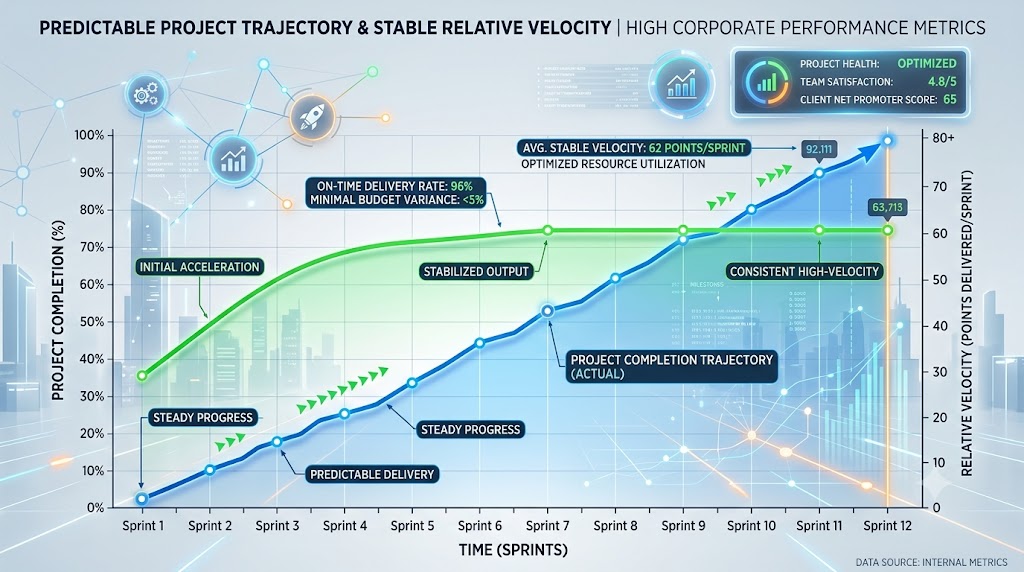
When teams own their estimates and project boundaries are protected by real historical metrics, scope creep is naturally contained. The conversation with business stakeholders shifts from defensive negotiations about arbitrary deadlines to collaborative discussions about product scope and feature prioritization. If a stakeholder introduces an urgent feature mid-sprint, the data-driven framework allows the project manager to demonstrate exactly which stories must be deferred to accommodate the change.
For the ambitious project manager, mastering these core iteration mechanics is a massive career accelerator. It transforms your professional profile from a tactical task tracker into a high-value delivery strategist. Organizations actively seek out leaders who can cultivate team alignment, protect operational capacity, and generate predictable execution metrics out of volatile business requirements. Learning how to run these processes correctly establishes you as an elite professional capable of leading high-exposure enterprise projects.
Mastering the Mechanics of Elite Project Management
Elite project management is not built on guessing delivery dates or forcing developers to work overtime to hit unrealistic deadlines. It relies on implementing rigorous frameworks, establishing data-driven boundaries, and trusting your engineering teams to own their execution metrics. By converting complex technical requirements into value-driven user stories and establishing autonomous relative estimation processes, you create a scalable ecosystem built for predictable enterprise delivery.
If you are ready to stop guessing, move up the corporate ladder, and learn project management the right way, reach out to Skillsetify. We do not just teach frameworks: we show you your exact career growth trajectory.