Strategic Roadmaps, Core Roles, and Backlog Generation in Scrum Architecture
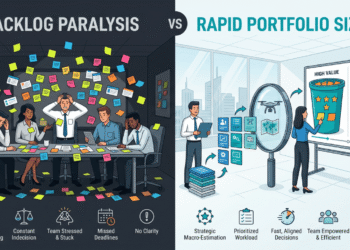
Imagine Monday morning at 8:00 AM. Your phone is ringing off the hook, the vice president of product is demanding an explanation for a three month delay, and your development team is staring blankly at a chaotic list of four hundred unstructured tasks. The engineering lead claims they are waiting on architectural decisions. The stakeholders believe the features were finalized last quarter. The budget is nearly exhausted, team morale is flatlining, and nobody can definitively answer a simple question: What are we actually building, and when will it be done?
This is the ultimate corporate nightmare, yet it plays out in enterprise tech organizations every single day.
A common corporate myth suggests that Agile frameworks, specifically Scrum, mean working without a definitive plan or a long term structure. Ambitious project managers are often told to embrace chaos under the guise of flexibility. But true agility is not an absence of structure: it is the highest form of discipline. When your projects suffer from perpetual scope creep, team burnout, or disjointed releases, the root cause is never the development team’s capability. The failure lies at the very inception of the project lifecycle: a complete collapse in translating product vision into an executable, high value backlog.
The Scrum Architecture: Understanding the Core Pillars
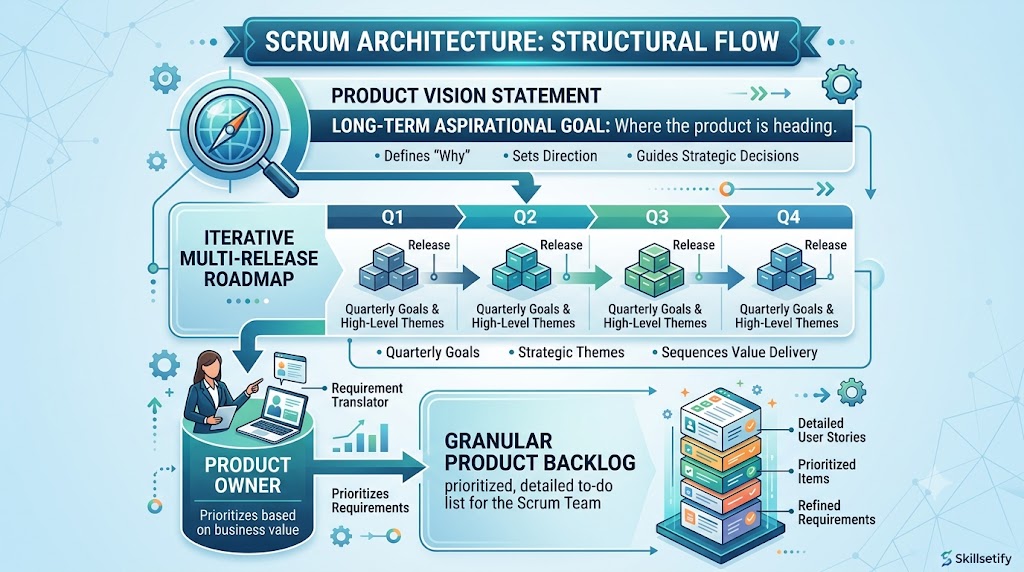
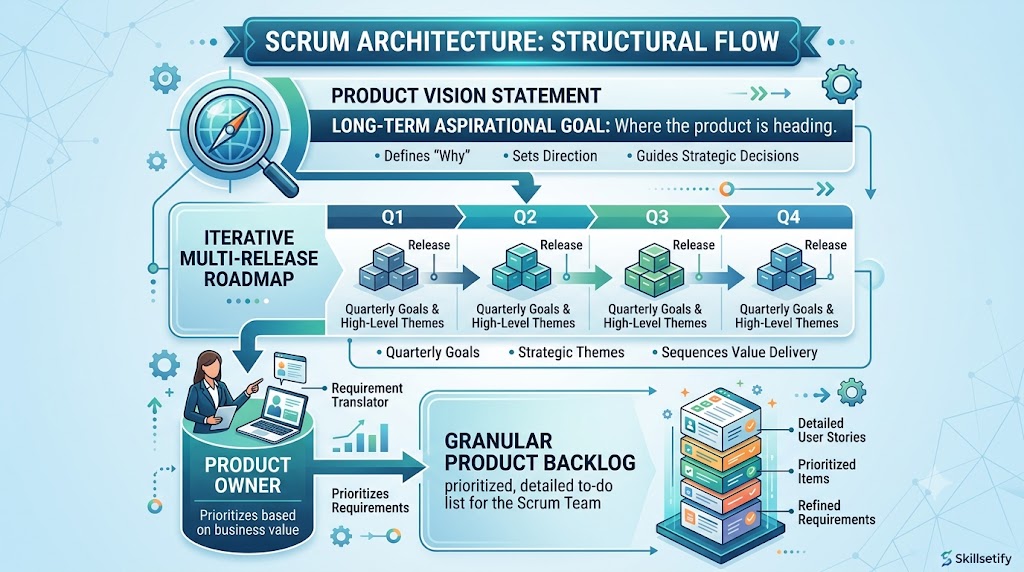
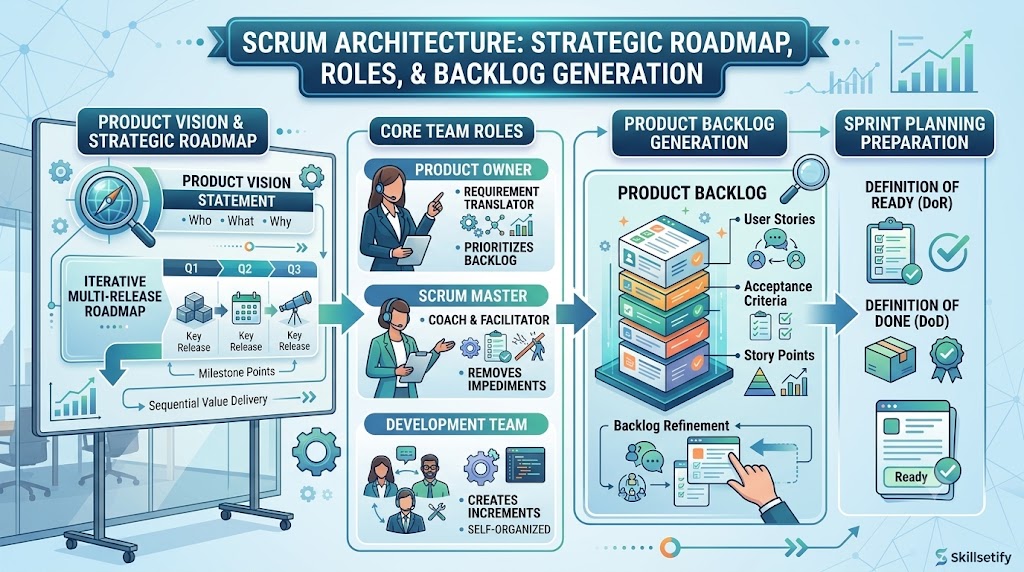
To build a project management engine that delivers predictable value, you must master the mechanics of the three foundational components of Scrum architecture: the Product Vision Statement, the Iterative Multi Release Roadmap, and the explicit translation mechanism managed by the Product Owner.
The Project Vision Statement: The North Star
Every elite enterprise delivery begins with absolute clarity of purpose. The Project Vision Statement is not a marketing tagline. It is a precise, high level operational mandate that establishes the destination of the product. It answers who the target customer is, what systemic problem the product solves, what unique value it provides, and how it aligns with corporate strategy. Without this North Star, teams optimize for speed over direction, building beautifully engineered features that the market does not want or need.
The Iterative Multi Release Roadmap: Time Boxing vs. Flexibility
Once the vision is cast, it must be mapped against time without trapping the organization in rigid, deterministic cycles. This is achieved through an iterative multi release roadmap.
Unlike legacy software development roadmaps that plot specific tasks out across years, an elite Agile roadmap maps value increments, themes, and capabilities across time horizons. These horizons are typically structured quarterly or semi annually, depending entirely on project complexity. The roadmap provides stakeholders with the strategic timeline they require for resource budgeting, while preserving the development team’s autonomy to adapt tactics based on feedback from continuous delivery.
The Product Owner: The Essential Translator
The bridge between high level strategic intent and day to day tactical execution is the Product Owner. The Product Owner operates as the commercial custodian of the project. Their ultimate responsibility is to take raw, ambitious business requirements from users, buyers, and executives, filter them through the lens of technical feasibility, and translate them into clean, high value user stories within a structured product backlog.
The Master Framework: From Ambition to Backlog Generation
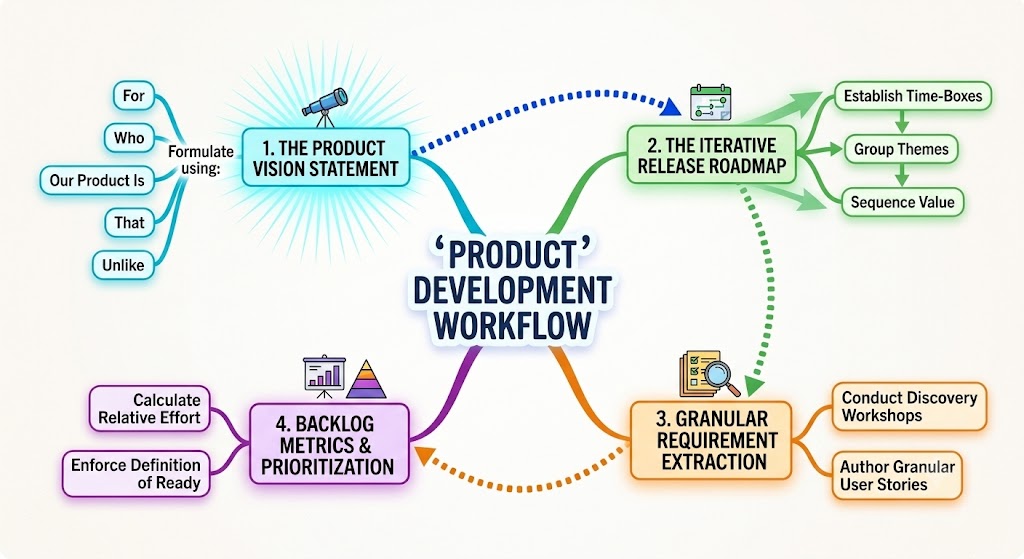
Transforming a grand corporate strategy into structured, daily developer tasks requires a meticulous, systematic methodology. Below is the exact execution blueprint used by elite B2B project management leaders to move seamlessly from vision statement to backlog optimization.
Step 1: Formulate the Product Vision Statement
Do not draft an abstract statement. Utilize the industry standard framework to anchor your project in commercial reality:
For [target customer/segment]
Who [statement of the need or opportunity]
Our product is [product category/name]
That [compelling benefit / reason to buy]
Unlike [primary competitive alternative]
Our product [statement of primary differentiation]
Step 2: Establish the Iterative Multi Release Roadmap
Break the expansive vision down into manageable, shippable increments using a structured cadence:
Define the Time Box Cadence: Establish the standard cadence for your strategic checkpoints, such as bi weekly sprints organized into quarterly releases.
Cluster Capabilities into Themes: Group related feature sets into high level themes rather than standalone technical tickets. For instance, cluster user security into a “Zero Trust Authentication Framework” theme.
Sequence by Value and Risk: Place high risk, high value dependencies in the earliest release cycles to validate your technical architecture rapidly.
Step 3: Granular Requirement Extraction & User Story Generation
The Product Owner must systematically deconstruct high level roadmaps into detailed user stories. Every user story must be written from the direct perspective of the end user, following a precise, non negotiable syntax:
Consider a real enterprise scenario where a delivery team needs to build a reporting interface for an executive team. The user story must read exactly like this:
As a Marketing Director, I want to securely log into the centralized analytics platform and extract segmented quarterly performance data, So that I can automatically generate corporate compliance reports without manual data entry.
Every user story must be paired with clear, binary Acceptance Criteria. These criteria define the explicit boundaries of the feature, ensuring that developers know exactly what must be true for the work to be deemed complete.
Step 4: Backlog Refinement, Effort Metrics, and the Definition of Ready
A backlog is not a static vault: it is a dynamic to do list. Product Owners and cross functional engineering teams must host dedicated Product Backlog Refinement sessions once per sprint. During these sessions, the team actively groom the list, prune outdated requirements, adjust priorities based on market movement, and estimate relative complexity using sizing metrics like Story Points.
Story points represent relative effort, complexity, and risk, rather than a fixed number of calendar hours. To ensure delivery predictability, every user story must fulfill a strict Definition of Ready (DoR) before it is ever allowed to enter a sprint planning cycle. The story must be clearly understood by the team, completely free of external blocks, and mapped out with explicit success criteria.
The Professional Transformation: From Chaos to Predictable Delivery
When you implement this foundational architecture correctly, the professional environment shifts overnight. You permanently leave behind the exhausting cycles of scope creep, late night crisis deployments, and hostile stakeholder updates.
Instead, the project engine moves into a state of elite delivery. The team operates with an autonomous, self organized cadence, knowing exactly what value they are expected to build during every single time boxed sprint. Scope changes stop breaking your delivery pipeline, because the multi release roadmap sets explicit boundaries for what is included in the current release cycle, and what is safely deferred to the product backlog for future refinement.
For an ambitious project manager or product professional, mastering this specific architectural capability changes the entire trajectory of your career. You stop being viewed by senior leadership as an administrator who simply tracks spreadsheets, logs tasks, or coordinates status meetings. You transform into a strategic asset: a high impact leader capable of taking complex corporate goals, organizing technical resources with absolute clarity, and steering highly complex enterprise initiatives toward predictable, on time execution.
Elevating Your Enterprise Delivery Matrix
Building a sustainable, high-performance delivery engine requires more than simply reading about frameworks. It demands an absolute commitment to structural discipline, clear accountability, and continuous improvement.
If you are ready to stop guessing at project variables, eliminate execution roadblocks, accelerate your corporate advancement, and master the art of enterprise delivery the right way, it is time to connect with the specialists. At Skillsetify, we do not simply lecture you on the rules of framework manuals: we map out your exact operational growth trajectory, equip you with deep baseline methodologies, and transform you into the elite leader that top tier organizations actively compete to hire.
Reach out to Skillsetify today and let us build your path to predictable leadership success.