Synchronizing the Sprint Loop with Daily Stand-up Governance
1. The Cost of the Sixty-Minute "Stand-up"
It is Tuesday morning, exactly 9:42 AM. A high-profile software transformation project for an enterprise retail client is entering its final delivery weeks. Inside the main conference room, twelve engineers, a product owner, two business analysts, and a delivery manager are trapped in an standard corporate ritual. What was scheduled as a quick, fifteen-minute tactical alignment touchpoint has devolved into a sprawling, multi-headed technical debate. One developer is giving a line-by-line breakdown of a backend database failure, another is arguing with the product owner over an ambiguous requirement, and the rest of the room has checked out, quietly opening laptops to check emails.
By the time the meeting wraps up, fifty-two minutes have passed. No clear blockers have been resolved, the real-time status of the active iteration is completely obscured, and twelve highly compensated professional tracks have effectively lost an hour of development momentum. Multiply this pattern across a multi-team delivery organization, and thousands of execution hours vanish every month.
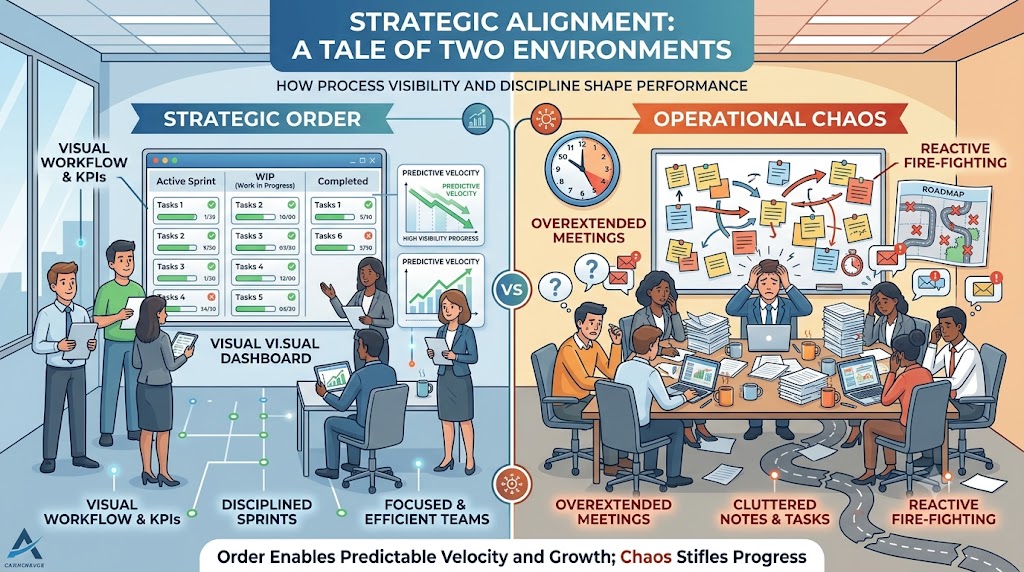
This scenario highlights a common corporate myth: The Daily Scrum is a status update tool designed for management report generation.
When treated as an administrative sign-off, the meeting fails completely. Elite delivery teams know that the daily touchpoint is a strategic optimization engine owned exclusively by the development team. Its single purpose is to measure execution velocity within a strict fifteen-minute boundary and fine-tune the delivery loop. If your daily meetings routinely breach the fifteen-minute mark, your underlying sprint loop is structurally compromised.
2. Breaking Down the Mechanics of Modern Iteration Cycles
To correct an underperforming sprint cycle, a project manager must understand the structural relationship between technical execution loops and operational governance. Deliverables cannot move fluidly through an active sprint backlog if the daily check-ins fail to capture blockers.
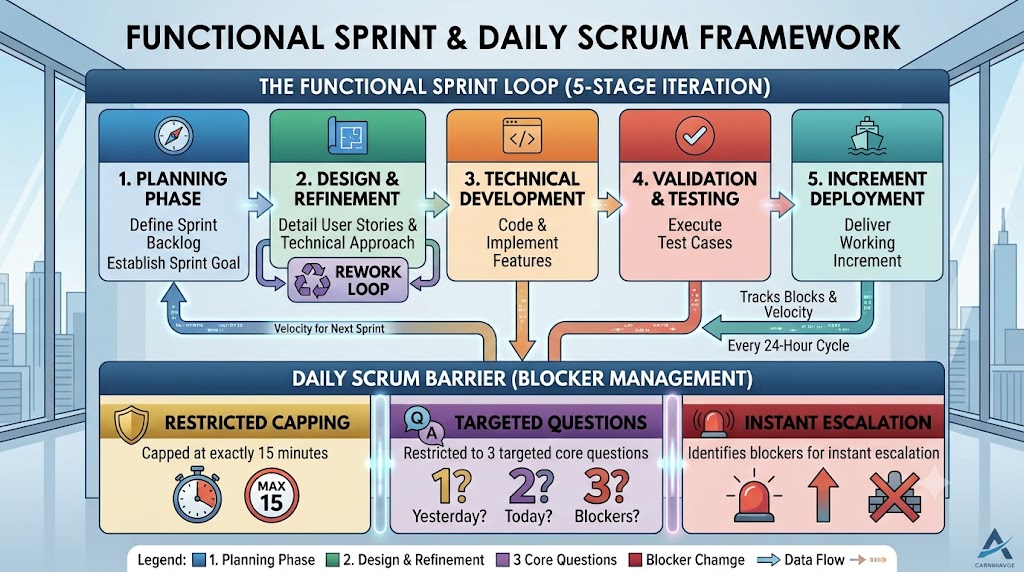
The Architecture of the Functional Sprint Loop
A functional execution loop operates as a self-contained product delivery engine. Unlike historical, sequential management approaches where design, development, and testing happen over separate months, modern framework execution compresses this entire cycle into a tight time-box.
Every user story pulled into an active iteration must move fluidly through distinct engineering states:
The Planning Input: The development team evaluates the refined user stories, translates requirement blocks into explicit development tasks, and commits to a stable delivery target based entirely on documented velocity.
The Design and Refinement State: Technical parameters are locked down before development begins. If architectural inconsistencies are discovered, the story moves through a brief rework loop to clear up technical dependencies without stalling the wider team.
The Technical Development Phase: Code is generated in strict alignment with architectural design standards and comments are embedded directly within the codebase to ensure long-term maintainability.
The Validation and Testing Checkpoint: Deliverables are automatically pushed to specialized testing servers for continuous evaluation. This step confirms that the engineering output matches all documented acceptance criteria before the iteration closes.
The Mathematics of the Fifteen-Minute Daily Scrum Barrier
The daily check-in is the operational guardrail that keeps this execution loop on schedule. It is not an engineering workshop: it is a structured, fast-paced evaluation loop designed to optimize the team’s effort over the next twenty-four hours.
To protect this fifteen-minute boundary, project leaders must enforce strict technical constraints:
The Rule of the Three Questions: Every team member speaks for a maximum of ninety seconds, focusing exclusively on three data points: What was completed over the past twenty-four hours? What is the primary target for the next twenty-four hours? Are there any active blockers stalling progress?
The Parking Lot Protocol: Technical design updates, architectural disagreements, and client feature requests are strictly barred from the main meeting. Any topic requiring deep troubleshooting is instantly moved to the “Parking Lot”—a targeted follow-up session held immediately after the stand-up, attended only by the specific team members needed to solve that exact problem.
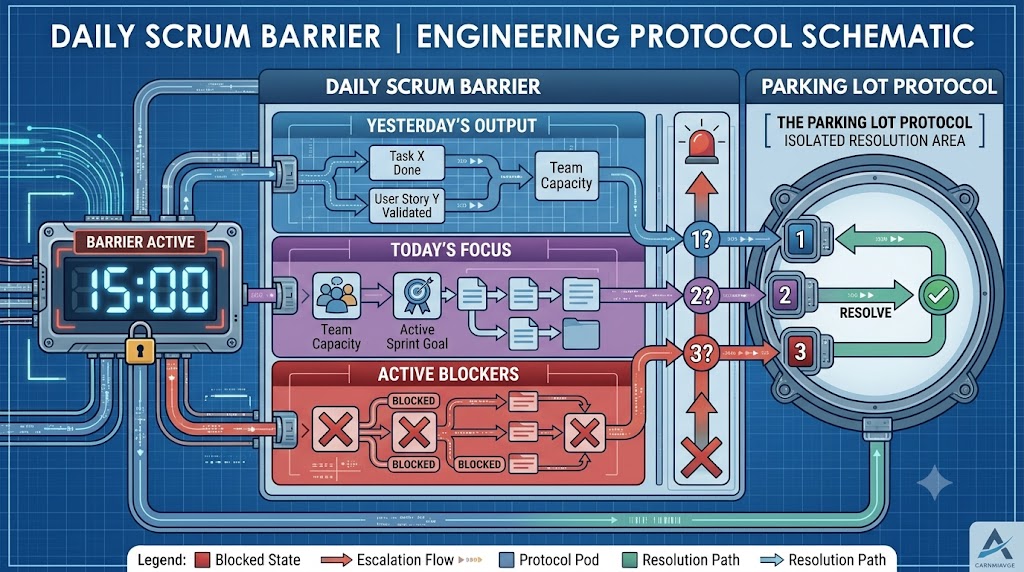
The Step-by-Step Sprint Loop Execution Framework
For project professionals managing erratic delivery timelines, this structured execution blueprint can be integrated directly into your operations to establish immediate predictability.
Step 1: Establish Clear Entrance Criteria (Definition of Ready)
Before any user story can be selected during execution planning, it must pass a clear readiness checkpoint. This technical screen ensures that the item is properly detailed from a user perspective, prioritizes business value, and contains unambiguous acceptance criteria. If a story lacks clear boundaries, it is barred from the active iteration.
Step 2: Enforce Technical Time-Boxing and Backlog Management
Lock down the iteration window to a fixed timeline, ideally a two-week execution box. The development team retains full autonomy during planning to decide exactly how many stories they can safely deliver.
Once this capacity is set, the active iteration backlog is completely locked to prevent external scope creep from disrupting the engineering team.
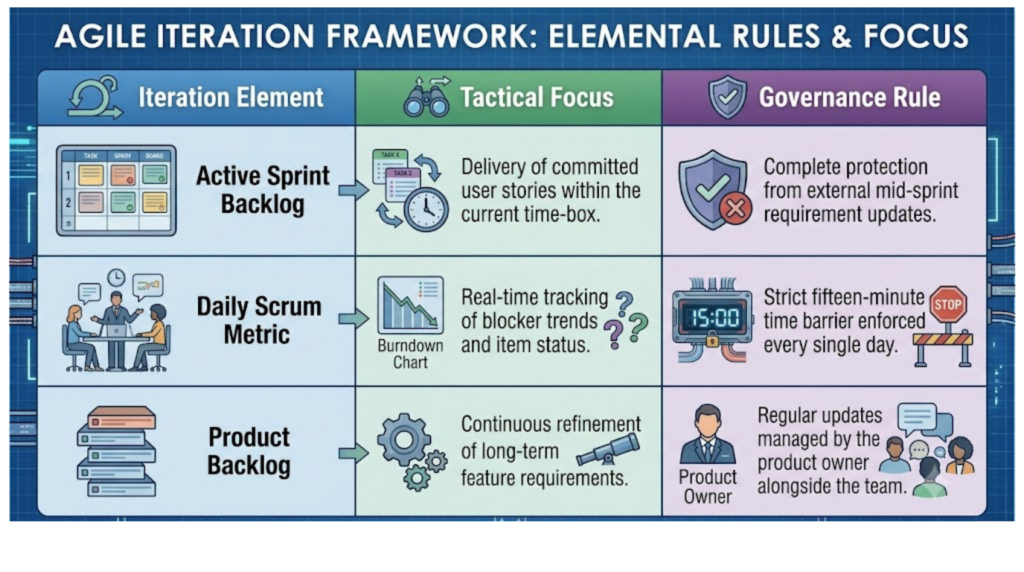
Step 3: Implement Visual Work Management Channels
Deploy highly scannable visual project tracking pipelines using a clear three-column framework: To-Do, In Progress, and Done. Team members pull tasks across these development channels themselves to maximize transparency across the organization. This visual setup allows any stakeholder to immediately assess the status of any feature item at a single glance.
Step 4: Secure the Daily Stand-up Safeguards
Run the daily touchpoint at the exact same time and place every morning to build an unshakeable operational rhythm. The Scrum Master or project manager facilitates the logistics but never forces status collection. The development team directs the update path, treating the session as a collaborative alignment tool to spot blocker trends before they impact the wider delivery timeline.
Step 5: Execute Structured Iteration Reviews and Post-Mortems
At the close of the execution window, the team hosts two essential governance sessions:
The Feature Review Checkpoint: A formal session where stakeholders evaluate functional deliverables against the acceptance criteria to confirm successful delivery.
The Process Continuous Improvement Retrospective: A dedicated team evaluation focused entirely on process optimization. The team examines delivery friction, surfaces root causes of timeline delays, and agrees on clear process updates to implement in the very next loop.
3. Shifting from Reactive Firefighting to Predictive Velocity
When you implement this structured execution cycle correctly, the operational transformation inside the organization is clear. The daily reality of reactive firefighting, unexpected late-stage bottlenecks, and developer burnout disappears.
Instead, the delivery pipeline establishes an unshakeable, predictable velocity. Project professionals can look at their delivery charts and tell stakeholders exactly when enterprise milestones will hit production with data-backed accuracy.
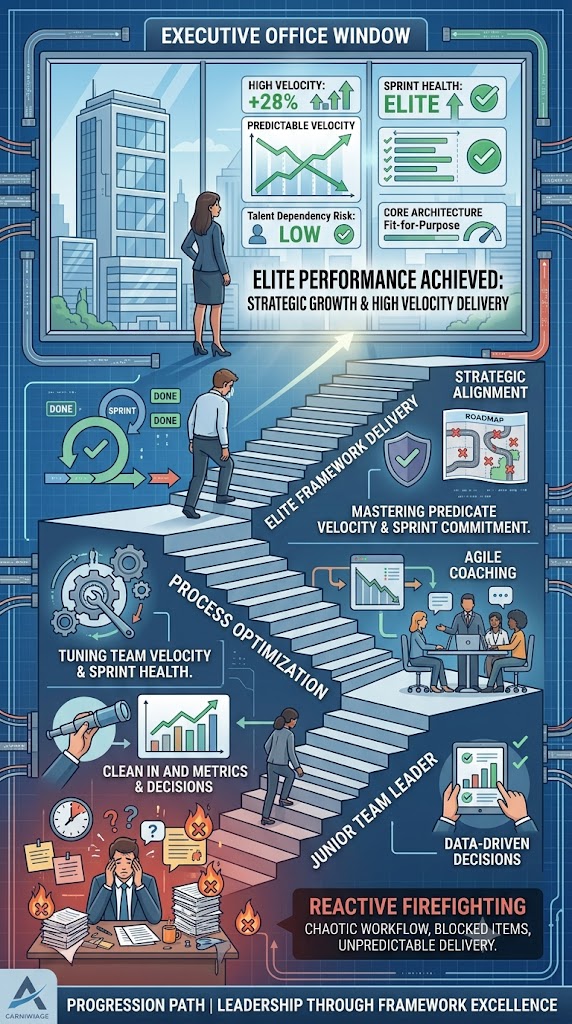
For the ambitious project manager, mastering this balance between execution speed and operational discipline changes their career path. Moving beyond basic, theoretical certifications, professionals who can successfully run disciplined execution loops become invaluable assets to senior enterprise leadership. You stop functioning as a basic task tracker and start operating as a high-value delivery strategist, clearing a straight path to senior corporate leadership roles.
4. The Skillsetify Excellence Advantage
Optimizing your functional delivery loop and protecting your daily stand-up barriers is not a minor operational tweak: it is a fundamental shift that directly impacts enterprise delivery velocity and organizational performance. By connecting tight execution boundaries with disciplined daily governance, you eliminate delivery waste, protect valuable project margins, and build an adaptable, elite engineering engine.
If you are ready to stop guessing, move up the corporate ladder, and learn project management the right way, reach out to Skillsetify. We do not just teach frameworks: we show you your exact career growth trajectory. Turn operational chaos into predictive execution value today.