Why Rigid Waterfalls Fail Modern Software, and How Extreme Programming Restores Elite Delivery
Imagine it is midnight on a Sunday. You are a Senior Project Manager, and tomorrow morning the executive steering committee expects the grand launch of your new enterprise platform, a system 18 months in the making. Millions of dollars have been spent, thousands of pages of requirements documents have been signed off, and the development team has spent the last month trying to stitch the individual modules together.
You open the staging environment, attempt to execute the primary user workflow, and the entire system crashes. Total database failure. You look at your tracking dashboard: it displays columns of beautiful, green checkmarks from the initial scope sign-offs to the architecture reviews. Yet, the software is dead on arrival.
This is the classic Waterfall trap: the illusion of progress through paper trails, culminating in a catastrophic, late-stage reality check.
The most pervasive corporate myth circulating in boardrooms today is that methodology choice is merely an administrative preference, or worse, that Extreme Programming (XP) is just chaotic, undisciplined coding for teams that reject structure. In reality, XP is one of the most rigorously disciplined frameworks ever created. It trades the comfortable, administrative bureaucracy of traditional models for absolute, real-time technical accountability.
The Core Philosophy: Gated Linearity vs. Adaptive Incrementalism
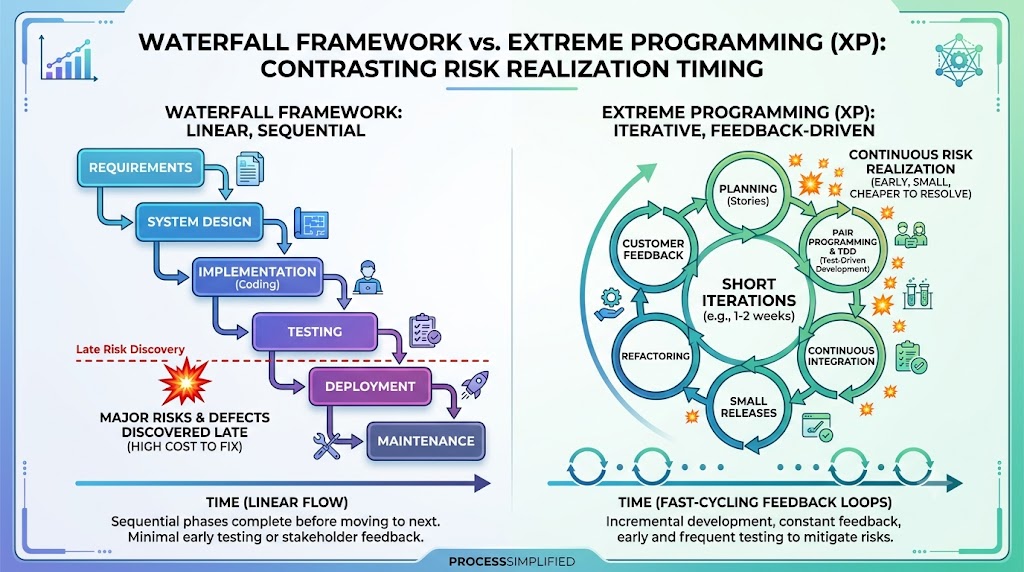
To understand why projects fail at the finish line, we must contrast the core mechanics of traditional Waterfall methods with the highly collaborative, fast-cycling nature of Extreme Programming.
Traditional Waterfall operates on a simple, linear assumption: you can perfectly predict the future. The project moves sequentially through rigid, gated phases: Requirements, Design, Development, Testing, and Release. Once a gate closes, returning to a previous phase requires an expensive, formal change request process. Communication with stakeholders is heavily restricted, occurring primarily at the very beginning and the absolute end of the project life cycle.
Extreme Programming operates on the exact opposite paradigm: change is inevitable, so we must design a system that embraces it. XP is a software development framework built on fast feedback loops, radical simplicity, and relentless collaboration. Instead of waiting months to test a mass of integrated code, XP teams deliver working software in tiny, incremental updates, constantly steering the product based on real-world feedback.
The Mechanics of Extreme Programming
At the heart of XP are engineering practices designed to maximize software quality while minimizing waste:
Test-Driven Development (TDD): In an XP environment, developers write the test cases before writing a single line of production code. This test-first approach forces engineers to start with the end in mind, deeply understanding the requirement before building the implementation. It creates an automated safety net that catches regressions instantly.
Pair Programming: This is a highly disciplined maker-checker system where two engineers work at one workstation. One developer codes (the driver) while the other observes, reviews, checks for syntax errors, and strategizes the next steps (the navigator). Every few hours, they switch roles. While executives sometimes worry this doubles labor costs, the dramatic reduction in defects and code debt makes it incredibly cost-effective for complex products.
The On-Site Customer: XP removes the telephone game of project management by requiring a dedicated customer representative to sit directly with the development team. When a developer hits a point of ambiguity, they do not file a ticket or wait for a weekly sync: they turn around and get immediate clarification.
Continuous Integration (CI): Instead of saving integration for the final month, XP teams integrate and test their code multiple times a day. Automated build tools run the entire test suite against every code check-in, ensuring that bugs are caught minutes after they are introduced.
Code Refactoring and Clean Design: XP values simplicity. Developers constantly restructure existing code to improve its internal architecture, readability, and maintainability without altering its external behavior. This prevents code from becoming a fragile mess that everyone is afraid to touch.
Collective Code Ownership: No single programmer owns a specific module. Every team member is empowered, and expected, to review, improve, and edit any part of the codebase to fix an issue or add value.
Sustainable Pace (The 40-Hour Week): XP strictly discourages team burnout. Burned-out developers write low-quality code, introduce bugs, and make poor architectural decisions. A rigid adherence to sustainable hours ensures the team consistently delivers elite, high-quality output.
Deep Dive: Methodology Contrasts
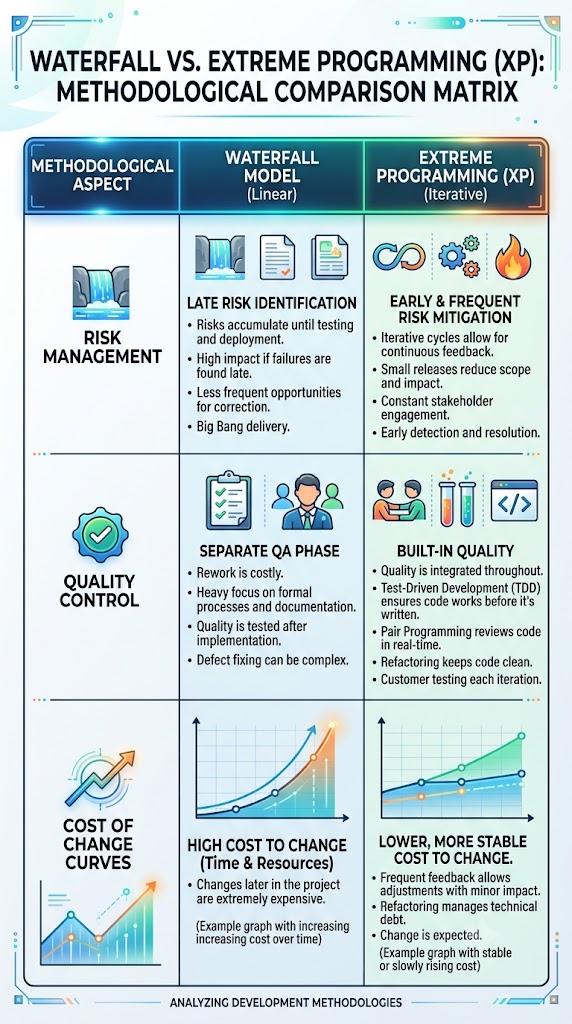
When evaluating these frameworks, project leaders must analyze how each handles risk, quality, and change. The table below outlines the core structural differences between these two methodologies:
| Structural Dimension | Traditional Waterfall Frameworks | Extreme Programming (XP) Framework |
| Process Flow | Linear, sequential, and gated. | Iterative, adaptive, and cyclical. |
| Requirement Definition | Fixed up front during the initial planning phase. | Dynamic, evolving through continuous customer dialogue. |
| Risk Realization | Late in the lifecycle, typically during integration and testing. | Extremely early, mitigated by daily builds and automated tests. |
| Customer Interaction | High at initiation and closure: minimal during development. | Constant, driven by an on-site customer representative. |
| Quality Control | Reactive: testing occurs after the product is fully built. | Proactive: built-in via Test-Driven Development and Pair Programming. |
| Release Cadence | Single big-bang release at the end of the timeline. | Small, frequent releases deployed on a regular cadence. |
| Team Structure | Siloed functional teams (Analysts, Devs, QA Engineers). | Cross-functional, self-organizing teams with collective ownership. |
The Masterclass Implementation Framework
For project managers stuck in a rigid environment who want to shift toward the adaptive, high-quality ecosystem of Extreme Programming, standard agile platitudes are not enough. You need an exact, operational roadmap.
Here is a step-by-step framework to transition your team away from late-stage integration crises and move toward elite, fast-cycling delivery:
Step 1: Establish the On-Site Feedback Loop
Remove the layers of separation between your builders and your users. If you cannot get a literal customer to sit in the room, designate a highly empowered Product Owner to act as the embedded customer. This individual must be available throughout the day to answer questions, validate implementations, and review features as they are built.
Step 2: Transition to a Test-First Mindset
Mandate that no new features enter production without corresponding automated tests. Start by introducing Test-Driven Development on a single module. Have your developers write the test cases first, watch them fail, and then write the minimal amount of code required to make those tests pass. This eliminates gold plating: the bad habit of building extra features that no one asked for.
Step 3: Implement the Maker-Checker Pairings
Introduce Pair Programming systematically. Do not force it on the team for eight hours a day immediately. Start by pairing engineers on complex tasks: legacy code refactoring, critical security modules, or high-risk integrations. Track the defect rate of paired tasks against solo tasks to prove the value of the maker-checker model to senior management.
Step 4: Automate the Pulse via Continuous Integration
Stop manual code deployments. Set up an automated Continuous Integration pipeline. Configure the system so that every time an engineer pushes code, the entire automated test suite runs immediately. If a test fails, the build breaks, and fixing that build becomes the team’s top priority. This ensures your staging environment is always in a working, deployable state.
Step 5: Enforce Sustainable Pace to Protect Code Quality
Eliminate the culture of heroics and midnight crunch sessions. Track your team’s velocity based on a standard 40-hour work week. If the team cannot fit the assigned features into a small release window without working overtime, reduce the scope of the release. Protecting your team from burnout is the single best way to ensure they maintain the strict discipline required for clean code architecture.
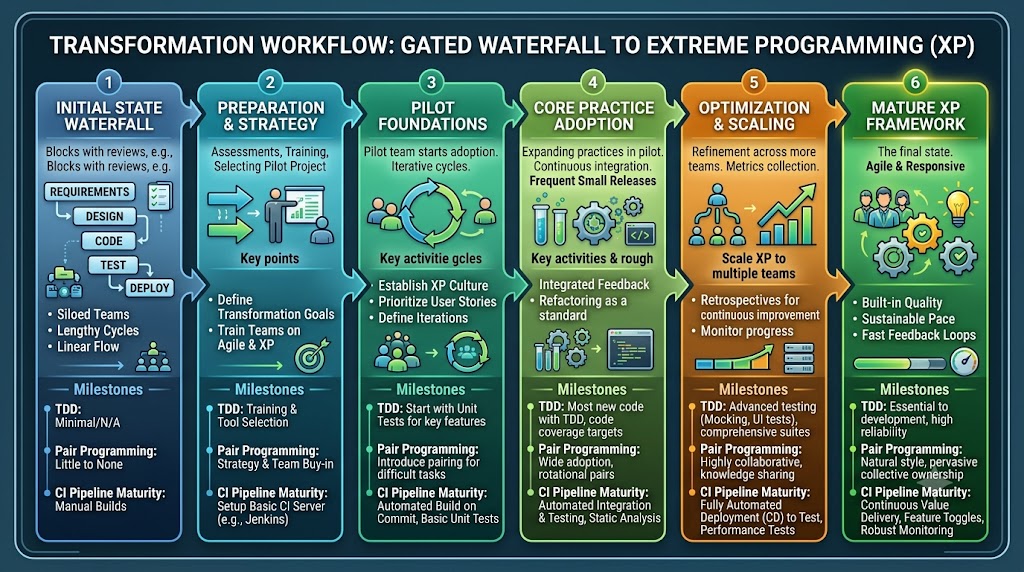
From Chaos to Elite Delivery
When you implement Extreme Programming correctly, the professional transformation is profound. The constant anxiety of the late-stage integration phase vanishes. You no longer have to explain to stakeholders why a project that looked perfect on paper for a year has suddenly stalled out during testing. Scope creep ceases to be a project-killing threat because your architecture is intentionally modular, and your delivery cadence is built to absorb changes seamlessly.
Instead of navigating team burnout and finger-pointing during integration failures, you lead a highly collaborative, self-organizing unit. The team operates with absolute clarity because everyone shares collective ownership of the code, bugs are eliminated minutes after they are written, and value is delivered to production in predictable, high-quality increments.
Learning project management the right way means moving past the administrative comfort of checked boxes and paper gates. It requires mastering the technical frameworks that actually drive elite software delivery. When you possess the skills to establish real-time quality guardrails, design fast feedback loops, and manage adaptive timelines, your career trajectory shifts dramatically. You transform from an administrative coordinator into an indispensable strategic leader capable of steering high-stakes enterprise initiatives to success.
Securing Your Career Trajectory
Relying on outdated, purely linear models in a fast-evolving software landscape is a recipe for project failure and career stagnation. Managing a project successfully requires more than just tracking timelines on a spreadsheet: it requires aligning your operational framework with engineering reality to ensure quality is built into the product from day one.
Extreme Programming provides the tools, discipline, and feedback loops needed to eliminate unpredictability and deliver elite software under changing corporate conditions.
If you are ready to stop guessing, move up the corporate ladder, and learn project management the right way, reach out to Skillsetify. We do not just teach frameworks: we show you your exact career growth trajectory.