Why Hyper-Specialized Corporate Functions Are Killing Execution (And How Elite Leaders Cross the Divide)
Imagine this scenario: It is 48 hours before the scheduled rollout of a $4 million enterprise software upgrade. The C-suite is anticipating a seamless launch. Yet, inside the project war room, progress has ground to a complete halt.
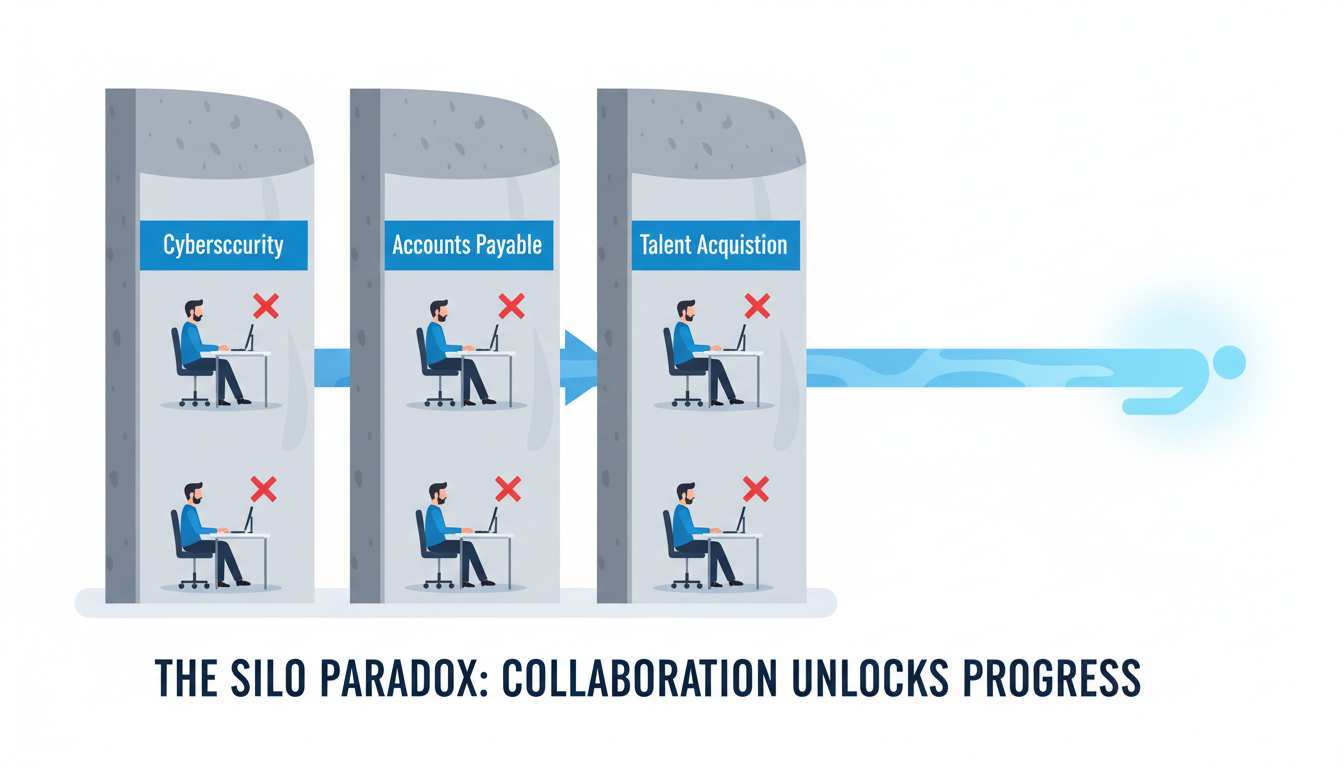
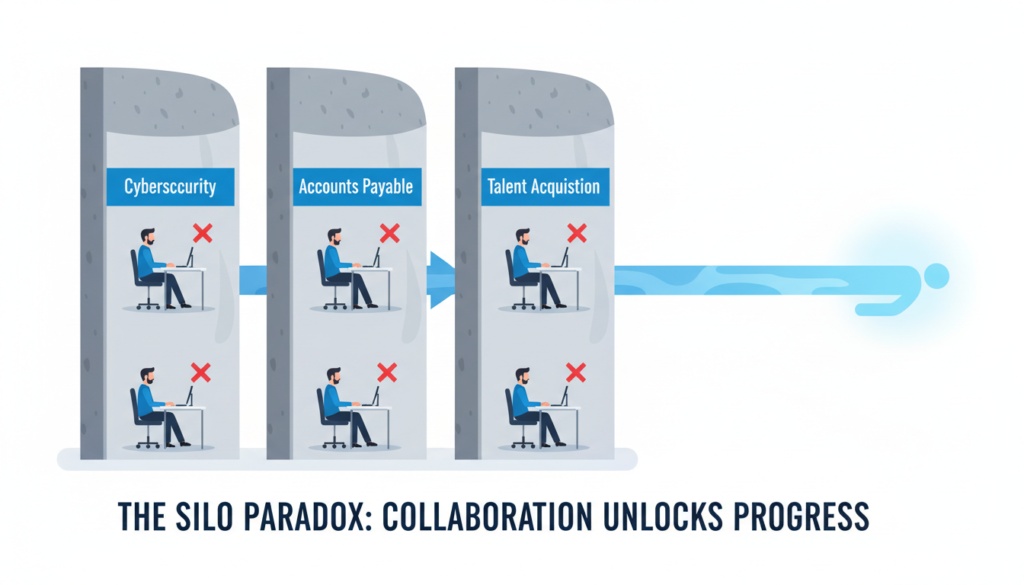
The Infrastructure sub-team in IT claims the server migration is 100% complete. However, Cybersecurity refuses to grant firewall access because Talent Acquisition in HR failed to clear the background checks for the third-party contractor accounts in time. Meanwhile, Accounts Receivable in Finance has placed a vendor hold on a key software license because Accounts Payable had not processed the vendor’s invoice due to an internal approvals mismatch.
Every single sub-function operated according to its specific departmental guidelines and metrics. Yet, the collective enterprise deliverable is paralyzed.
This is the modern Silo Paradox.
A pervasive corporate myth dictates that as organizations grow, splitting macro-departments into deep, hyper-specialized sub-functions automatically boosts operational efficiency. Executives assume that hiring narrow specialists for every microscopic workflow builds an unstoppable engine.
The reality is starkly different: hyper-specialization without horizontal cross-functional orchestration creates defensive silos, severe communication black holes, and territorial friction. Specialization creates isolated capability. Without leaders who actively cut across functional lines, deep domain expertise becomes an organizational bottleneck rather than a strategic asset.
The Anatomy of Sub-Functional Fragmentation
To solve execution friction, leaders must first understand why traditional departments fracture as organizations scale. In a startup or small enterprise, a single HR manager handles everything from recruitment to payroll. As the company expands, increased workload and domain complexity force macro-departments to split into specialized sub-functions.
Consider how primary corporate departments fracture into specialized micro-domains:
Human Resources: Fractures into Talent Acquisition, Onboarding & Staffing, Learning & Development (L&D), Employee Relations, Compensation & Benefits, and HR Policy Deployment.
Finance: Splits into Financial Planning & Analysis (FP&A), Capital Budgeting, Accounts Payable (AP), Accounts Receivable (AR), Treasury, and Tax Compliance.
Marketing & Sales: Divides into Market Research, Performance Marketing, Public Relations (PR), Events Management, Digital & Social Media, and Account Management.
Information Technology: Separates into Enterprise Architecture, Infrastructure, Cybersecurity, Application Support, and Data Analytics.
Legal: Dissects into Intellectual Property (IP) Management, Corporate Governance, Regulatory Compliance, and Commercial Contracting.
While this division allows professionals to build world-class domain expertise, it creates systemic vulnerability. Each sub-function establishes its own priorities, software stacks, terminology, and key performance indicators (KPIs).
The Structural Friction Matrix
| Macro Department | Specialized Sub-Functions | Primary Sub-Functional Metric | Common Execution Friction Point |
| Finance | AP, AR, FP&A, Treasury | Cash flow optimization & strict budget adherence | Delaying critical vendor payments needed for immediate project milestones. |
| HR | Talent Acquisition, L&D, Onboarding | Cost-per-hire & standardized onboarding cycles | Slow contractor vetting that stalls technical development sprints. |
| IT | Cybersecurity, Infrastructure, Apps | Zero security breaches & maximum system uptime | Restrictive permissions blocking rapid API integrations across platforms. |
| Legal | IP, Compliance, Contracts | Risk mitigation & contractual protection | Prolonged Statement of Work (SOW) reviews delaying vendor activation. |
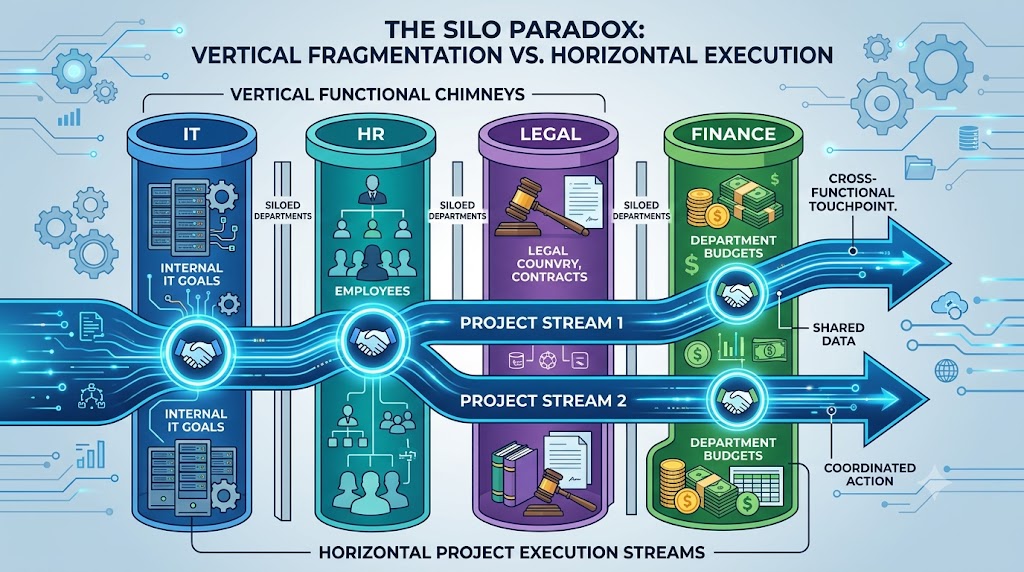
When a project requires contributions from four macro-departments, it actually requires alignment across a dozen micro-sub-functions. Traditional vertical command structures fail here because no single sub-functional manager owns the end-to-end outcome.
The Cross-Functional Imperative: Horizontal Alignment in a Vertical World
High-performing organizations do not abandon functional specialization. Instead, they master horizontal orchestration. They build structural mechanisms that allow teams to cut across functional lines without destroying functional reporting lines.
“Specialization provides depth, but cross-functional execution provides velocity. An organization that cannot bridge its internal boundaries will inevitably watch its market share erode to competitors who can.”
Horizontal execution requires shifting from a purely functional mindset (managing activities within a silo) to a portfolio and value-stream mindset (managing flow across silos). This demands that project leaders act as integrative tissue, aligning disparate sub-functional incentives toward a single business outcome.
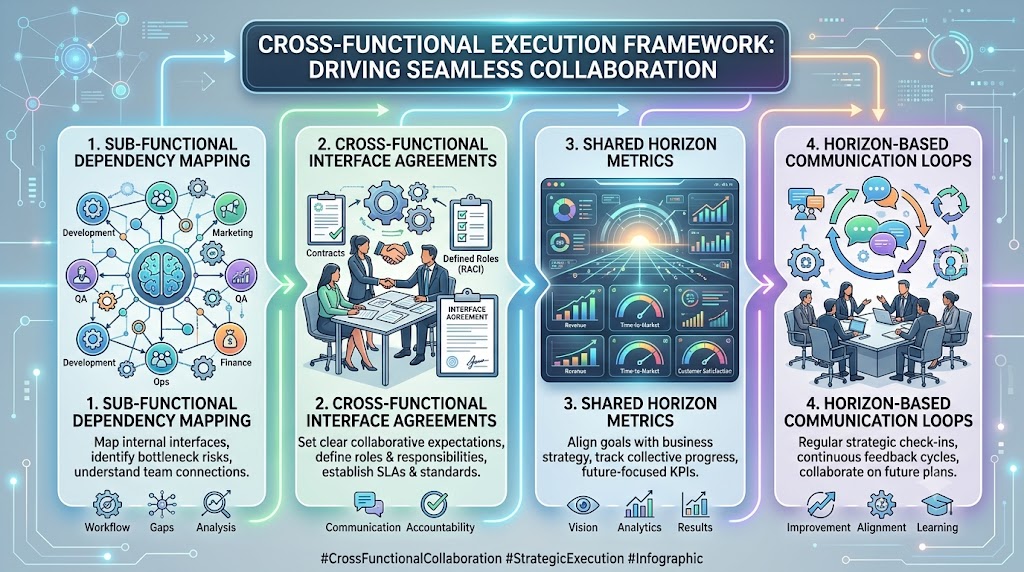
The Cross-Functional Execution Framework (The PM Playbook)
To successfully execute initiatives across fractured corporate structures, project leaders must implement a structured, repeatable cross-functional playbook.
Step 1: Map the Sub-Functional Dependency Web (RACI 2.0)
Standard RACI matrices often fail because they stay at the macro-departmental level (e.g., listing “Legal” as Responsible). Effective leaders map down to the explicit sub-function:
Identify the exact micro-team required (e.g., Commercial Contracts versus IP Management).
Define explicit handoff triggers between sub-functions rather than broad areas of responsibility.
Pinpoint single points of failure where sub-functional approval is required before progress can resume.
Step 2: Establish Cross-Functional Interface Agreements (CIAs)
Treat internal sub-functions with the same operational clarity as external service providers:
Draft lightweight internal service expectations defining turnaround response times, review windows, and deliverable standards.
For instance, establish a CIA with Cybersecurity guaranteeing a 48-hour SLA for sandbox testing approvals during active deployment phases.
Pre-clear baseline compliance requirements so sub-teams do not introduce new approval criteria midway through a project.
Step 3: Deploy Shared Horizon Metrics
Sub-functional conflicts arise when internal team incentives directly clash (e.g., Cybersecurity rewarded for zero risk vs. Product Development rewarded for feature speed):
Establish overriding project goals that tie a portion of every sub-function’s success evaluation to the overall project delivery date.
Create joint accountability metrics, such as shared time-to-market speed or cross-departmental throughput velocity.
Step 4: Institute Horizon-Based Communication Loops
Eliminate broad status meetings that compel specialists to sit through irrelevant departmental updates:
Structure project touchpoints around horizontal deliverables rather than vertical departments.
Focus discussions exclusively on cross-sub-functional blockers, handoffs, and risk mitigation.
Utilize centralized, transparent dashboards that visualize real-time dependency status across all sub-functions.
From Functional Friction to Elite Delivery
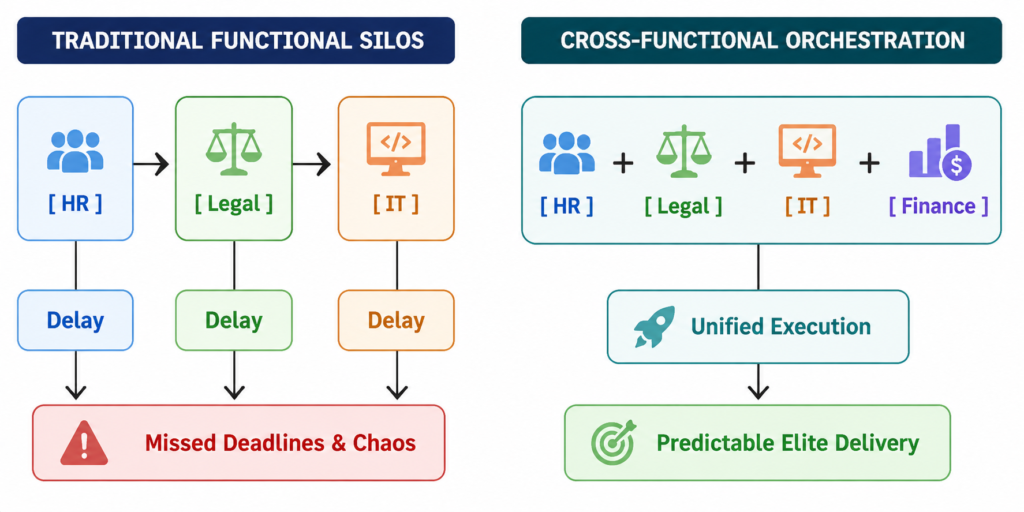
Imagine an enterprise where functional boundaries cease to act as structural brick walls.
When cross-functional execution is mastered correctly, operational chaos evaporates. Scope creep caused by late-stage departmental objections disappears because every key sub-function was integrated during initial roadmap alignment. Team burnout drops significantly as frantic, last-minute fire drills are replaced by predictable handoffs and clear interface expectations.
Projects transition from unpredictable struggles to disciplined, high-velocity engines.
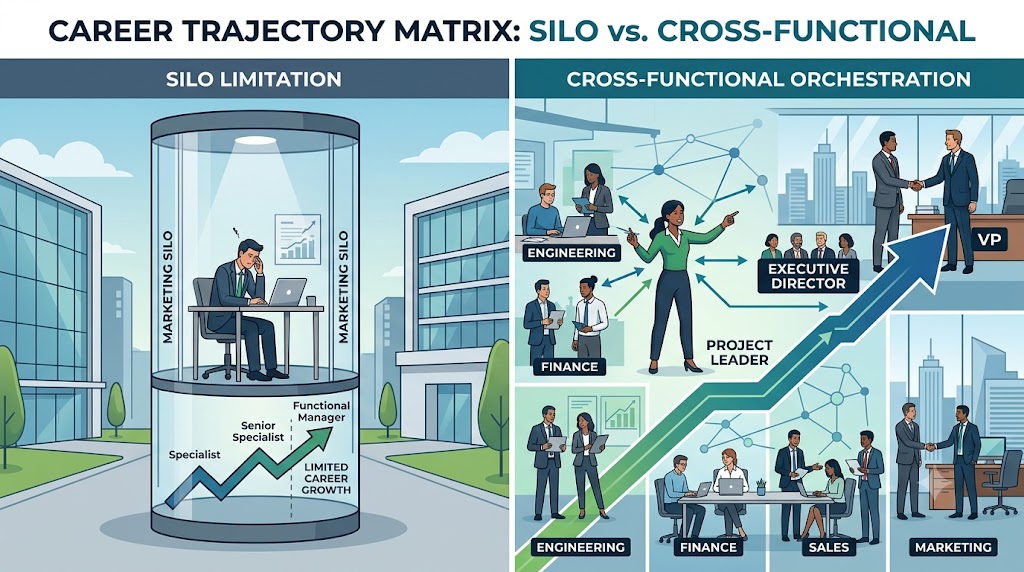
For project managers, business leaders, and functional specialists, mastering this capability is the single greatest career accelerant available today.
In modern enterprise environments, tactical task tracking within a single silo is rapidly being automated. The professionals who command real authority, earn rapid promotions, and step into executive leadership are those who demonstrate the strategic ability to orchestrate execution across departments. They are the leaders who can align Finance, Legal, HR, Marketing, and Technology behind a unified business vision.
When you learn project management the right way, you stop acting as a passive tracker of departmental delays. You become a strategic catalyst capable of navigating corporate hierarchies, eliminating organizational bottlenecks, and driving predictable revenue growth.
Master the Art of Strategic Execution with Skillsetify
Navigating complex corporate hierarchies and bridging fractured sub-functions is not a skill picked up through trial and error. It requires battle-tested methodologies, real-world execution frameworks, and guidance from industry leaders who have successfully managed complex enterprise portfolios.
The difference between an average project coordinator and an elite corporate leader comes down to execution mastery. Are you equipped to break down departmental silos, align competing sub-functional goals, and lead complex enterprise initiatives to completion?
If you are ready to stop guessing, move up the corporate ladder, and learn project management the right way, reach out to Skillsetify. We do not just teach frameworks: we show you your exact career growth trajectory.