How Master Governance Structures Prevent Multi-Million Dollar Corporate Waste
Imagine a high-stakes executive committee meeting at a Fortune 500 tech enterprise. Three senior vice presidents are locked in a heated debate over budget allocations. The SVP of Cloud Infrastructure is demanding an additional $15 million to modernize legacy server clusters. The SVP of Retail Solutions wants $12 million to expand point-of-sale software into European markets. Meanwhile, the Chief Risk Officer points out that a mandatory data privacy compliance project is facing a $5 million deficit that could lead to crippling regulatory fines.
Every executive presents compelling spreadsheets, glowing ROI projections, and passionate arguments. Yet, the CEO and CFO sit in uncomfortable silence, unable to reach a decision.
Why? Because the enterprise is managing all these initiatives out of a single, monolithic, unstructured bucket of work. Funding decisions are driven by executive volume and political influence rather than strategic taxonomy.
This scenario plays out across corporate boardrooms daily. A dangerously common corporate myth persists: a company only needs one generic portfolio to manage all its projects, and any formal categorization is just administrative bureaucracy.
In reality, running a multi-million-dollar organization without distinct, specialized portfolio types is like trying to manage an investment fund by putting all cash into a single, unhedged stock. To maximize resource efficiency, balance risk, and drive long-term value, enterprise organizations must structure their initiatives using precise portfolio types.
What Is a Corporate Portfolio? The Foundations of Enterprise Alignment
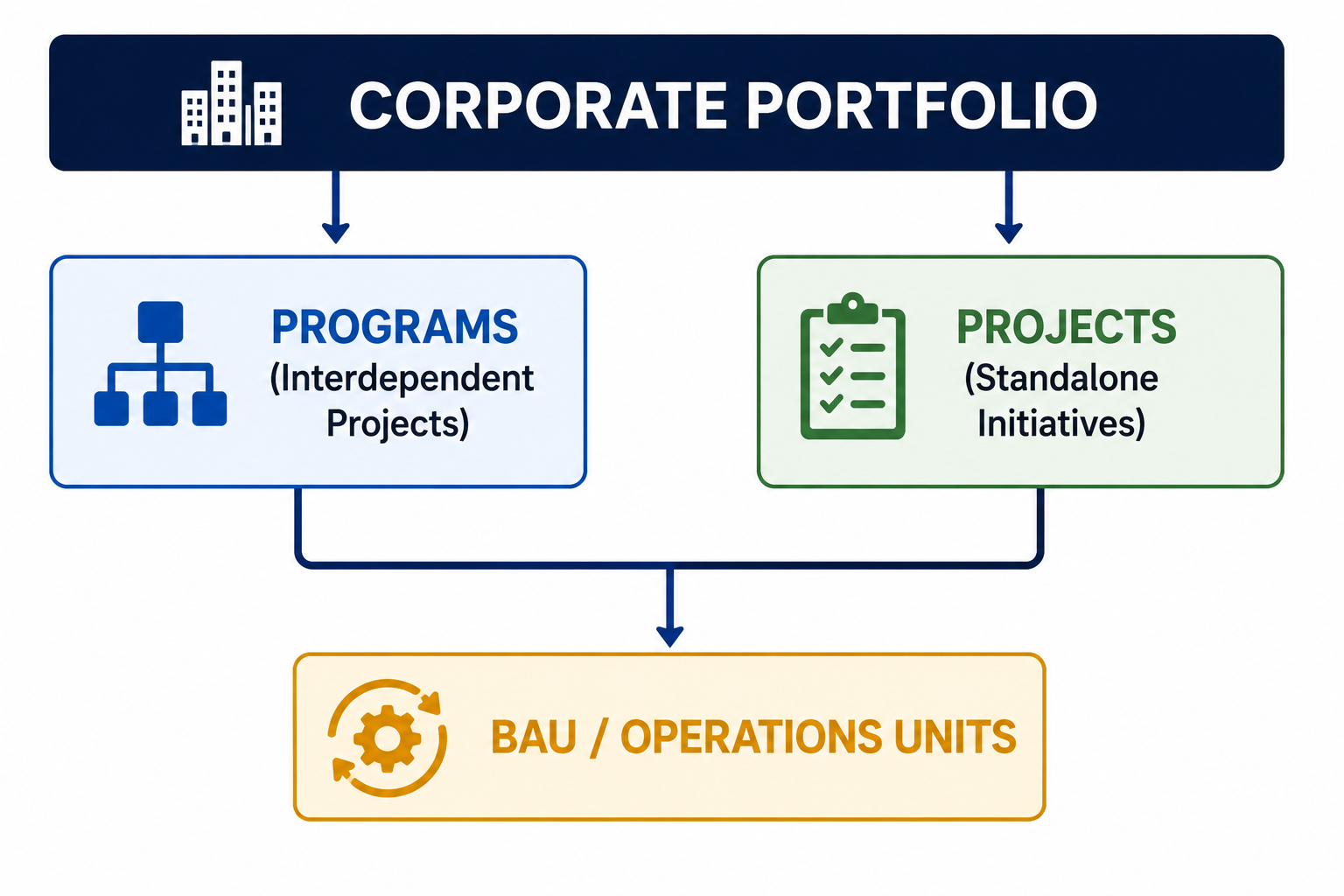
At its core, a portfolio is simply a group. In an enterprise context, a corporate portfolio is a strategically organized collection of programs, projects, operational activities, and sub-portfolios managed together to achieve specific organizational objectives.
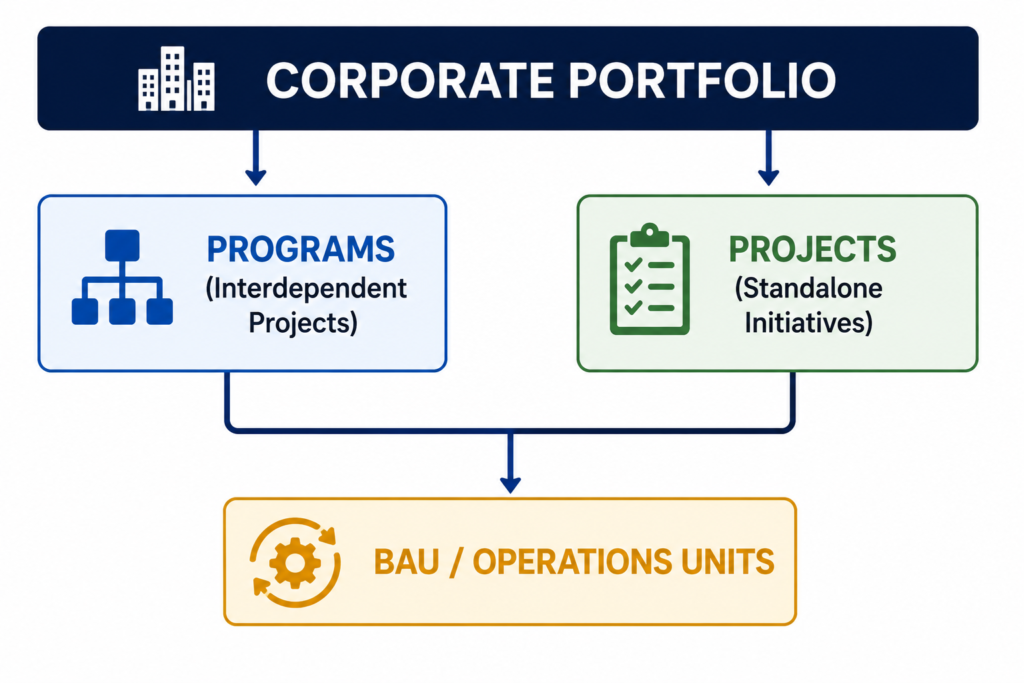
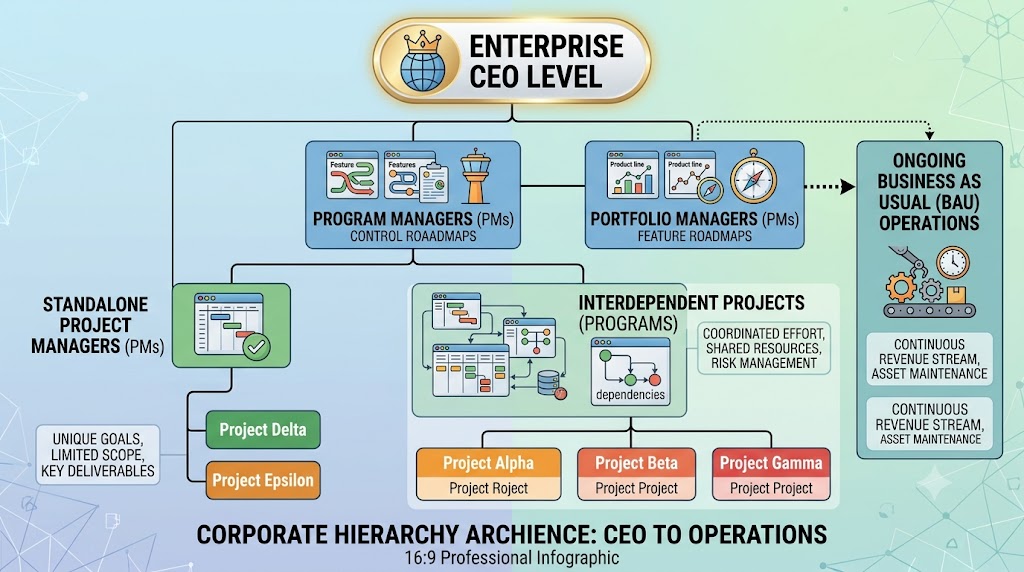
While projects focus on “doing things right” (delivering specific scope on time and within budget), portfolio management focuses on “doing the right things”. It sits at the executive layer, bridging the gap between high-level corporate strategy and ground-level project execution.
Why Organizations Must Categorize Portfolios
Without structured portfolio categorization, organizations suffer from systemic inefficiencies:
Misaligned Capital Allocation: Capital flows to pet projects rather than strategic priorities.
Capacity & Bench Management Chaos: Resource pooling becomes impossible because skills are isolated in uncoordinated departmental silos.
Compounded Enterprise Risk: Risks identified in one product line or region are not cross-pollinated to protect other operational areas.
Failed Governance: A single set of rigid governance rules is applied identically to high-risk futuristic R&D and routine IT maintenance, paralyzing innovation or compromising security.
Deep-Dive: The Core Enterprise Portfolio Types
Elite organizations tailor their portfolio structures to match their business models, geographic footprints, and market strategies. Below are the primary portfolio types used across global enterprises.
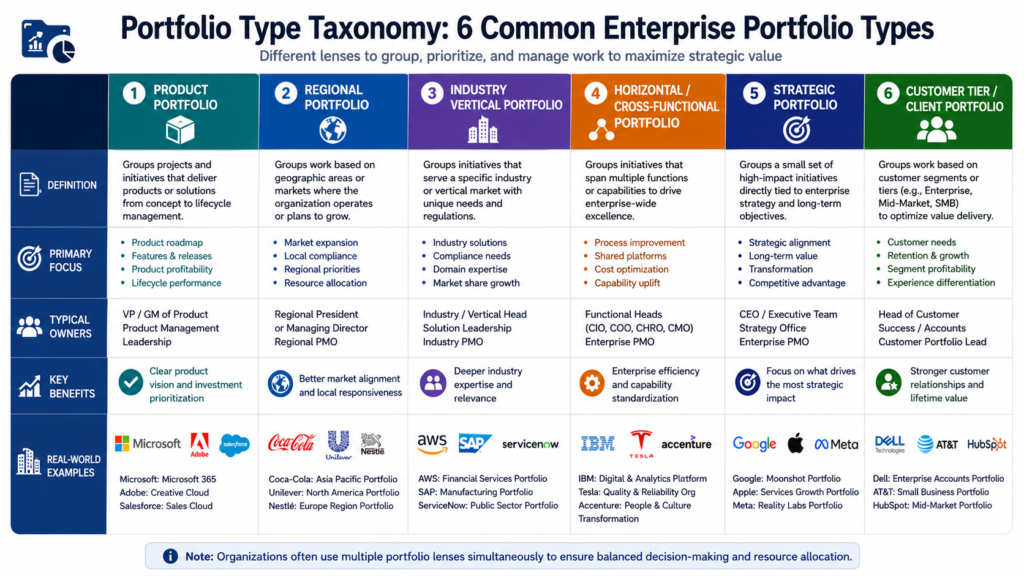
1. Product Portfolios
A Product Portfolio groups initiatives, enhancements, and operational support based on specific product lines or software suites offered by the company.
Real-World Example: Tech giants like Apple group their initiatives into distinct product lines such as iPhone, Mac, iPad, and Wearables. Microsoft manages product portfolios around Office 365, Azure, Teams, and Copilot. Automakers like Toyota maintain separate portfolios for passenger cars, commercial trucks, and electric vehicles.
Key Advantage: Allows product owners and portfolio managers to align feature roadmaps, coordinate release schedules, and manage the full product lifecycle: from initial Proof of Concept (POC) to feature-rich launches and eventual software sunsetting.
2. Regional Portfolios
A Regional Portfolio organizes business operations, expansion initiatives, and compliance projects by geographic territory.
Real-World Example: Multi-national corporations divide operations into regional structures such as North America (NA), Asia-Pacific (APAC), Europe, Middle East & Africa (EMEA), and Latin America (LATAM).
Key Advantage: Enables leadership to apply regional regulatory requirements, adapt to local market behaviors, and make location-specific resource decisions without being tied down by central corporate bureaucracy.
3. Industry Vertical Portfolios
Commonly utilized by global service-based giants, IT consultancies, and system integrators, Industry Vertical Portfolios organize clients, contracts, and delivery programs by market domain.
Real-World Example: Enterprise consultancies like Accenture, TCS, IBM, and Infosys group client engagements into industry verticals such as Banking, Financial Services & Insurance (BFSI), Healthcare & Life Sciences, Retail & Consumer Goods, and Energy & Utilities.
Key Advantage: Fosters deep domain expertise. Project managers and engineers develop specialized knowledge within specific industries, allowing standard solution patterns and regulatory frameworks to be reused across multiple client accounts.
4. Horizontal / Cross-Functional Portfolios
While vertical portfolios focus deep within a specific domain or product, a Horizontal Portfolio cuts across multiple departments, business functions, or regions to deliver shared capabilities.
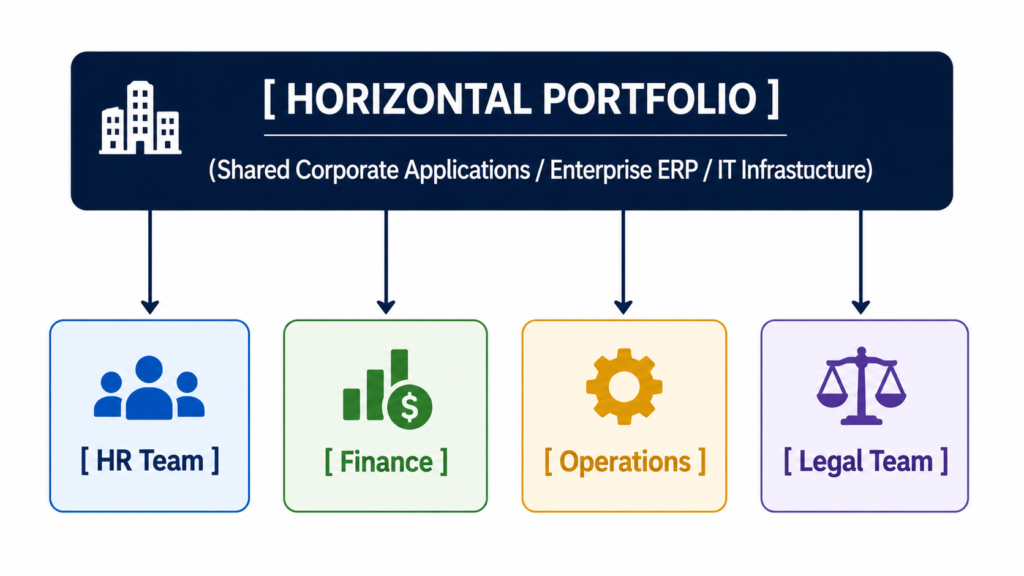
Real-World Example: Implementing an enterprise-wide Oracle ERP or Salesforce CRM platform requires coordination across Sales, HR, Finance, Legal, and IT. A staffing company onboarding a client candidate must cut across Sales (account management), HR (recruitment), Legal (SOW agreements), Finance (billing), and IT (access provisioning).
Key Advantage: Breaks down departmental silos, standardizes enterprise-wide processes, eliminates redundant tool procurement, and ensures corporate-wide compliance.
5. Strategic Portfolios
A Strategic Portfolio is explicitly structured around high-level corporate transformation goals rather than daily operations.
Real-World Example: An enterprise might establish a Mergers & Acquisitions (M&A) Portfolio to manage target acquisitions and post-merger integrations. Other strategic types include Market Expansion Portfolios, Digital Transformation Portfolios, or Futuristic R&D Portfolios.
Key Advantage: Protects transformative, high-risk initiatives from being choked by daily operational demands. It provides C-suite executives with direct oversight of strategic bets
6. Customer Tier / Client Portfolios
Service providers and B2B vendors frequently group projects based on client size, contract value, or organizational type.
Real-World Example: Structuring client groups into Fortune 50 Accounts, Fortune 500 Accounts, Mid-Market Accounts, and Government/Public Sector.
Key Advantage: Ensures high-value accounts receive premium dedicated oversight and specialized SLAs, while smaller accounts are managed through standardized, cost-effective delivery frameworks
Step-by-Step Implementation Framework: Structuring Your Enterprise Portfolios
Transforming corporate chaos into a structured portfolio management ecosystem requires an intentional, step-by-step approach. Follow this five-stage framework to design and deploy an effective portfolio strategy.
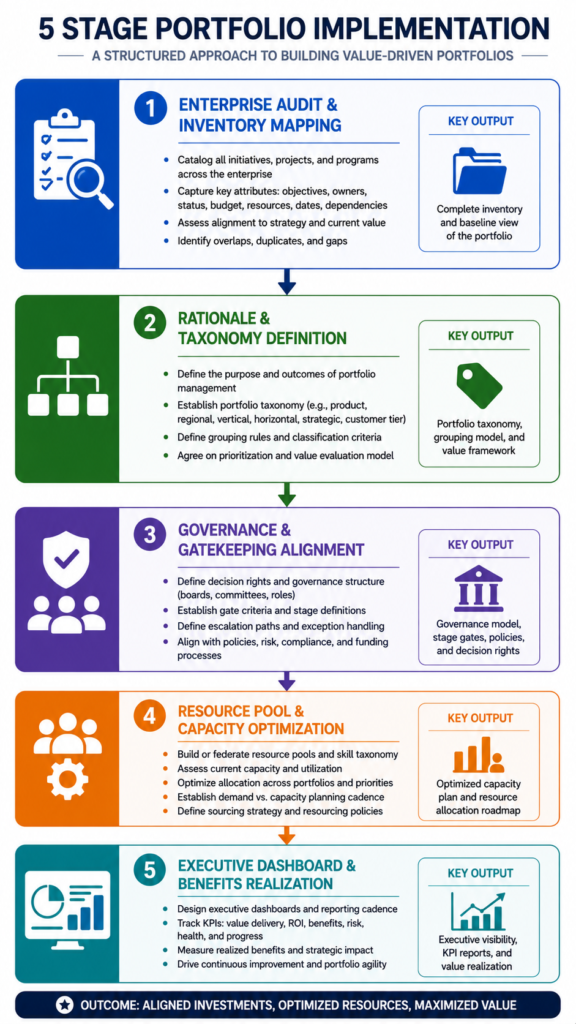
Stage 1: Enterprise Audit & Inventory Mapping
Conduct a comprehensive audit across all active corporate initiatives. Catalog every active project, program, operational effort, and software enhancement. Capture initial budgets, resource allocations, target timelines, and executive sponsors.
Stage 2: Rationale & Taxonomy Definition
Analyze the inventory for natural commonalities. Determine the primary organizational lens that matches your corporate strategy:
Are your major costs driven by geographic expansion? (Choose Regional).
Are you managing distinct commercial software assets? (Choose Product).
Are you serving distinct industry client groups? (Choose Verticals).
Group every initiative into its designated portfolio, removing overlapping or duplicate efforts.
Stage 3: Establish Portfolio-Specific Governance
Define tailored gatekeeping rules for each portfolio type:
For R&D Strategic Portfolios: Use lean, milestone-based funding gates with high risk tolerance.
For Horizontal Enterprise Applications: Enforce strict cross-functional steering committees and compliance sign-offs.
For Product Portfolios: Tie approvals directly to business case validation, technical feasibility studies, and market demand metrics.
Stage 4: Optimize Resource Pools & Capacity Management
Establish shared resource benches within each portfolio. Instead of every project manager hoarding specialized talent, create pooled benches across common portfolio domains. This allows engineering and technical staff to be redeployed smoothly as project demands fluctuate.
Stage 5: Implement Executive Dashboards & Benefits Realization
Establish consolidated reporting up to the executive layer (CEO and C-suite). Track financial health, milestone progress, risk profiles, and benefits realization across every portfolio. Ensure that as individual project iterations complete, their incremental value flows up through releases, enriches the product line, strengthens the portfolio, and drives corporate growth
Comparative Matrix: Portfolio Types at a Glance
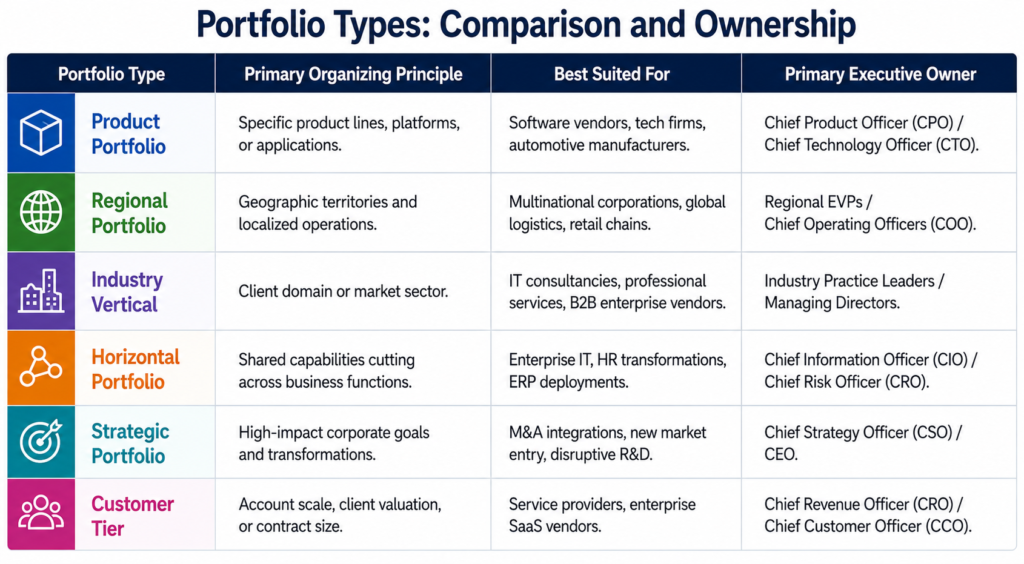
Shift From Execution Chaos to Strategic Leadership
Mastering portfolio structures changes how you operate as a professional.
When you understand how corporate hierarchies are built and how capital flows from executive strategy down to project sprints, you stop being an operational task tracker. You no longer just manage schedules and run daily standups without understanding the larger picture.
By mastering portfolio management concepts, you gain a seat at the strategic table. You understand why projects are funded, how capacity is managed across teams, and how to communicate fluently with C-suite executives in terms of revenue, risk, and value delivery.
Transform Your Strategic Leadership with Skillsetify
If you are ready to stop guessing, move up the corporate ladder, and learn project management the right way, reach out to Skillsetify. We do not just teach frameworks: we show you your exact career growth trajectory.
Mastering enterprise governance, advanced portfolio management, and strategic execution is the fastest route to senior executive roles. Contact Skillsetify today to elevate your skills, command authority in the boardroom, and lead high-stakes corporate portfolios with total confidence.