Why Your Corporate Structure Fails Without Horizontal Portfolios
Monday morning, 8:00 AM. A high-stakes corporate quarterly review is underway, and the room is radiating stress.
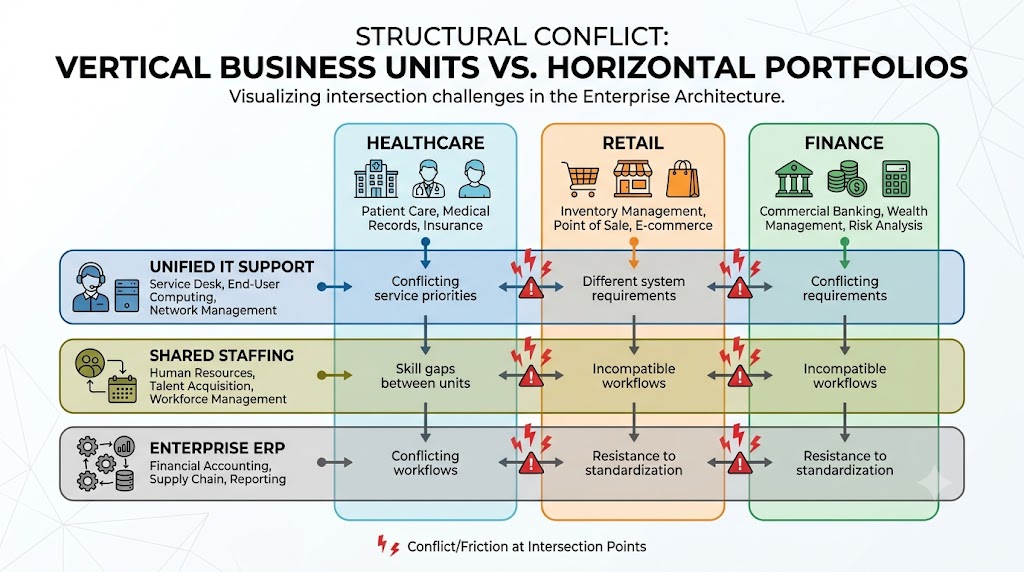
The Vice President of Banking and Financial Services is furious. His team’s critical customer onboarding application is stalled because the central IT support group cannot deliver a required security patch. In the seat next to him, the Vice President of Healthcare is equally livid. She claims that same central IT support group was pulled away to fix a mobile point-of-sale glitch for the Retail division, leaving her clinical compliance project completely starved of resources.
Meanwhile, the Head of IT Infrastructure sits in the middle, overwhelmed and facing a barrage of criticism. His shared support group is caught in an impossible tug-of-war between competing, powerful business unit heads. Every division is demanding dedicated attention, custom features, and immediate turnaround times, all while using the exact same underlying technology stacks and operational talent pools.
Costs are ballooning. Velocity has ground to a complete halt. Key engineers are burning out, and executive leadership is looking for someone to blame.
This exact nightmare unfolds every day across modern enterprises. When organizations scale, leadership naturally seeks ways to organize complex operations. However, when those organizational structures fail to align with how value actually flows across the enterprise, structural paralysis is inevitable.
The Corporate Myth: The common belief in enterprise architecture is that doubling down on vertical business line autonomy is the ultimate key to agility. Executives assume that giving every business unit its own dedicated resources, independent budget, and isolated operational teams will solve delivery bottlenecks.
In reality, total vertical isolation creates massive operational friction. It leads to duplicated technology stacks, rampant vendor spending, talent hoarding, and a complete breakdown of cross-departmental collaboration. To solve this, forward-thinking enterprises rely on a crucial structural solution: Horizontal Portfolios.
Demystifying Horizontal Portfolios: The Architecture of Cross-Functional Synergy
To understand why traditional corporate structures break down, you must first understand how corporate hierarchies organize their operational portfolios.
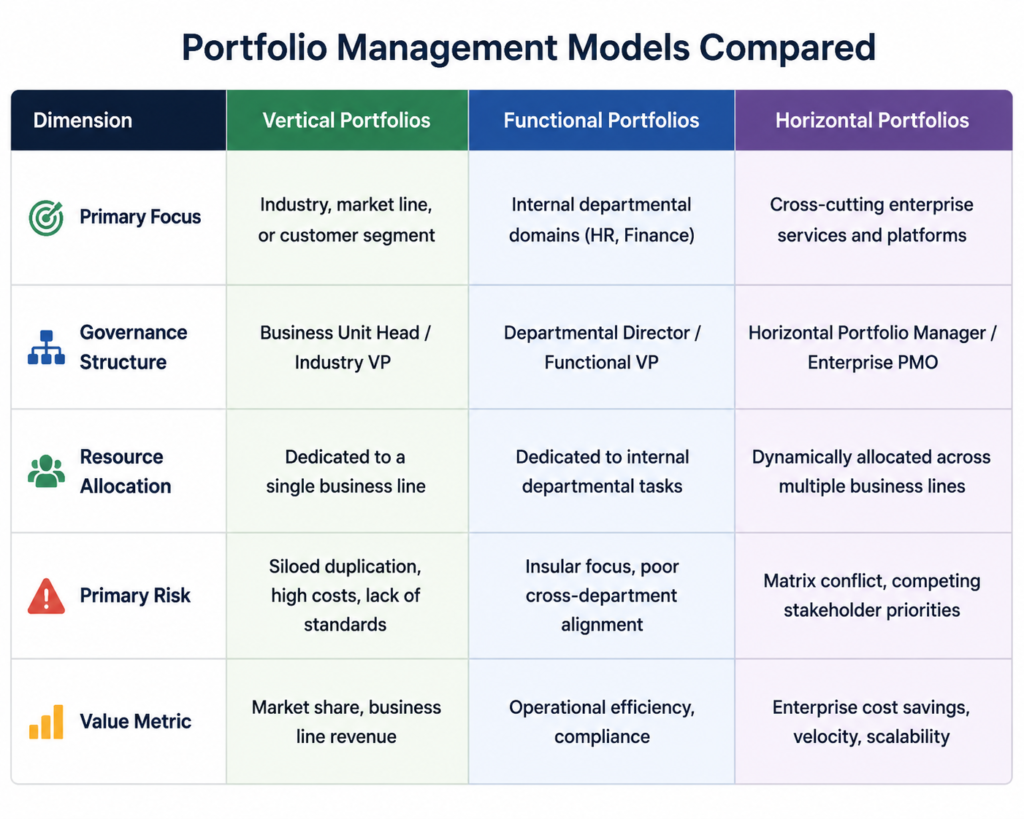
In standard organizational theory, portfolios are grouped by shared characteristics to make management manageable. Most leaders are familiar with two primary portfolio models:
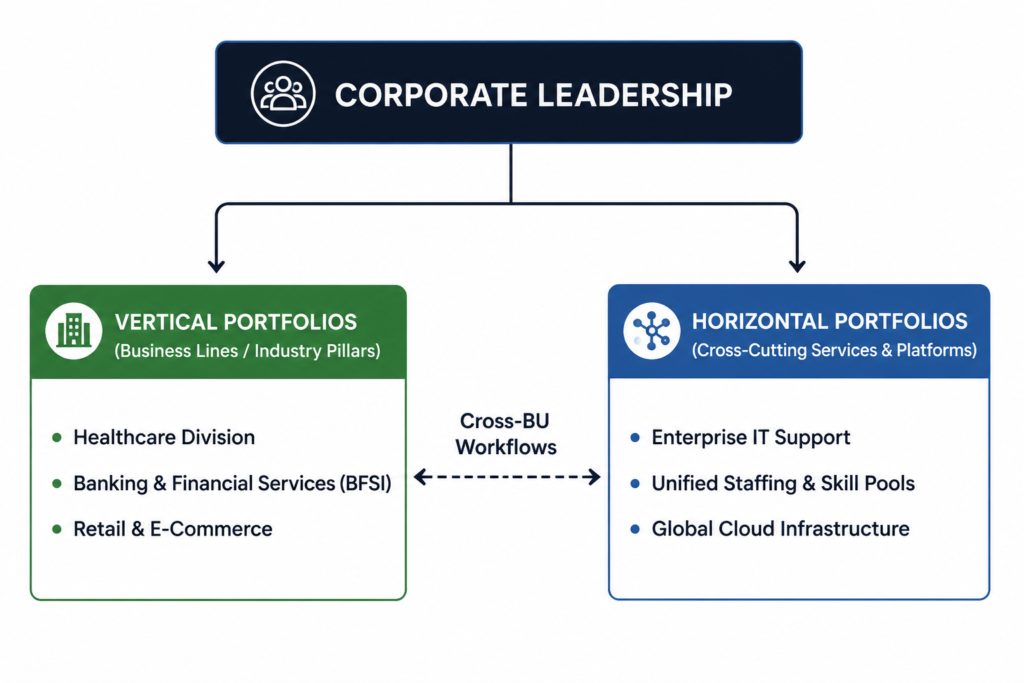
Vertical Portfolios: These are organized around specific market segments, distinct product lines, or client industries. For example, a global IT consultancy might maintain distinct vertical portfolios for Healthcare, BFSI (Banking, Financial Services, and Insurance), and Retail.
Functional Portfolios: These are structured around internal operational departments. HR, Legal, Marketing, and Finance operate as distinct functional pillars, maintaining their own localized projects and operational pipelines.
What is a Horizontal Portfolio?
A Horizontal Portfolio is a strategic grouping of workflows, services, applications, or resource pools that cut directly across distinct business lines and functional departments.
Instead of isolating resources within a single vertical pillar, a horizontal portfolio aggregates cross-cutting organizational capabilities under a single, unified governance structure.
Consider a global staffing model or an enterprise IT support framework. Healthcare needs IT support. Retail needs IT support. BFSI needs IT support. If each vertical builds its own isolated support desk, the company pays triple the operational cost, fragmenting its data and introducing massive compliance risks.
A horizontal portfolio consolidates IT support into an enterprise-wide capability. It treats IT support not as a fragmented vertical task, but as a centralized, high-efficiency engine that serves every business line simultaneousl
The Core Mechanics of Horizontal Alignment
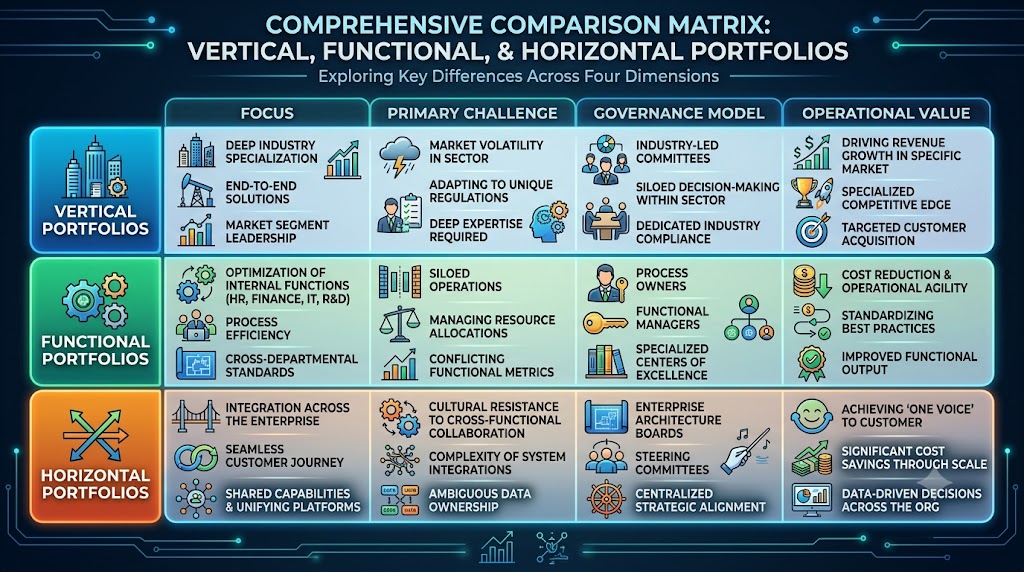
How do horizontal portfolios work in practice? They rely on three foundational pillars:
Shared Capabilities as a Service: Horizontal portfolios reframe internal operations as standardized services. Whether delivering cloud architecture, unified talent acquisition, or cybersecurity compliance, the horizontal portfolio establishes clear service tiers that vertical business units consume.
Centralized Resource Pooling: Rather than allowing business units to hoard specialized talent (such as AI engineers, DevOps specialists, or senior project managers), horizontal portfolios manage these skills as a shared enterprise asset. Talent is deployed dynamically to high-priority business initiatives based on corporate strategy rather than political muscle.
Unified Enterprise Governance: Horizontal portfolios establish standardized operating procedures, technology stacks, and reporting metrics across all business units. This eliminates the headache of managing five different enterprise software solutions across five different departments.
The 5-Step Implementation Framework for Program Leaders
Transitioning from siloed vertical operations to an optimized horizontal portfolio requires deliberate governance, change management, and strategic structure. Here is the step-by-step framework every project and program leader must execute to build and manage a horizontal portfolio successfully.
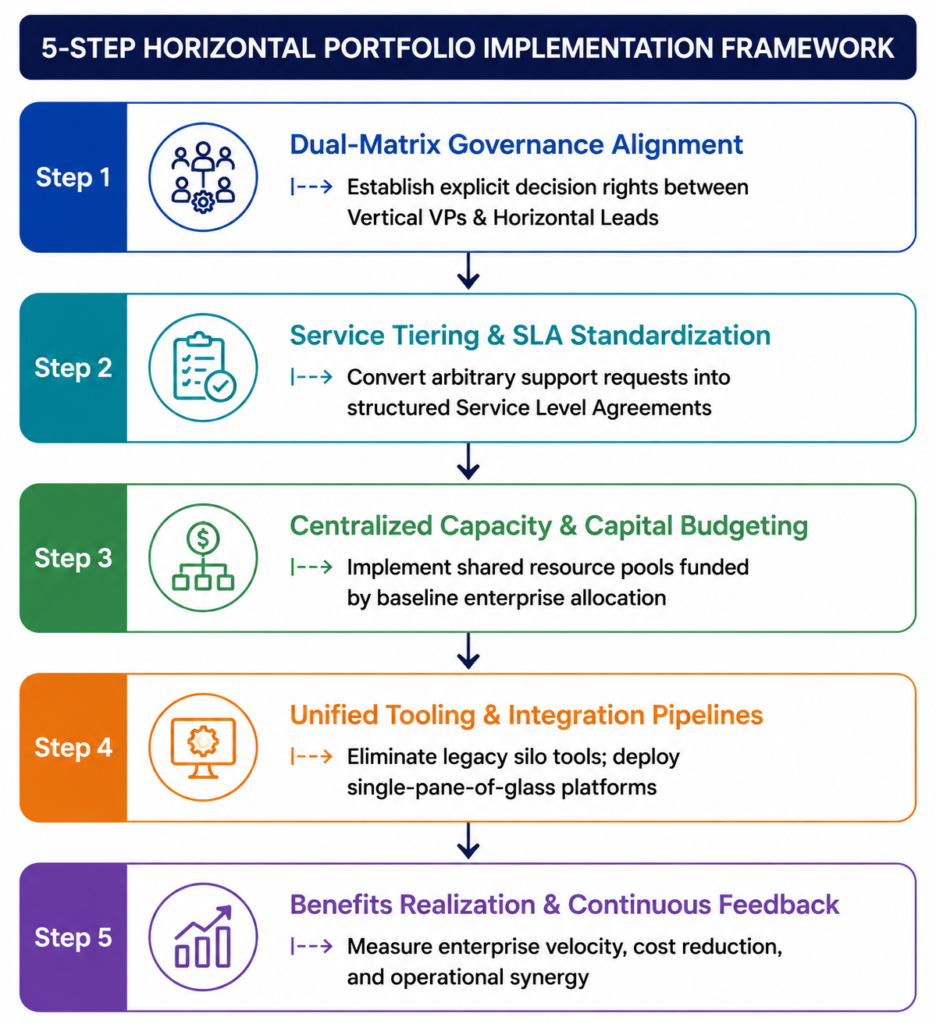
Step 1: Establish Dual-Matrix Governance Alignment
The primary reason horizontal portfolios fail is ambiguous authority. When a project manager running a horizontal service receives conflicting directives from the VP of Retail and the VP of Healthcare, who wins?
To prevent gridlock, you must establish explicit dual-matrix decision rights:
Vertical Leaders retain authority over WHAT business outcomes need to be achieved and WHEN market opportunities must be seized.
Horizontal Portfolio Leaders retain authority over HOW the cross-cutting service is designed, WHO from the shared pool is assigned to execute it, and WHAT enterprise standards must be enforced.
Document these decision rights in an Enterprise Governance Charter before delivering a single task.
Step 2: Define Cross-Cutting Value and SLAs
A horizontal service cannot operate on informal requests and political favors. You must establish structured Service Level Agreements (SLAs) and value definitions for every capability within the portfolio.
If the horizontal portfolio governs unified staffing, define explicit service level metrics:
Time-to-deploy for specialized technical roles.
Standardized onboarding compliance frameworks across all business lines.
Clear escalation paths for sudden changes in resource demand.
By converting arbitrary requests into structured SLAs, you remove emotion from resource allocation.
Step 3: Implement Centralized Capacity and Capital Budgeting
If a horizontal portfolio relies entirely on chargebacks or variable funding from individual vertical business units, it will fail. Vertical leaders will constantly threaten to pull their funding whenever short-term pressure hits.
Secure a centralized baseline capital budget for the horizontal portfolio at the executive corporate level. Fund the baseline infrastructure, core tooling, and central talent pool through corporate overhead allocations. Use variable chargebacks only for custom, high-volume vertical consumption beyond the agreed-upon SLA baseline.
Step 4: Standardize Enterprise Tooling and Data Pipelines
A horizontal workflow cannot run on fragmented systems. If the Healthcare line tracks projects in Jira, Retail uses Asana, and BFSI tracks work in legacy spreadsheets, your horizontal team will waste thousands of hours manually translating status reports.
Enforce a single-pane-of-glass enterprise tooling strategy. Standardize work management software, intake portals, and reporting dashboards across every business line that interacts with the horizontal portfolio.
Step 5: Track Benefits Realization and Continuous Feedback Loops
Horizontal portfolios prove their worth through enterprise value metrics. Establish a quarterly Benefits Realization review to track performance across three key indicators:
Cost Avoidance: Total capital saved by eliminating duplicated software licenses, redundant hardware, or parallel team hires.
Velocity Metrics: Reductions in cycle time for cross-cutting services (e.g., how quickly an IT environment can be provisioned for a new project in any business line).
Synergy Realization: The percentage of shared assets, codebase modules, or operational frameworks reused across multiple business units.
Transforming Enterprise Complexity into Career Velocity
Implementing horizontal portfolios does far more than streamline corporate operations: it fundamentally transforms the day-to-day reality of project delivery.
Life Before vs. Life After Horizontal Optimization
Before horizontal portfolio optimization, project managers spend their lives fighting endless fires. They deal with scope creep caused by conflicting business unit demands, constant resource starvation as teams are poached by louder executives, and chronic team burnout resulting from chaotic, uncoordinated schedules.
After implementing a structured horizontal portfolio, delivery shifts into an elite, predictable cadence:
Scope Drift Disappears: Clear SLAs and intake portals ensure that work requests are properly vetted, standardized, and prioritized before hitting delivery teams.
Resource Predictability: Centralized capacity management replaces political wrestling matches over headcount. Project managers know exactly when talent is available and how long they have access to it.
Elimination of Redundancy: Instead of reinventing the wheel for every project, teams leverage existing enterprise assets, shared codebases, and unified service frameworks, cutting delivery timelines in half.
The Strategic Leadership Advantage
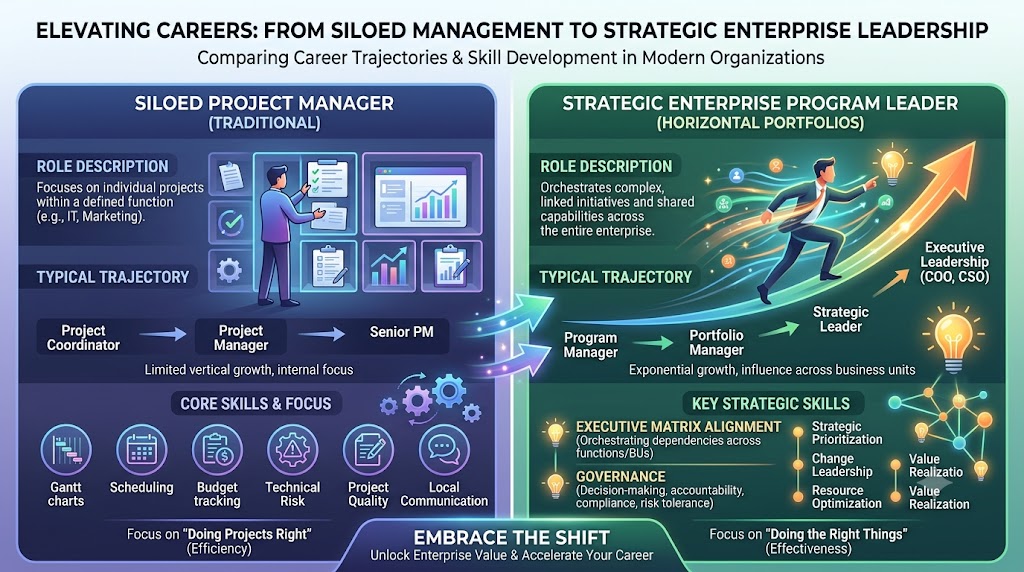
From a career perspective, mastering horizontal portfolios is the single fastest way to transition from a tactical task manager to an executive-ready program leader.
Most project managers stay trapped within single verticals or localized project teams. They master basic scheduling and task tracking, but they remain invisible to C-suite leadership because their scope of impact is isolated.
When you learn to manage a horizontal portfolio, you operate at the intersection of enterprise strategy and execution. You gain high visibility across every major business unit in the organization. You master the exact skills that corporate executives search for:
Navigating complex, matrixed stakeholder environments.
Aligning financial capital budgeting with long-term strategic vision.
Eliminating enterprise waste while scaling delivery velocity across multiple business lines simultaneously.
Navigating these complex organizational structures is not something you pick up by accident. It requires moving beyond standard project management formulas and mastering the true architecture of modern corporate delivery.
Master Strategic Leadership with Skillsetify
Managing complex workflows that cut across distinct business lines is no longer an optional skill: it is the defining requirement for elite enterprise leaders. Organizations do not suffer from a lack of ideas; they suffer from an inability to structure, govern, and execute work effectively across rigid internal boundaries.
By mastering horizontal portfolios, you position yourself as the indispensable leader who can bridge corporate silos, eliminate structural friction, and turn operational chaos into predictable, scalable value.
If you are ready to stop guessing, move up the corporate ladder, and learn project management the right way, reach out to Skillsetify. We do not just teach frameworks: we show you your exact career growth trajectory.