How Strategic Portfolio Management Eliminates Corporate Friction and Drives Measurable Value
magine it is Monday morning at 8:30 AM in the executive boardroom. The C-suite, board members, and senior directors are assembled around the table. The Chief Executive Officer slides a spreadsheet across the table, displaying a $50 million investment line item spanning 45 active technology and business initiatives. The CEO asks a devastatingly simple question:
“We are burning capital at record rates, yet our flagship product launch is seven months behind schedule, our engineering team is burning out, and two separate divisions just spent $2 million building identical internal AI platforms. Who is responsible for this, and where is our return on investment?”
Silence fills the room. Engineering blames Product for perpetual scope creep. Product points at Finance for delayed budget releases. Operations blames HR for headcount constraints. Everyone is managing their individual projects with textbook precision, yet the organization as a whole is bleeding capital and missing strategic targets.
This nightmare scenario unfolds daily in modern enterprises. The underlying cause is rarely bad project management: it is a fundamental misinterpretation of corporate structure and strategic governance.
Dispelling the Great Corporate Myth
A pervasive myth haunts executive leadership teams: the belief that executing individual projects with agility automatically translates to organizational success. Companies flood their departments with Scrum Masters and Project Managers, hoping that localized efficiency will magically synthesize into enterprise strategy.
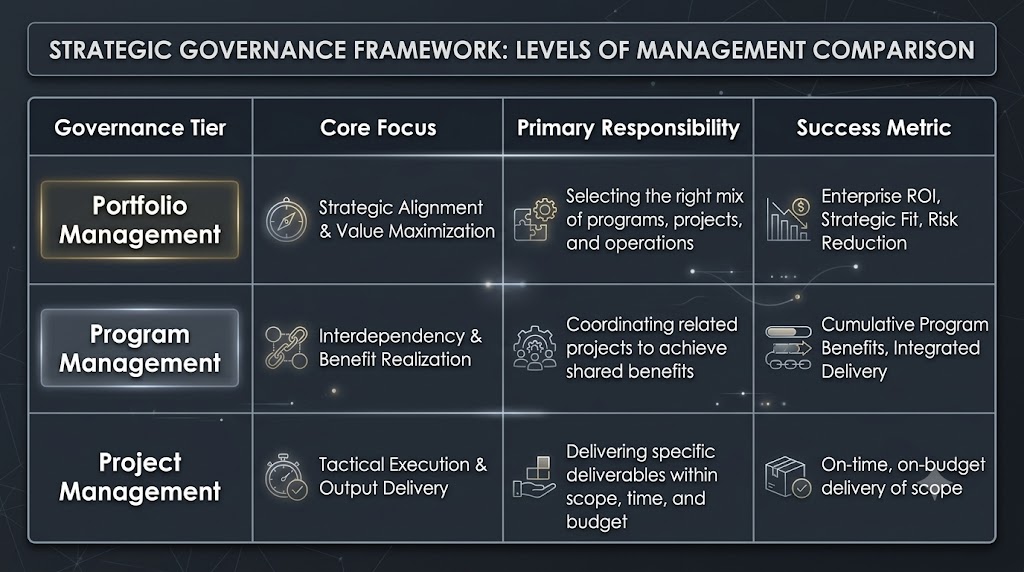
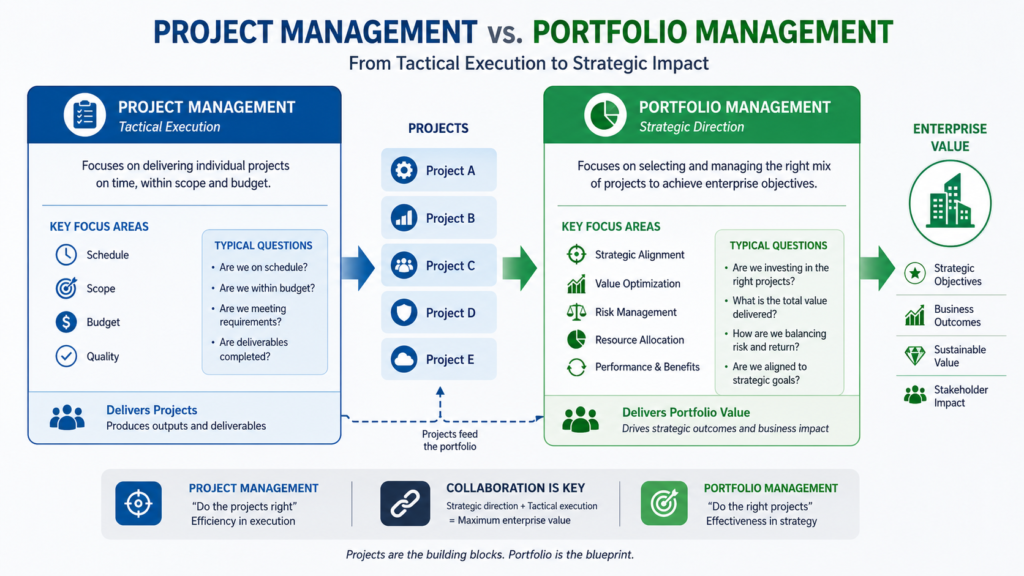
This is fundamentally false. Executing a flawed or misaligned initiative with operational efficiency simply means failing faster and more expensively. Individual project management answers the tactical question: “Are we building this project right?” Portfolio Management, by contrast, answers the strategic question: “Are we building the right projects, at the right time, with the right resources, to achieve our long-term corporate vision?”
Decoding Portfolio Value: The Strategic Translation Layer
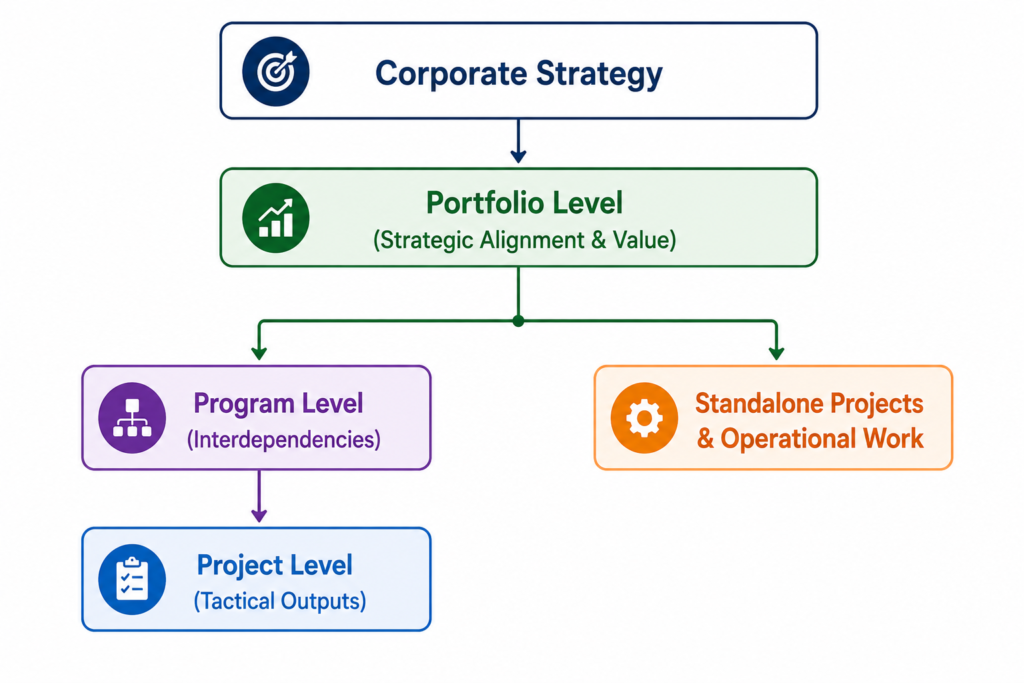
To understand why portfolio management is the ultimate lever for strategic execution, one must first master how modern corporate structures operate. Organizations naturally divide into functional departments such as Finance, HR, IT, Legal, and Marketing. While these operational silos maintain daily business-as-usual (BAU) activities, strategic growth demands cross-cutting initiatives that span across departments, business units, and global regions.
A Portfolio acts as a centralized strategic bucket: a curated collection of programs, individual projects, and operational work managed collectively to maximize return on investment, optimize shared capacity, and minimize systemic enterprise risk.
The Four Pillars of Enterprise Portfolio Value
1. Strategic Alignment
Every dollar spent and every engineering hour invested must directly map to executive strategy. Portfolio management provides continuous line-of-sight governance, ensuring that lower-level tactical execution directly feeds upper-level enterprise vision. If a proposed initiative does not align with core business goals, it is eliminated before consuming organizational bandwidth.
2. Streamlined Capacity Management & Resource Optimization
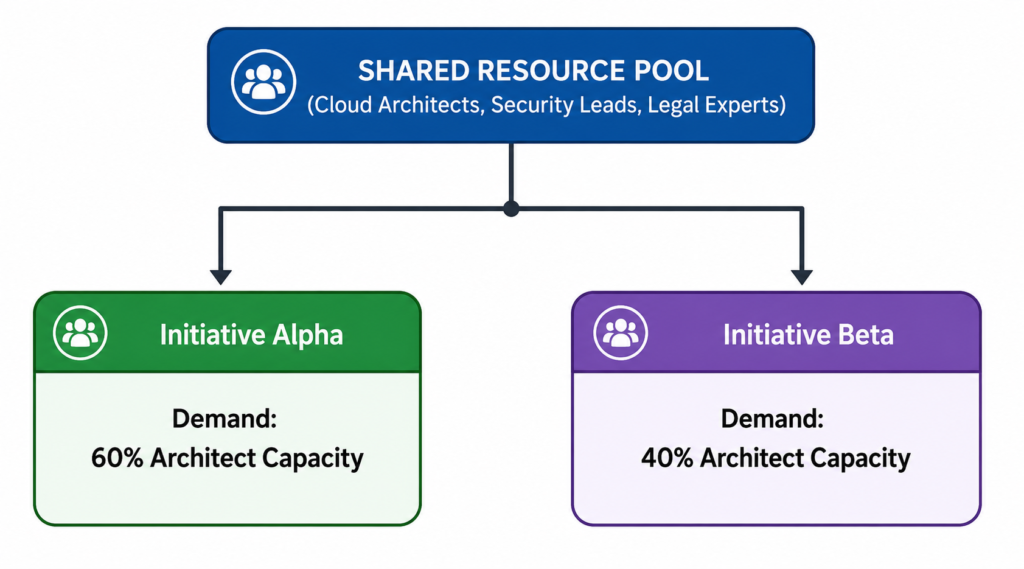
Human capital is finite. When multiple independent projects compete for the same specialized talent, multi-tasking and cognitive overload degrade delivery speed. Portfolio management pools shared resources, maintains healthy talent benches, and balances workload distribution across initiatives, eliminating resource cannibalization and preventing employee burnout.
3. Standardized Governance & Operational Efficiency
Without portfolio-level oversight, every department invents its own reporting standards, metrics, and approval gates. Portfolio management establishes uniform stage-gate criteria, standardized metrics, and clear entry and exit standards (such as Definition of Ready and Definition of Done) across the entire initiative pipeline.
4. Systemic Risk Mitigation
Projects do not fail in isolation: systemic risks aggregate across interconnected systems and dependencies. By grouping initiatives into logical portfolios, leadership can identify cross-project dependencies, track resource bottlenecks early, and make proactive calls to pivot, pause, or sunset failing endeavors before they cause catastrophic operational losses.
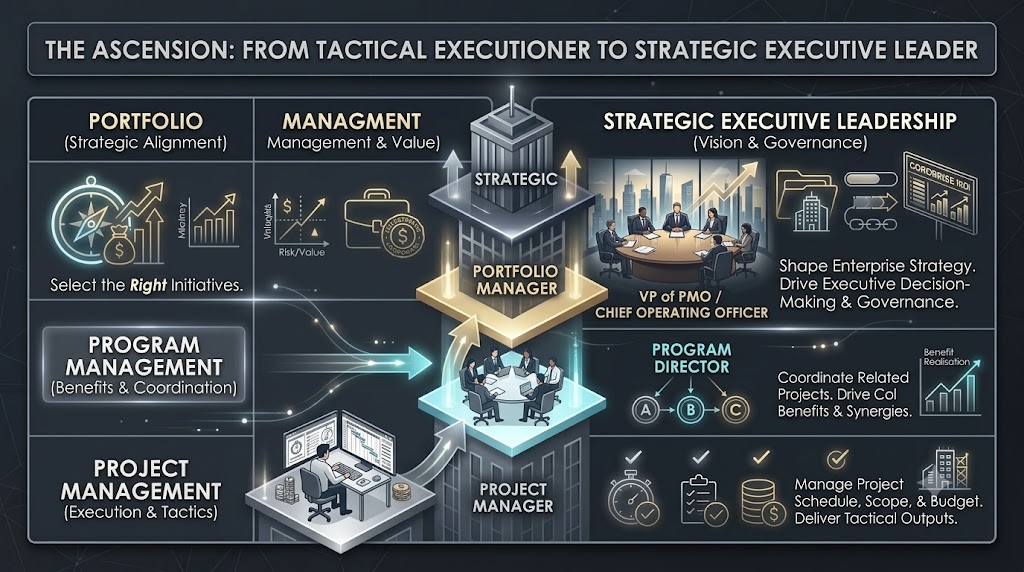
Project vs. Program vs. Portfolio Management: The Structural Hierarchy
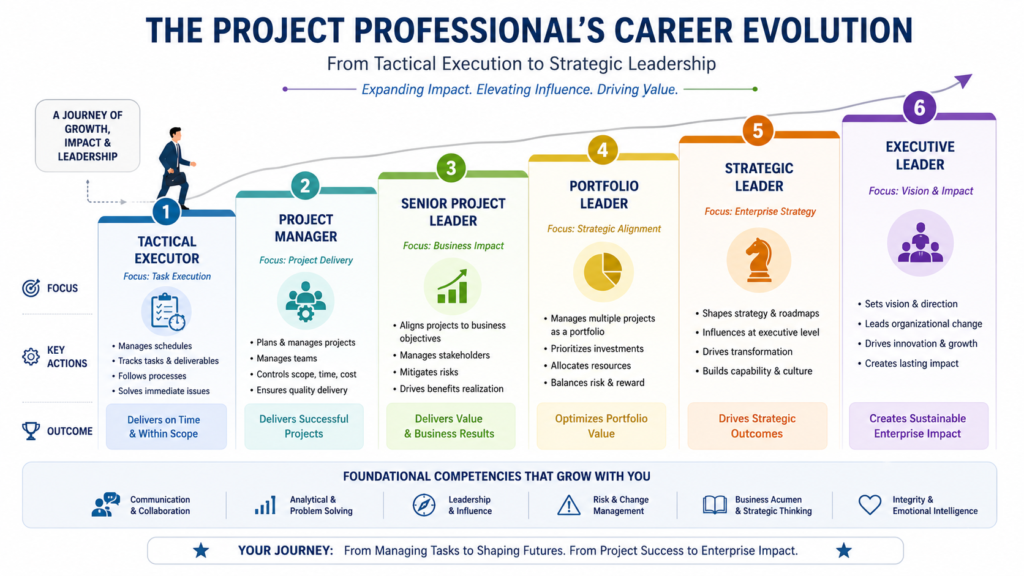
To establish clear accountability, leaders must distinguish between the distinct tiers of execution governance: