Why Your Software Pipeline is Bloated and How Lean Principles Salvage Corrupted Deliveries
It is 11:45 PM on a Thursday evening, fifteen minutes before a highly visible, multi-million dollar enterprise software release is scheduled to go live. The project manager sits in a war room surrounded by silent, exhausted developers, staring at a deployment dashboard flashing crimson. A wave of critical defects has just breached the staging environment, cascading across complex dependencies, un-integrated code branches, and misconfigured middleware databases.
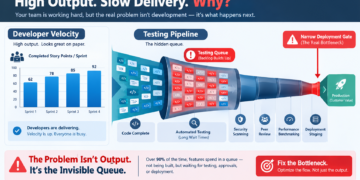
The launch is dead on arrival. For the past six months, the team tracked more than one hundred custom feature sets across separate, isolated departments. Yet, despite hitting every milestones milestone on the traditional project schedule, the final assembly is completely unviable.
This nightmare is not an isolated incident of bad luck. It is the natural consequence of the single greatest myth governing modern corporate boardrooms: the illusion that maximizing resource utilization and bloating software scope creates equivalent business value.
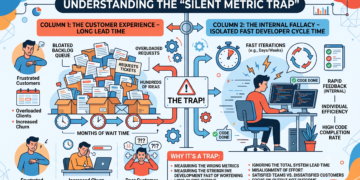
Many executives operate under the fundamentally flawed assumption that if software engineers are typing code 100% of the time, the project must be highly productive. This mentality views software as an additive assembly line where more features automatically translate to a more profitable product.
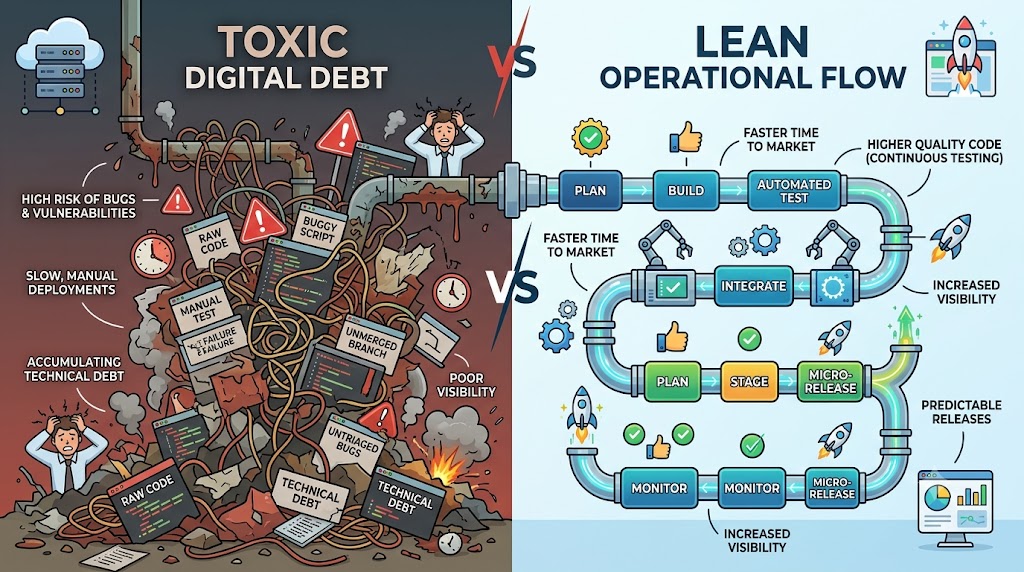
In reality, overproduction and excessive feature building generate massive amounts of digital inventory. This inventory takes the form of un-coded requirements, un-tested scripts, and stale code documentation. Just like physical inventory rotting in a legacy factory warehouse, this digital waste acts as toxic debt. It chokes operational speed, obfuscates technical transparency, and increases systemic delivery defects.
To break free from this loop of predictable failure, elite project leaders must discard outdated execution models. They need to look backward to look forward, adapting the rigorous continuous operational efficiency, optimization rules, and waste reduction mentalities perfected by legacy automotive manufacturing models directly into digital spaces.
The Transmutation of Efficiency: From Factory Floor to Digital Infrastructure
To understand how to eliminate waste in software, project managers must understand its origin. In the mid-twentieth century, manufacturing pioneers like Taiichi Ohno and Shigeo Shingo developed the Toyota Production System. This framework was built to systematically identify and eliminate Muda, the Japanese term for waste.
Decades later, this structural philosophy was adapted for the digital landscape. Lean Software Development is not a rigid collection of checklists or standard operating tools. It is a comprehensive philosophy that optimizes the end-to-end value stream by treating software development as a fluid, continuous pipeline rather than a series of static, batched phases.
The core mechanics of this methodology prioritize the total optimization of the system over the localized efficiency of separate teams. While traditional project management focuses heavily on controlling scope, cost, and strict schedules through top-down enforcement, Lean focuses entirely on accelerating velocity by removing non-value-adding operational friction.
By restructuring the digital delivery pipeline to prioritize value and eliminate systemic friction, project managers can drastically compress their delivery lead times while enhancing the overall quality of the product.
The Anatomy of Digital Waste: The 7 Deadly Software Mutas
In physical manufacturing, waste is highly visible. You can see piles of unused steel sheets rusting on the warehouse floor, or broken vehicle components stacked outside an assembly bay. In digital environments, however, waste is invisible, silent, and highly destructive.
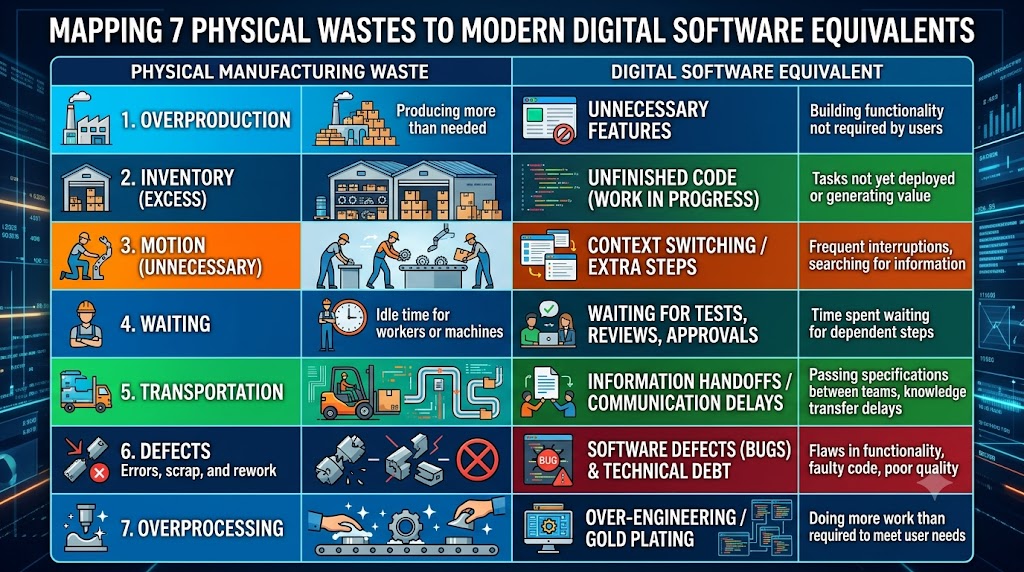
Project leaders must learn to identify the seven distinct expressions of software development waste:
Partially Done Work: This represents the software equivalent of factory inventory. It encompasses undocumented requirements, un-reviewed pull requests, and code branches that have not been integrated into the main repository. Partially done work ties up critical capital without delivering value, while rapidly growing obsolete as the core platform shifts.
Extra Features: Frequently referred to as gold plating, this occurs when teams build capabilities that the end user never requested or does not need. Every line of unnecessary code requires ongoing testing, introduces potential security vulnerabilities, and complicates the system architecture.
Lost Knowledge and Overprocessing: This waste manifests when organizations force developers to navigate convoluted, redundant toolsets or document systems in excessive detail. It also includes the cognitive friction of relearning complex algorithms due to poor team communication or missing standard baseline references.
Handoffs: The transition of a project component from product owners to architects, then to developers, then to quality assurance testers, and finally to system operators represents a massive structural vulnerability. With each sequential handoff, critical context is stripped away, causing delays and forcing teams into long cycles of rework.
Task Switching and Motion: Forcing engineers to juggle multiple projects concurrently destroys cognitive focus. When a developer switches contexts between disparate applications, they lose significant time simply trying to re-establish deep concentration.
Delays and Waiting: This includes the idle periods spent waiting for managerial sign-offs, vendor API documentation, hardware allocations, or cross-functional team dependencies to clear. Delays lengthen the feedback loop, keeping the organization from validating its assumptions with real market data.
Defects: Code bugs are the most visible form of waste. The impact of a defect escalates exponentially the longer it remains undetected within the delivery pipeline. A bug caught during initial development costs a fraction of the time to fix compared to one that corrupts a production database after release.
The Elite Project Manager’s Lean Implementation Framework
To execute this transition successfully, project managers cannot rely on vague directives. They require a rigorous, highly tactical operational playbook to identify waste, enforce workflow control, and optimize digital performance.
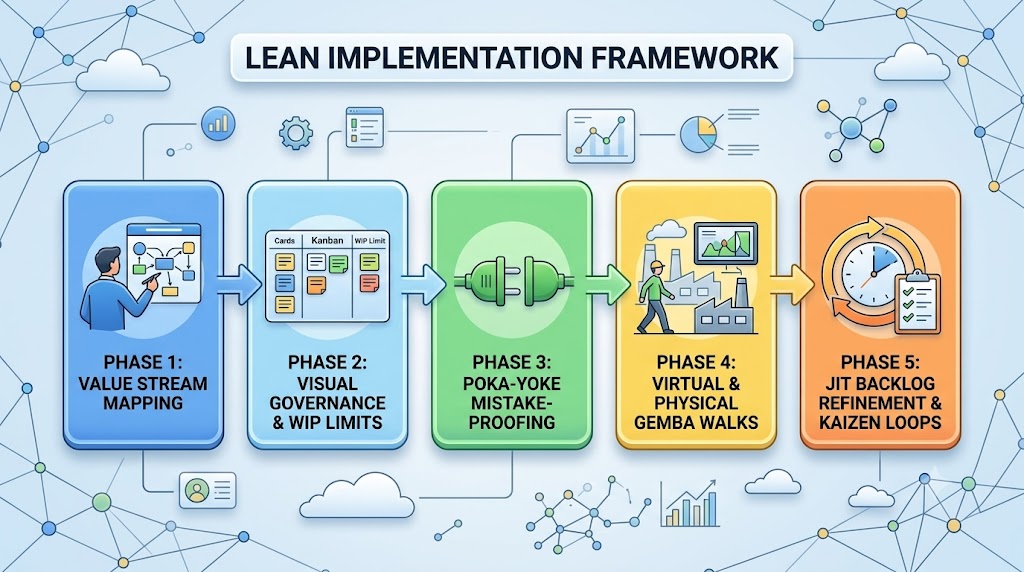
Phase 1: Execute End-to-End Value Stream Mapping (VSM)
The project leader must coordinate a comprehensive workshop with cross-functional stakeholders, including product owners, software developers, security analysts, test engineers, and operations personnel. Together, the team must chart every single activity required to transform an initial product hypothesis into a live production feature.
For every step in the pipeline, the project manager must record two vital metrics:
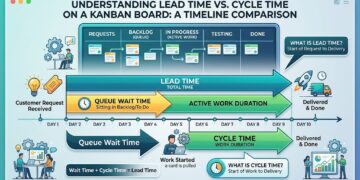
Processing Time: The duration during which an individual is actively performing high-value work on the asset.
Wait Time: The duration during which the asset sits idle in a queue, waiting for the next process, approval, or technical resource.
Once the entire workflow is mapped, the project manager calculates the Total Process Efficiency using a simple relationship:
Where Total Lead Time is equal to the sum of all Processing Time and Wait Time values combined. In a typical un-optimized corporate software pipeline, Process Efficiency frequently sits below 15%.
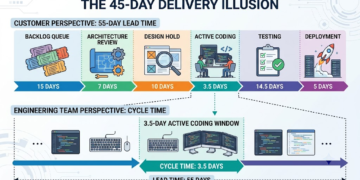
Consider an organization where a talent management or automated leave approval tool requires an engineer forty hours of active coding time, yet the total lead time from request to deployment stretches across eighty days due to long manual approval loops and slow cross-functional handoffs. By automating these non-value-adding approval thresholds and utilizing shared, standard tools, project teams can easily reduce total lag days by 40% to 50%, driving structural cost efficiency up.
Phase 2: Establish Visual Governance and Work-in-Progress (WIP) Limits
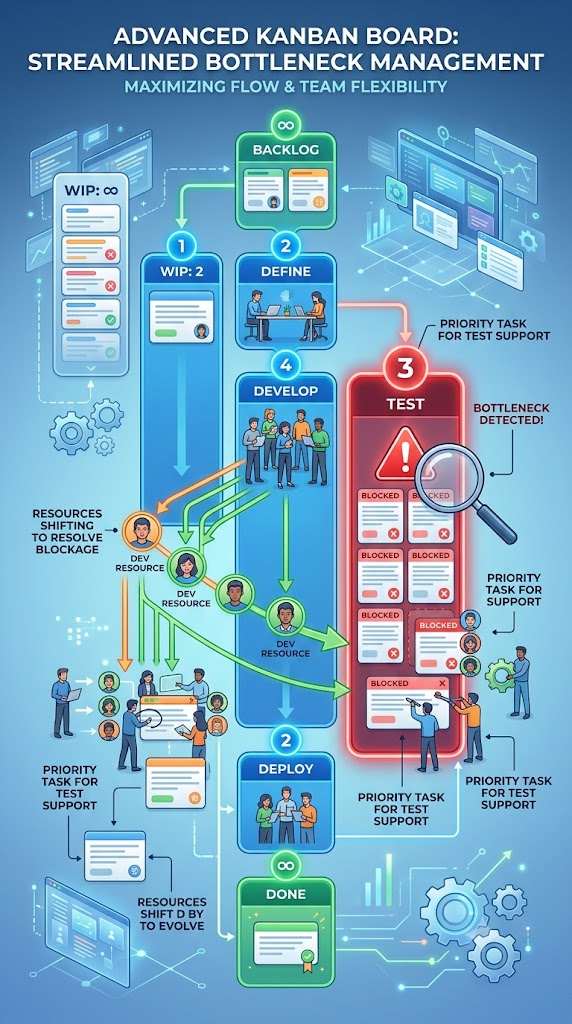
Project teams must manifest their newly mapped value streams onto highly visible Kanban architectures. Every column on the Kanban board must correspond to a specific step in the value stream mapping exercise rather than generic categories.
To eliminate the systemic waste of task switching, the project manager must establish strict Work-in-Progress limits for each column. For example, if a testing team consists of three individuals, the WIP limit for the testing phase column must be locked at a maximum index of three items simultaneously.
This mechanical constraint forces a fundamental shift from a push paradigm to a pull system. Teams are strictly prohibited from pushing new work down the pipeline when a downstream column hits its capacity limit. Instead, if a bottleneck forms, upstream resources must halt their current feature production and dedicate their energy to clearing the downstream logjam.
Phase 3: Integrate Mistake-Proofing (Poka-Yoke) Safeguards
Rather than inspecting for quality at the end of a long delivery cycle, the project manager must embed mistake-proofing mechanisms directly into the continuous integration and continuous deployment infrastructure. These digital safeguards function exactly like the automatic safety switches built into consumer vehicles, which automatically cut off an engine if a driver attempts to shift gears while the side stand is extended.
In digital infrastructure, this means configuring automated validation frameworks that execute immediate unit tests and style checks every time a developer commits code to the central repository. If a code contribution contains broken dependencies or fails to hit a mandated test coverage threshold, the integration pipeline must immediately reject the build.
The system instantly sounds an alert, halting further progress until the bug is remediated. This mechanism completely prevents the downstream contamination of the code base, ensuring that defects are caught immediately when they cost the least amount of time to resolve.
Phase 4: Conduct Digital and Physical Gemba Walks
Elite project managers must actively step out from behind high-level status spreadsheets and escape the isolation of administrative dashboards. They need to perform structured Gemba walks, journeying directly to the actual place where production work occurs.
In a digital environment, this means the project manager sits down with developers during active engineering sessions, directly observes code review behaviors, and reviews live deployment logs alongside the operations team. The goal of the Gemba walk is not to evaluate individual performance or micromanage technical execution.
Instead, it is to observe the system firsthand, looking for operational friction. The project leader watches for moments where developers are forced to manually copy files between environments, wait out long local test execution delays, or jump between multiple separate applications just to complete a routine update. These direct observations expose systemic inefficiencies that aggregated performance reports completely hide.
Phase 5: Operationalize Kaizen Cycles and Just-in-Time (JIT) Refinement
The final phase requires project leaders to establish structured loops for continuous improvement, known as Kaizen. Every two weeks, the project team must convene to review the stability of their value stream map, analyze defect trends, and identify the root causes of recent process delays using detailed root cause analysis tools like the Ishikawa fishbone diagram or the five whys technique.
Simultaneously, the project manager must transition the requirements pipeline to a Just-in-Time model. Traditional project management frequently forces teams to fully specify, analyze, and document hundreds of user requirements months before active coding begins. This creates a massive inventory of requirements that rapidly degrades as user preferences and market dynamics evolve.
Under a JIT approach, the project team maintains the overarching product vision but refines detailed requirements only when a feature nears the top of the queue. Requirements are detailed precisely when they are needed for construction, preventing wasted analysis work on features that may ultimately be modified or discarded entirely.
Additionally, project leaders should champion application rationalization and shared services models across the enterprise. By standardizing engineering toolsets, moving away from fragmented vendor licenses, and creating shared infrastructure hubs, the business can rapidly scale its delivery capacity while driving down operational costs.
The Professional Transformation
When you correctly execute this structural transformation, the chaotic day-to-day realities of corporate project delivery undergo a dramatic shift. The constant, high-stress emergencies that define typical software releases fade away.
Instead, the project ecosystem transforms into an elite, predictable pipeline. Scope creep is managed naturally by strict capacity constraints, and team burnout is eliminated by the protective structural barriers of WIP limits.
| BEFORE: RUNAWAY CHAOS | AFTER: LEAN DELIVERY |
|---|---|
| 🚫 Invisible, Bloated Digital Waste | ✅ Clear, Automated Value Stream |
| 🚫 Exhausting Context Switching | ✅ Protection of WIP Limits |
| 🚫 Long Downstream Defect Loops | ✅ Immediate Poka-Yoke Feedback |
| 🚫 Unpredictable, Late Deliveries | 🚀 Scalable, Hyper-Efficient Pipeline |
For the ambitious project manager, mastering these core principles is a significant career differentiator. The modern corporate environment is filled with standard coordinators who simply manage calendar invites, update static charts, and parrot high-level metrics.
By stepping up as an elite operational architect who can reshape workflow structures, eliminate waste, and quantify massive efficiency gains for the executive team, you immediately separate yourself from the pack. You shift from an administrative expense to a strategic asset, paving a clear path toward high-level leadership opportunities.
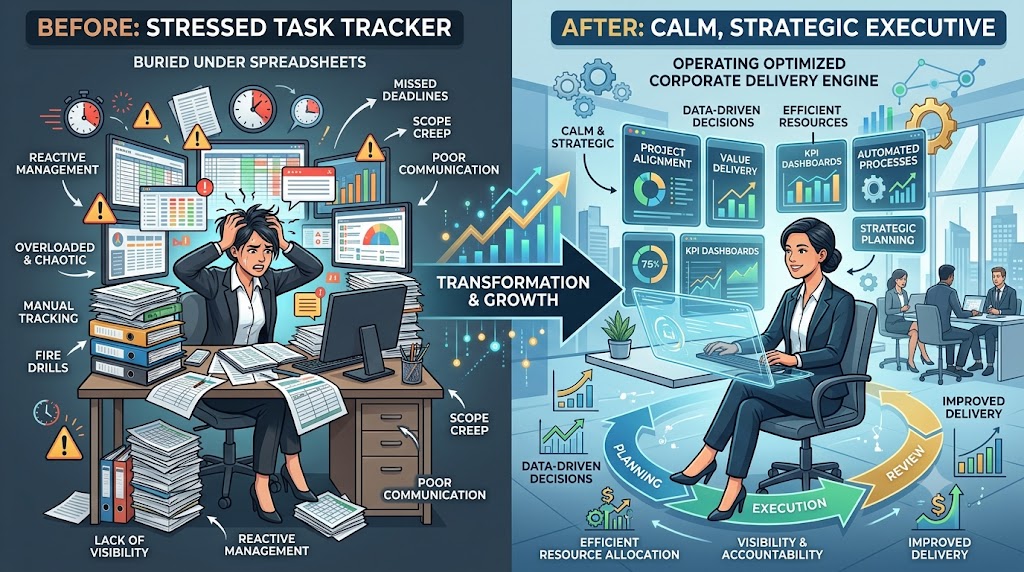
Transitioning from a traditional, reactive project management approach to an advanced, hyper-efficient Lean operational model requires more than reading theory. It demands a fundamental re-engineering of your professional capabilities, your structural mindsets, and your tactical execution playbooks.
The corporate landscape has little room for individuals who merely guess their way through complex delivery crises or rely on generic methodologies that guarantee project bloat.
If you are ready to stop guessing, move up the corporate ladder, and learn project management the right way, reach out to Skillsetify. We do not just teach frameworks: we show you your exact career growth trajectory. Our elite training programs provide the deep, metrics-driven toolsets and practical execution strategies you need to master digital environments, optimize engineering systems, and deliver exceptional corporate value.
Connect with Skillsetify today to secure your competitive advantage and accelerate your leadership trajectory.