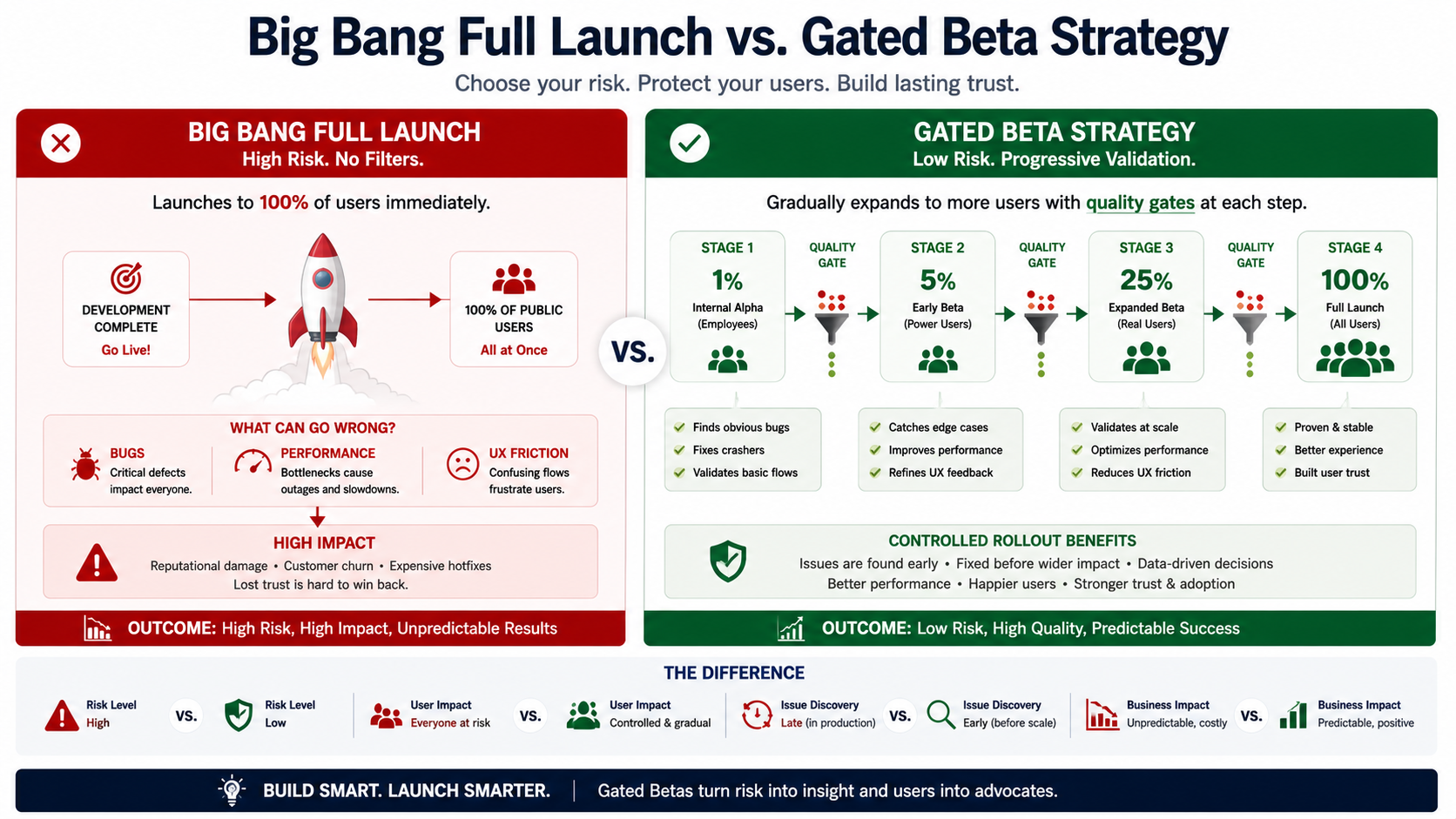
Why Full Launching Your Product Without a Beta Release Is Corporate Suicide
It is 8:00 AM on a Tuesday. After eighteen months of secretive, high-budget development, your enterprise software platform is finally live. Millions of dollars in marketing campaigns have been spent, press releases are out, and your CEO has hyped the launch on public media.
By 10:00 AM, customer support queues are overwhelmed. Real users are triggering edge-case database deadlocks that internal testing missed. The authentication gateway is crashing under enterprise firewall configurations, and users are taking to public channels to highlight broken workflows.
By 2:00 PM, the product release is paused. The marketing splash has turned into an executive public relations disaster, and engineering teams are facing burnout as they try to patch code in production.
This corporate catastrophe plays out across tech organizations regularly. A dangerously persistent corporate myth claims that elite organizations should keep products hidden until they are 100% complete, launching them with a massive, full-scale reveal to maximize market impact.
In reality, going straight to a full launch without a controlled beta release is pure gambling. Every successful digital product relies on a progression through distinct lifecycle stages: from bare-bones functional skeletons to controlled beta cohorts: before ever attempting a full-market rollout.
The Strategic Choice: Full Launch vs. Beta Version
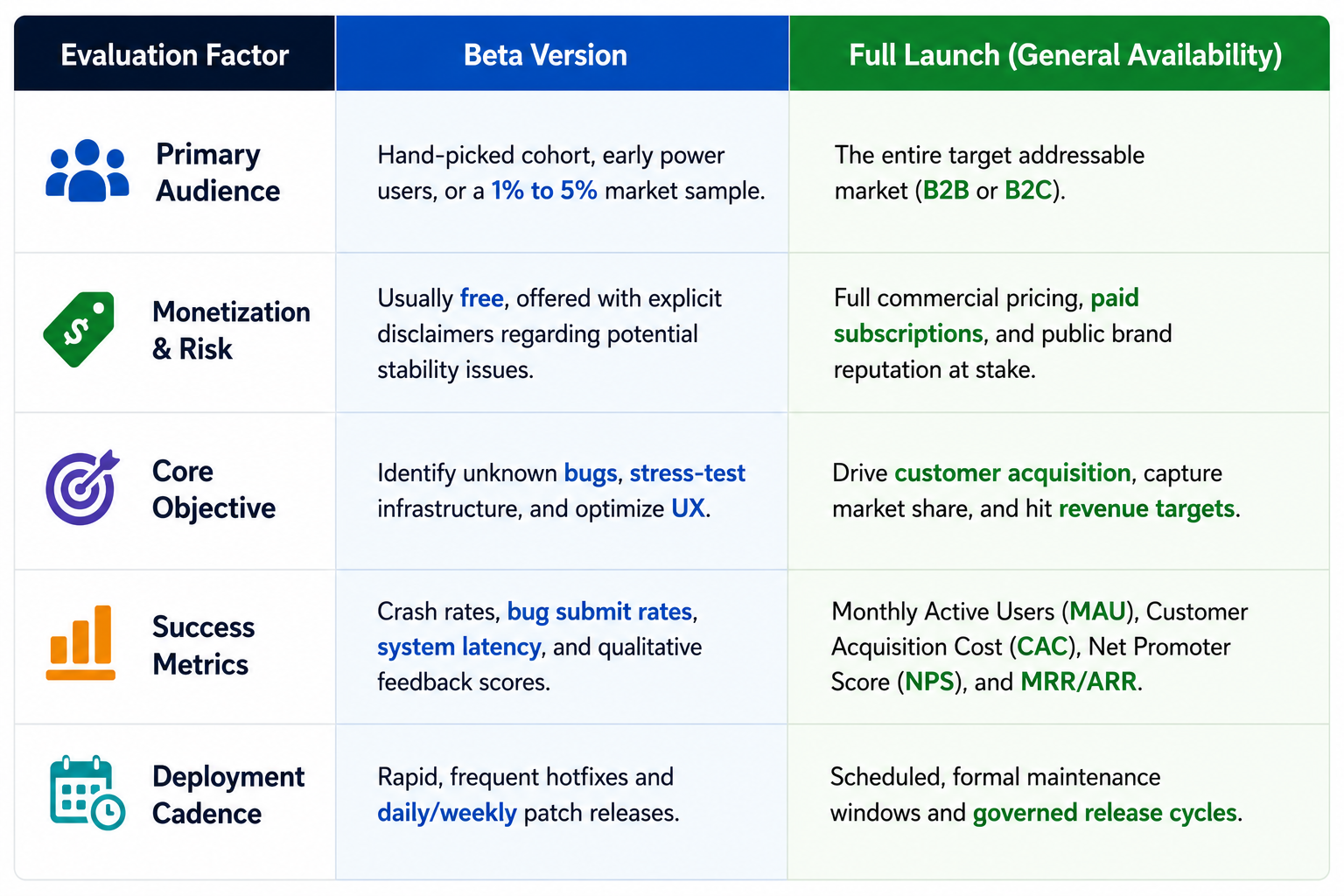
Understanding the distinction between a Beta Version and a Full Launch (General Availability) is not just a technical detail: it is a core business risk management framework.
What Is a Beta Version?
A beta release represents a stable, near-complete product deployment delivered to a selective, targeted cohort of real users. While the core system features and architecture are functionally complete, the beta phase is explicitly designed to operate as a live stress test.
The primary goals of a beta version include:
Edge-Case Discovery: Exposing the application to diverse real-world environments, hardware configurations, and network conditions that internal Quality Assurance (QA) cannot replicate.
Operational & Infrastructure Validation: Testing system scalability, database indexing, and API rate limits under actual concurrent user patterns.
Qualitative Feedback Loops: Collecting actionable usability insights directly from target consumers to refine UI flows and workflow nuances.
What Is a Full Launch (General Availability)?
A full launch, or General Availability (GA), is the unrestricted commercial deployment of a fully featured, fully optimized product to the broader market. At this stage, the product is fully backed by public marketing campaigns, strict Service Level Agreements (SLAs), dedicated customer support operations, and formal revenue expectations.
The Evolution of the Product Lifecycle
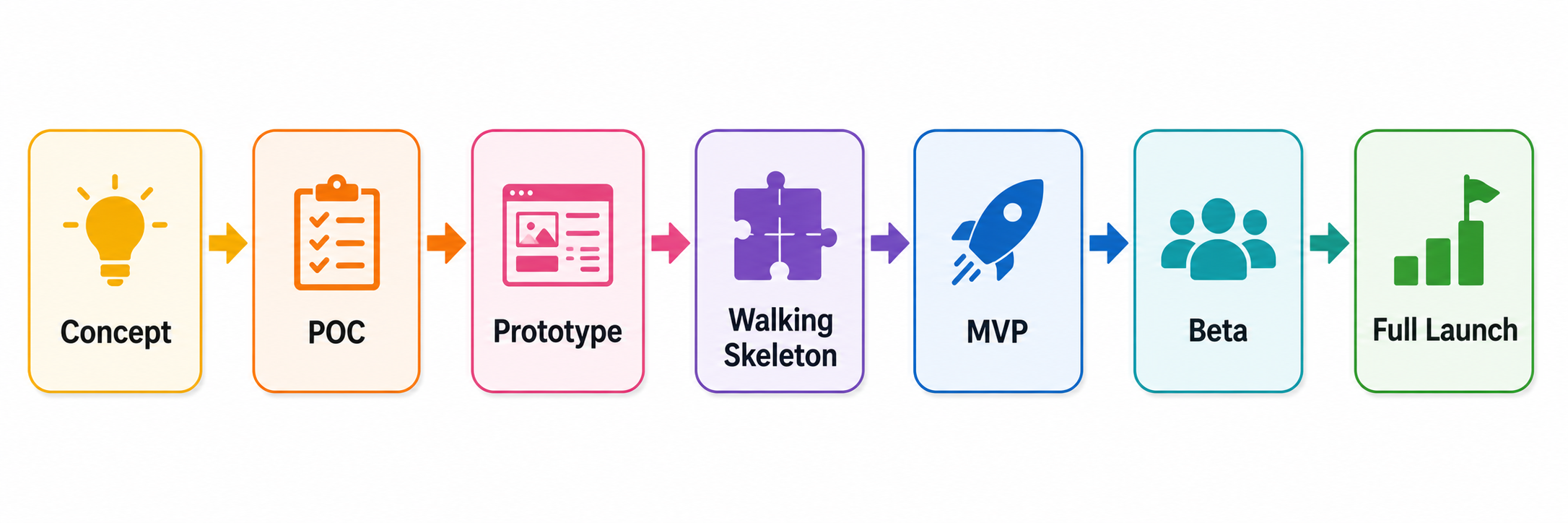
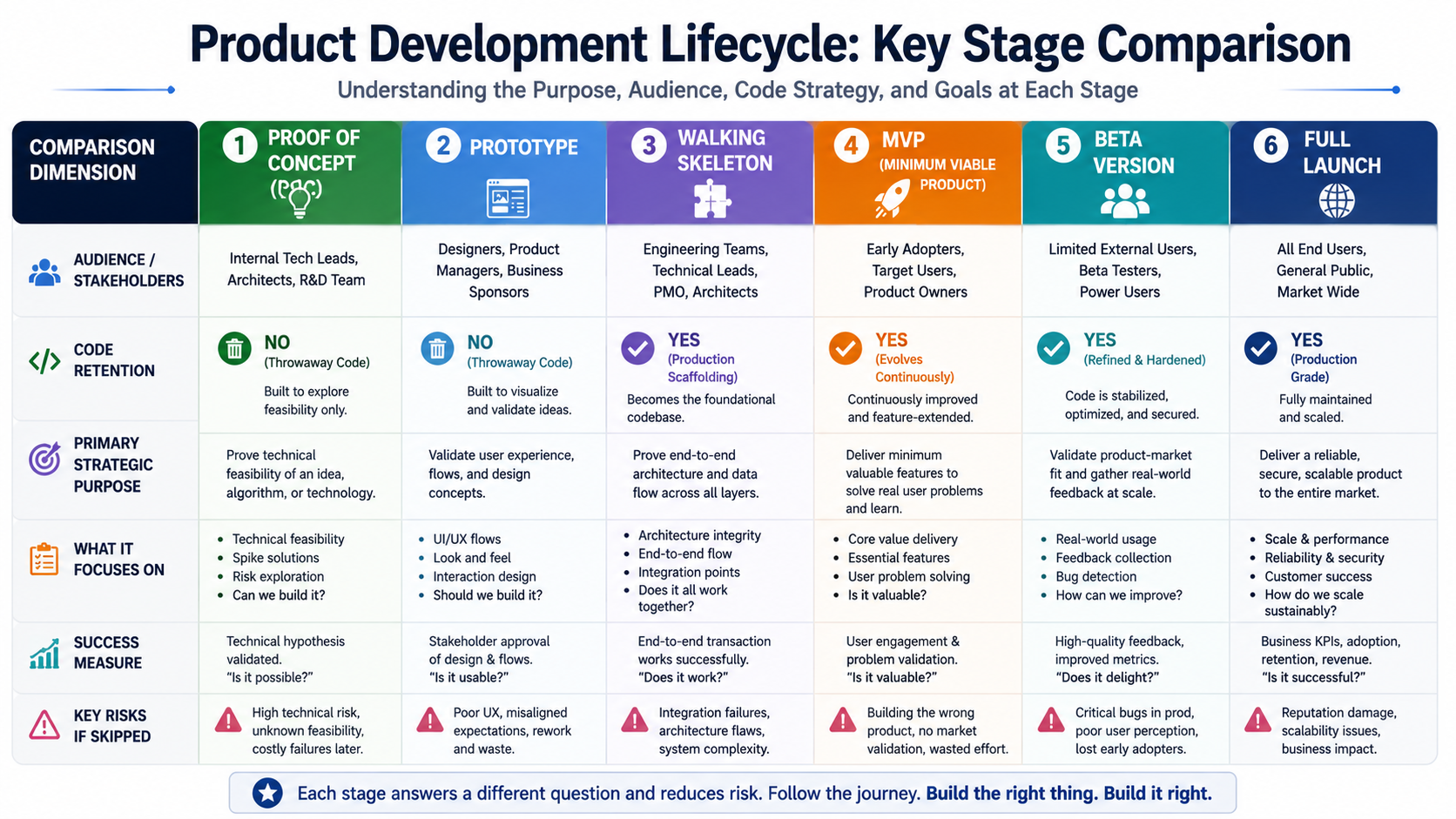
To place Beta releases in their proper strategic context, project leaders must master the full product development continuum:
Proof of Concept (POC): A small-scale lab test to verify basic technical feasibility.
Prototype: A visual or interactive design framework used to test user flows and gather early feedback.
Walking Skeleton: A bare-bones, end-to-end operational structure connecting every architectural tier (UI, API, Auth, Database) to prove system connectivity over visual design.
Minimum Viable Product (MVP): A basic product with core features released to early adopters to capture feedback and validate market demand.
Beta Version: A feature-complete, near-final product deployed to a controlled user sample to resolve final stability issues and edge-case bugs.
Full Feature Product (GA): The complete, enterprise-ready product launched for full public adoption.
The Comparative Framework: Beta vs. Full Launch
Step-by-Step Implementation Framework for Project Leaders
Transitioning a product from an internal build or Walking Skeleton into a controlled beta and eventually a full launch requires structured governance. Follow this five-phase framework to manage risk and protect your brand reputation.

Phase 1: Define Strict Entry and Exit Criteria
Do not start a beta testing program simply because a deadline arrives. Establish formal governance gates:
Beta Entry Criteria (Definition of Ready for Beta): System must pass all automated security audits, complete end-to-end integration testing, demonstrate a functional Walking Skeleton architecture, and achieve zero critical (P0/P1) open defects.
Beta Exit Criteria (Definition of Done for GA): Zero P0/P1 bugs, system latency below SLA targets under peak load, 99.9% uptime across the beta phase, and formal sign-offs from Legal, Compliance, and Security teams.
Phase 2: Select and Onboard Targeted Cohorts
Avoid opening the floodgates immediately. Segment your beta participants into controlled tiers:
Closed Beta (Cohort 1): Hand-pick trusted power users, key accounts, or internal employee groups who understand the product is in testing and will provide detailed qualitative feedback.
Open Beta (Cohort 2): Expand access to a broader sample (for example, 5% to 10% of sign-ups) to test infrastructure under higher load.
Clear Disclaimers: Apply subtle visual watermarks or UI banners indicating the product is in Beta to manage user expectations.
Phase 3: Instrument Telemetry and Feedback Loops
Relying solely on user-submitted support tickets is a mistake. Implement real-time system monitoring:
Automated Error Tracking: Integrate tools like Sentry or Datadog to capture unhandled exceptions and backend API failures automatically.
In-App Feedback Channels: Build embedded feedback widgets allowing beta users to log bugs or submit UX suggestions without leaving their active workflow.
Usage Analytics: Track user drop-off points to identify friction in core user journeys.
Phase 4: Execute Iterative Hardening
Use the insights gathered during beta testing to execute target bug-fixing and performance optimization cycles. Treat the beta period as a “hardening iteration”: an intentional buffer phase designed to fix defects, complete security reviews, and polish code before full deployment.
Phase 5: Execute a Staged Rollout to General Availability
When launching to the general public, replace “Big Bang” deployments with progressive traffic allocation (Feature Flagging or Canary Releases):
Day 1: Direct 5% of production traffic to the new platform. Monitor server load, error rates, and database performance.
Day 3: Expand traffic to 25% if health metrics remain stable.
Day 7: Scale to 100% full market availability, initiating major public marketing and sales efforts.

From High-Stakes Launches to Predictable, Elite Delivery
Shifting from chaotic “Big Bang” releases to a controlled, stage-gated launch framework changes the operational health of your team and your career trajectory.
When you implement beta phases and progressive rollouts, launch day stops being a high-stress event. You eliminate panic, prevent post-launch fire drills, and safeguard your engineering team from burnout. Progress is no longer measured by arbitrary launch deadlines, but by validated operational metrics and system resilience.
Learning project and product management the right way means managing risk before it turns into a public failure. When you demonstrate the ability to safeguard corporate capital, protect brand reputation, and ensure smooth product rollouts, executive leadership views you as an indispensable delivery leader.
Transform Your Strategic Leadership with Skillsetify
If you are ready to stop guessing, move up the corporate ladder, and learn project management the right way, reach out to Skillsetify. We do not just teach frameworks: we show you your exact career growth trajectory.
Mastering product lifecycle execution, beta release management, and enterprise governance is the fastest way to step into executive project leadership positions. Contact Skillsetify today to elevate your skills, lead complex product initiatives, and command authority in every stage of delivery.