Why Confusing "Software Sunsetting" with "Hardware Decommissioning" Is Crippling Enterprise IT Projects
Imagine this scenario: It is 2:00 AM on a Sunday. Your enterprise monitoring dashboard explodes with critical alerts. A major customer billing portal has gone completely dark. Executive leadership is blowing up your phone demanding answers, and your SLA clock is ticking toward a multi-million-dollar penalty.
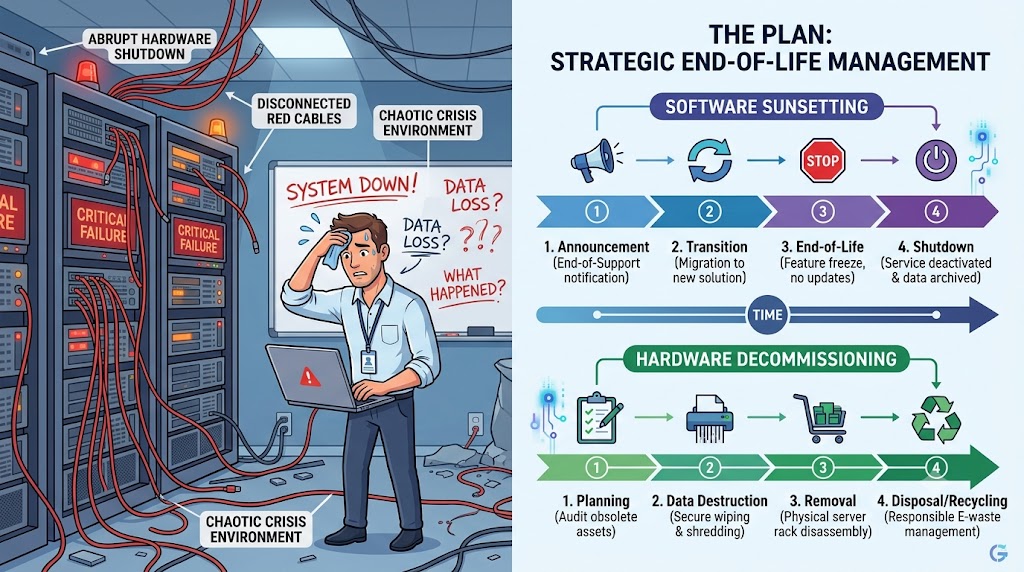
The root cause? A junior infrastructure engineer received a system ticket to “decommission the legacy host server.” Following orders, he unclipped the network cables and powered down the physical rack in the corporate data center.
The fatal flaw in this execution? The legacy software running on that rack was supposed to undergo a six-month phased sunsetting strategy. Client API integrations were never redirected, active databases were not backed up, and legal data retention schedules were completely ignored.
This exact chaos plays out in mid-size and enterprise corporations every single day. A pervasive corporate myth persists across IT departments: that “sunsetting” software and “decommissioning” hardware are merely interchangeable synonyms for turning something off. Believing this myth costs organizations millions in phantom cloud charges, catastrophic compliance penalties, and unrecoverable operational downtime.
Understanding the Mechanics: Sunset vs. Decommission
To master product lifecycle management, enterprise project managers must treat software sunsetting and hardware decommissioning as two distinct, highly synchronized disciplines within the final stages of the Product Life Cycle.
What is Software Sunsetting?
Software sunsetting is the deliberate, phase-by-phase retirement of a software application, platform, or feature set. Sunsetting is fundamentally a strategic software governance process focused on user experience, data integrity, business operations, and system dependencies.
When an enterprise decides to sunset an application, the software is not abruptly erased. Instead, project managers execute a multi-tier phase-out schedule:
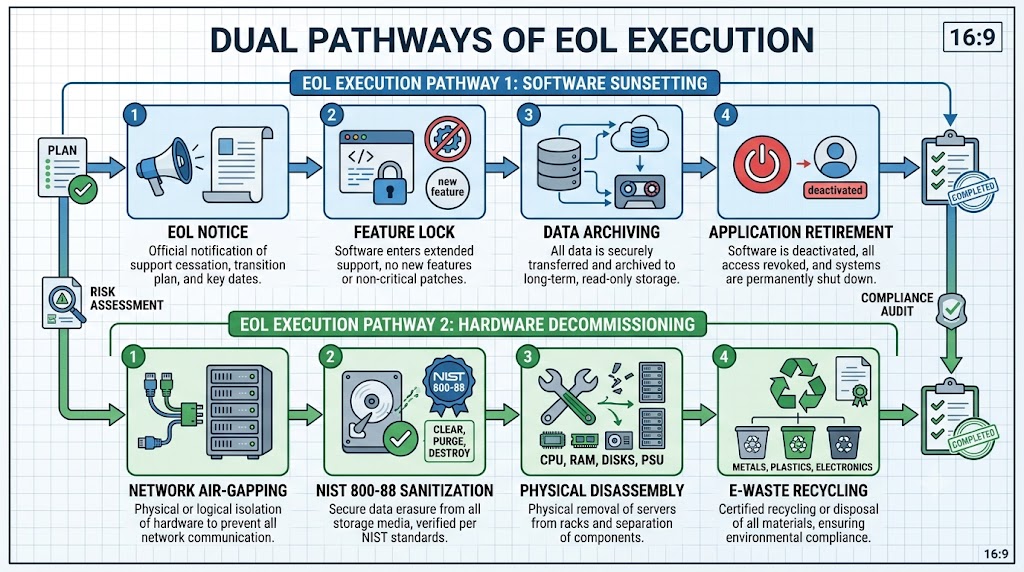
Feature Lock & Deprecation Announcement: Halting all active feature development and issuing formal End-of-Life (EOL) notices to internal users, external clients, and downstream system owners.
Read-Only & Maintenance State: Restricting data write permissions across the system to prevent fresh transaction entries while keeping historical records accessible for business reporting.
Data Extraction & Archiving: Extracting legacy application databases into cold storage or secure data lakes to satisfy regulatory compliance rules, such as GDPR, HIPAA, or SOC 2 data retention schedules (which frequently mandate keeping records for 7 to 10 years).
Interface & Service Retirement: Terminating API endpoints, cutting off front-end user interface logins, and unbinding background microservices.
What is Hardware Decommissioning?
Hardware decommissioning is the physical or infrastructure-level teardown of physical servers, storage arrays, networking hardware, or virtual cloud infrastructure hosting the software. While sunsetting governs application logic, workflows, and user data access, decommissioning governs copper, silicon, physical rack space, and underlying cloud compute units.
The mechanics of decommissioning focus heavily on physical asset security, risk mitigation, and financial cost recovery:
Resource Isolation & Air-Gapping: Disconnecting physical servers from corporate network backbones to ensure no hidden network dependencies or orphan scripts are running on the host hardware.
Certified Data Sanitization: Overwriting storage drives, demagnetizing magnetic media through degaussing, or physically shredding hard drives in strict compliance with NIST SP 800-88 guidelines.
Hardware Extraction & Rack Disassembly: Unmounting physical server blades, logging hardware serial numbers in enterprise asset management tools, and reclaiming data center floor space.
Eco-Friendly E-Waste Disposal: Partnering with certified e-waste recycling vendors to dispose of physical materials in adherence with environmental sustainability policies.
The Core Differentiators: Software vs. Hardware EOL
To lead software retirement and physical infrastructure teardown effectively, project managers must understand how these two processes contrast across critical operational vectors:
| Operational Vector | Software Sunsetting | Hardware Decommissioning |
| Primary Focus | User experience, application dependencies, data retention | Physical silicon assets, media destruction, rack space |
| Execution Horizon | Phased over 6 to 18 months | Executed in days to weeks following software retirement |
| Primary Risks | Broken API connections, workflow disruption, compliance fines | Physical security breaches, un-sanitized storage, phantom cloud bills |
| Key Stakeholders | Product Owners, Solution Architects, Compliance Officers, End Users | Infrastructure Leads, Datacenter Ops, Security Officers, E-Waste Vendors |
| Success Metric | Zero user disruption, complete data archive migration | 100% media destruction certification, updated asset registries |
Step-by-Step Implementation Framework for Project Managers
Executing a combined software sunsetting and hardware decommissioning project requires a disciplined, four-phase implementation blueprint that guarantees zero business disruption.
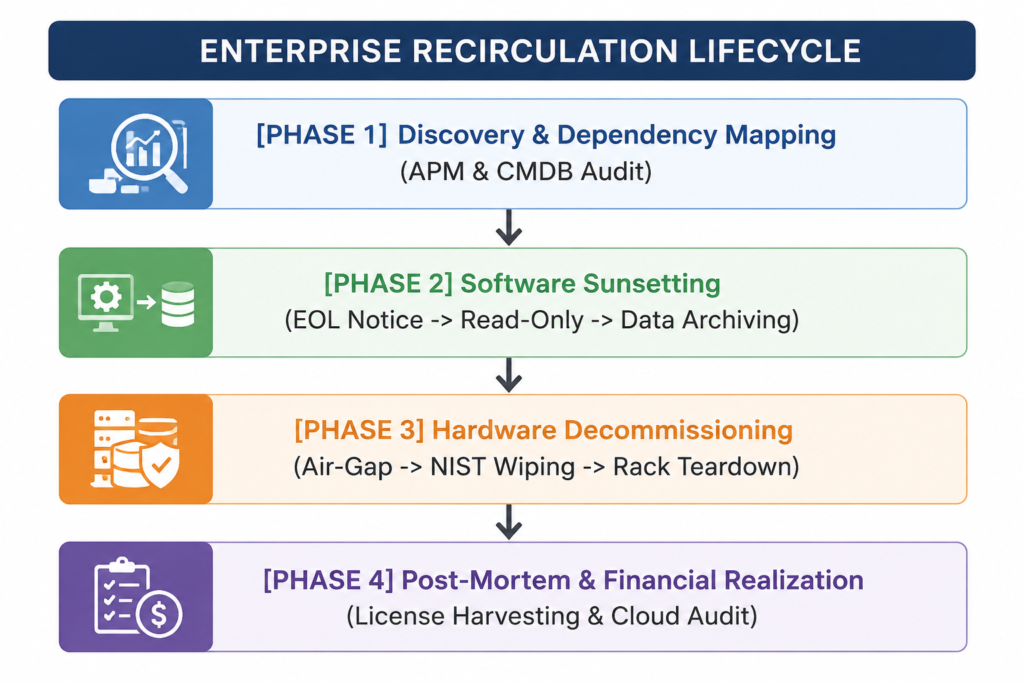
Phase 1: Discovery and Dependency Mapping
Audit Application Portfolio Management (APM) Systems: Catalog every downstream system, internal team, external customer, and automated API integration connecting to the software scheduled for retirement.
Audit Configuration Management Databases (CMDB): Map the software application directly to its host physical servers, storage LUNs, network switches, or cloud virtual machine instances.
Establish Legal and Compliance Baselines: Consult legal and risk teams to define mandatory data retention windows, security auditing parameters, and privacy regulations.
Phase 2: The Sunsetting Protocol (Software Phasing)
Issue the Official EOL Cascade: Publish a transparent communication schedule to all users. Establish clear milestone dates: T-180 days for final EOL announcement, T-90 days for new feature lock, T-30 days for read-only transition, and T-0 for application shutdown.
Institute Rate-Limiting and Deprecation Flags: Implement soft rate-limiting on legacy API calls to actively encourage third-party developers to migrate their systems to modern alternative endpoints.
Transition to Read-Only Architecture: Lock user write access, create static database snapshots, and execute ETL (Extract, Transform, Load) routines to shift historical records into long-term cold archives or data lakes.
Final Application Unbinding: Terminate runtime application servers, dismantle front-end web domains, and invalidate authentication tokens.
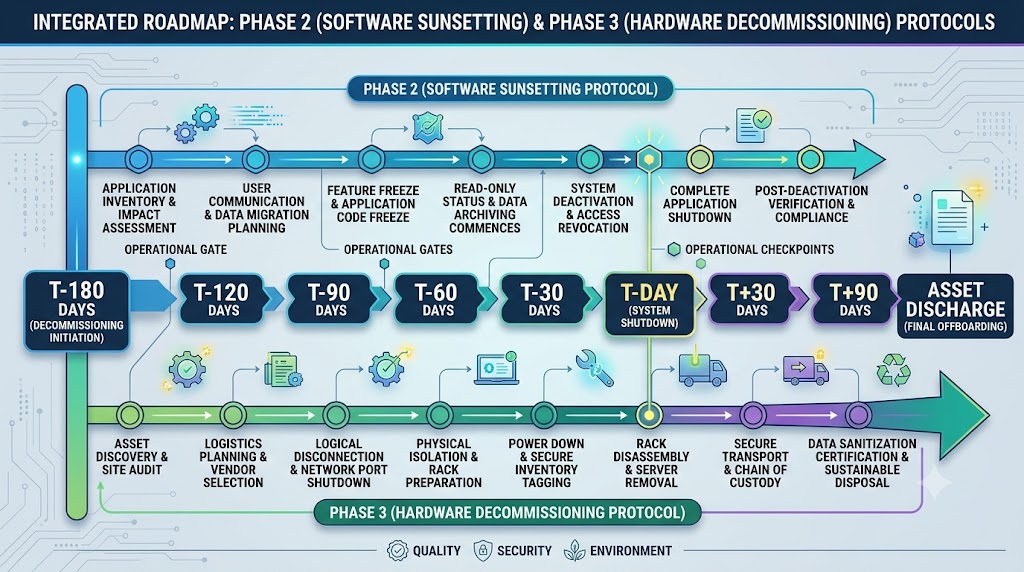
Phase 3: The Decommissioning Protocol (Hardware Execution)
Enforce Network Air-Gapping: Disconnect physical network interfaces or remove cloud Virtual Private Cloud (VPC) attachments. Keep the isolated infrastructure powered on for a 72-hour observation window to confirm no orphaned enterprise services fail.
Execute Certified Data Sanitization: Perform multi-pass drive overwriting or physical media destruction according to NIST SP 800-88 guidelines. Collect official Certificates of Data Destruction for risk defense records.
Execute Physical Teardown and Asset Logging: Unmount physical server blades, remove cabling, and update CMDB records to reflect retired status. Hand physical equipment over to certified e-waste vendors or corporate hardware refurbishment teams.
Phase 4: Post-Mortem and Financial Realization
License Harvesting: Cancel legacy software maintenance contracts, enterprise user licenses, and third-party vendor support SLAs to stop recurring software expenses.
Infrastructure Cost Recovery: Terminate unneeded cloud tenant subscriptions, reallocate physical data center rack space, and eliminate unnecessary HVAC power draws.
Final Governance Sign-Off: Package data retention manifests, legal archiving confirmations, and hardware destruction certificates into a master audit report for executive leadership.
Shifting From Firefighting Chaos to Strategic Lifecycle Mastery
When a project manager masters the synchronization of software sunsetting and hardware decommissioning, the operational reality of the organization changes dramatically. You eliminate frantic weekend outage calls, eliminate unexpected legal compliance fines, and stop phantom cloud infrastructure costs from draining corporate budgets.
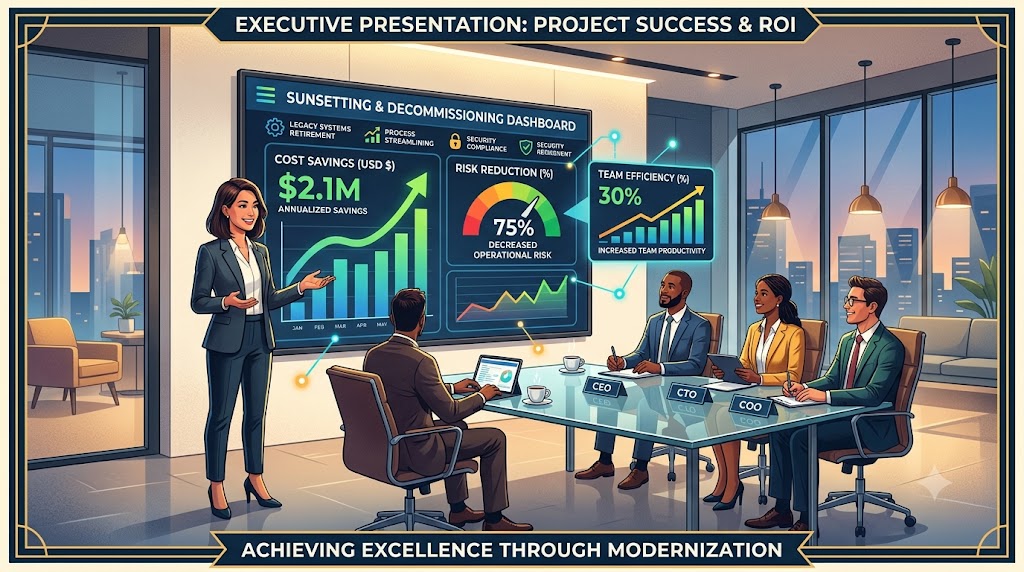
Instead of reacting to chaos, you deliver predictable, secure, and cost-effective outcomes. Enterprise executives stop viewing you as a basic task tracker who merely forwards updates. They begin seeing you as a strategic leader who actively mitigates business risk, enforces institutional compliance, and frees up capital for future digital innovation. Mastering the final stages of the product life cycle is one of the clearest paths to transforming your reputation from an entry-level coordinator into an elite enterprise leader.
Master Enterprise Project Leadership with Skillsetify
Executing a flawless software sunsetting initiative alongside a physical hardware decommissioning strategy demands elite structural thinking, deep governance knowledge, and cross-functional leadership skills. In today’s competitive corporate landscape, reading standard textbooks is not enough to stand out. You need real-world, battle-tested project methodologies that drive measurable business impact.
If you are ready to stop guessing, move up the corporate ladder, and learn project management the right way, reach out to Skillsetify. We do not just teach frameworks: we show you your exact career growth trajectory.