Why Prototyping is Your Only Shield Against Product Failure
It is 6:00 PM on a Thursday, and an enterprise software rollout is hours away from launch. The executive sponsor clicks through the brand-new client portal that took eight months and $1.5 million to build. Within three minutes, complete silence fills the room.
The user interface is a labyrinth. Key approval workflows require fourteen manual clicks across three separate browser tabs. What made complete sense in a 100-page Functional Requirements Document (FRD) is practically unusable in practice.
The project manager faces an agonizing choice: launch a product that will frustrate enterprise clients from day one, or halt the deployment and explain to C-suite executives why engineering needs another six months of expensive rework.
This nightmare scenario plays out in corporate boardrooms every single day. The root cause is rarely incompetent developers or faulty technology stacks. It is a fundamental misunderstanding of how complex ideas must be validated before production begins.
The Corporate Myth: “Prototyping is an unnecessary design luxury that delays our time-to-market. We already have detailed documentation, so engineers should jump straight to production code.
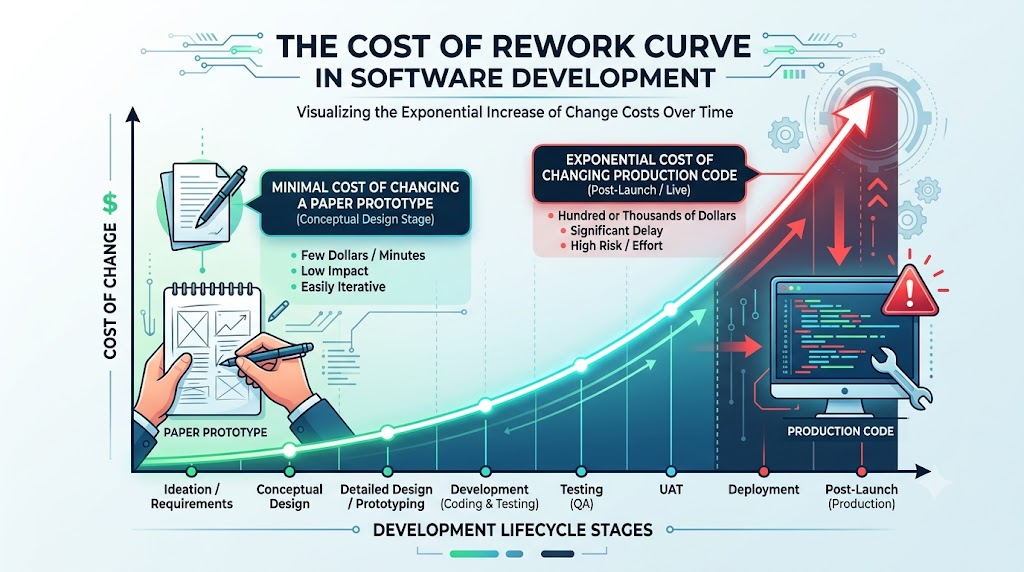
The Corporate Reality: Skipping prototyping does not save time: it merely delays your rework until it is at its most expensive. Building software based on static text documents creates “digital ghosts”: fully coded applications that meet specs perfectly on paper but fail completely in the hands of real human users. Prototyping is not design fluff. It is low-cost insurance against catastrophic engineering waste.
Deconstructing Prototyping Within the Product Life Cycle
To lead modern initiatives effectively, project leaders must understand where prototyping fits within the overarching product life cycle. Every digital product begins with an idea. That idea evolves into a business case to evaluate financial viability and technical feasibility. However, before committing significant engineering capital to a full-scale build, organizations must visually and functionally validate their concepts.
Prototyping is the practice of bringing an idea to life visually and functionally through sketches, wireframes, or interactive digital models to gather early user feedback. It bridges the gap between abstract requirements and real-world user experiences long before production code is written.
The Validation Spectrum: POC vs. Prototype vs. MVP
Misclassifying early-stage artifacts leads to mismatched stakeholder expectations and misallocated budgets. Project managers must clearly distinguish between these critical development stages:
Proof of Concept (POC): A small, internal technical test designed to answer one specific question: Is this technically feasible? A POC validates backend feasibility (e.g., testing whether an API can process thousands of transactions per second) without focusing on UI or user workflows.
Prototype: A visual and functional model created to answer the question: How will the user interact with this? It tests design logic, user journeys, and usability through interactive flows, ranging from paper sketches to rich clickable wireframes.
Walking Skeleton: An end-to-end architectural implementation featuring bare-bones functionality. It connects all core system layers (database, API, front-end) to prove the system architecture functions end-to-end before adding feature depth or UI polish.
Minimum Viable Product (MVP): A functional version of the product containing basic meat and skin on the skeleton, launched to real market users to generate value, gather usage analytics, and validate market demand.
Choosing the Right Prototype Fidelity
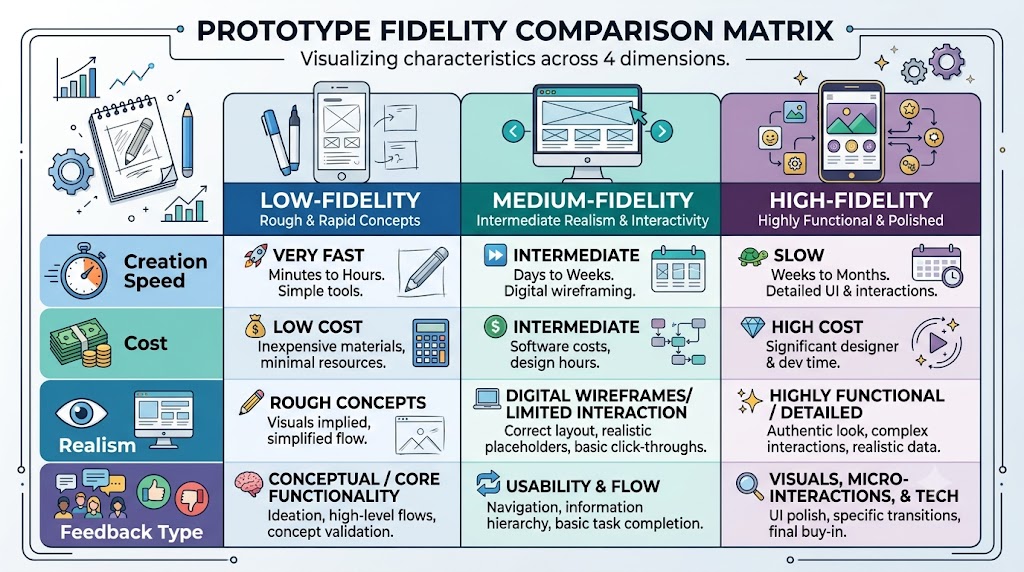
Not all prototypes serve the same purpose. Selecting the appropriate fidelity level ensures you gather actionable feedback without wasting design resources.
| Prototype Level | Form Factor | Primary Objective | Best Used For |
| Low-Fidelity (Lo-Fi) | Paper sketches, index cards, rough wireframes | Rapid ideation, layout testing, conceptual architecture | Initial discovery meetings and early stakeholder brainstorming |
| Medium-Fidelity (Med-Fi) | Clickable wireframes (e.g., Figma, Balsamiq) with grey-box styling | Information architecture, navigation logic, user flow verification | Sprint Zero and early product backlog refinement |
| High-Fidelity (Hi-Fi) | Pixel-perfect interactive UI designs with micro-interactions | Simulating realistic end-user experience, testing brand visual appeal | Rigorous usability testing and executive sign-off before coding |
The PM's 5-Step Prototyping Implementation Blueprint
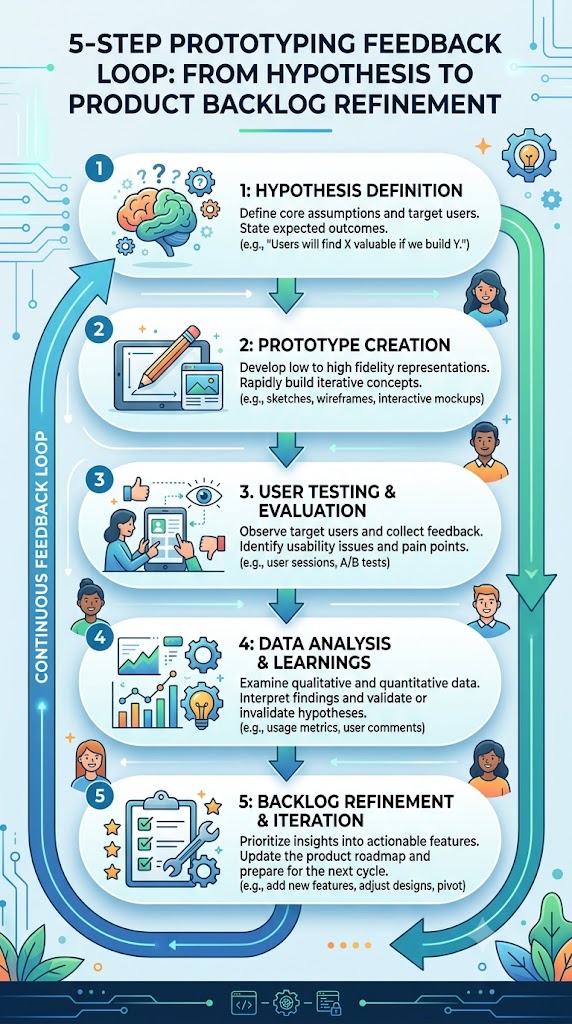
To transform prototyping from an ad-hoc design task into a repeatable project management capability, implement this structured five-step framework across your development cycles.
Step 1: Formulate Explicit Test Hypotheses
Never build a prototype without defining what you are trying to learn. Establish quantitative and qualitative hypotheses prior to design work.
Vague Objective: “Let us see if customers like the new analytics dashboard.”
Actionable Hypothesis: “Operations managers can generate a custom monthly audit report in under 30 seconds using our new filter workflow.”
Step 2: Match Fidelity to the Testing Goal
Select the lowest fidelity required to test your specific hypothesis. If you are validating high-level navigation hierarchy, do not spend two weeks polishing visual styling. Use grey-box wireframes. Conversely, if you are testing user confidence during a complex financial transaction flow, invest in a high-fidelity prototype that feels completely authentic.
Step 3: Execute Time-Boxed Design Sprints
Integrate prototyping directly into your Agile planning cadence. Conduct three- to five-day design sprints where cross-functional team members (product managers, UX designers, lead developers) collaboratively sketch, decide, and prototype core flows. Time-boxing prevents endless aesthetic tweaking and keeps teams focused on core user value.
Step 4: Conduct Structured Usability Testing
Place the prototype into the hands of 5 to 8 target users. Industry consensus confirms that testing with just five representative users uncovers up to 85 percent of core usability defects.
Observe Behavior: Watch where users hesitate, click incorrectly, or express frustration. Do not guide them through the task.
Think-Aloud Protocol: Ask participants to verbalize their thought process as they navigate through the interactive model.
Step 5: Synthesize Feedback into Backlog User Stories
Categorize feedback into usability adjustments, technical constraints, and missing feature requirements. Translate these insights directly into refined user stories within your product backlog. Define clear Definition of Ready (DoR) criteria (entry criteria) and Definition of Done (DoD) parameters (exit criteria) based on validated user expectations.
From Chaotic Firefighting to Predictable Delivery Excellence
Imagine leading a project environment where late-stage engineering surprises completely disappear. When visual and functional prototyping becomes standard practice in your product life cycle, the dynamic across your organization transforms immediately.
For Development Teams: Engineers receive validated, unambiguous specifications. They stop guessing user intent and no longer waste cycles writing code for features that get scrapped three weeks later.
For Executive Leadership: Sponsors see, feel, and approve real interactive designs weeks before major capital expenditure budgets are unlocked, driving total strategic alignment.
For Project Managers: Scope creep plunges dramatically because workflow bottlenecks and missing requirements are uncovered when changes cost pennies, not thousands of dollars in emergency engineering rework.
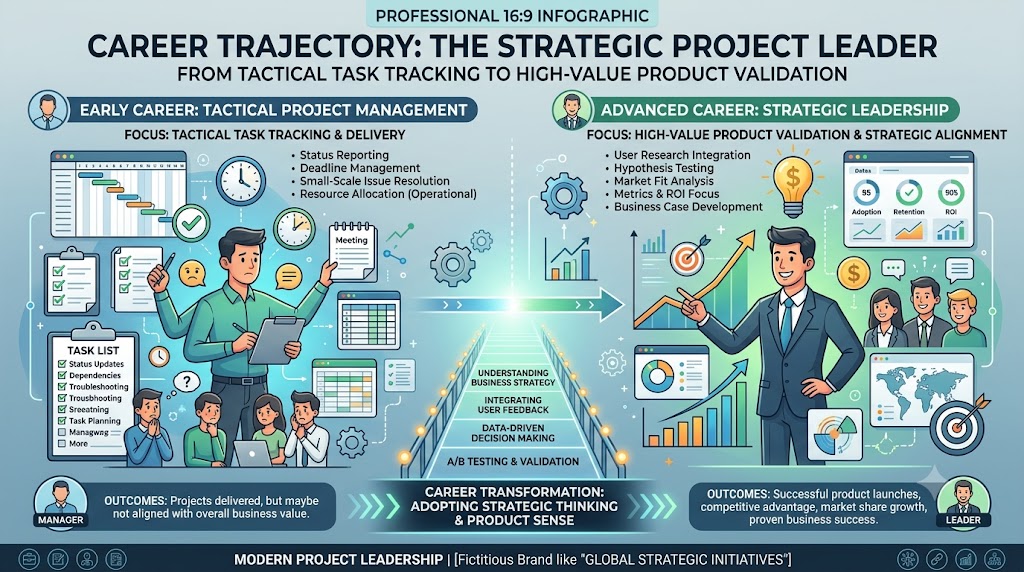
Mastering early-stage validation elevates your standing as a project leader. You transition from a tactical task tracker who merely updates schedules into a strategic product leader who shapes successful business outcomes. You become the go-to professional known for delivering complex enterprise initiatives on time, under budget, and with high end-user adoption.
Elevate Your Project Leadership with Skillsetify
Great product delivery is not an accident: it is the result of applying elite frameworks at every stage of the life cycle. Prototyping is just one critical piece of a modern project leader’s toolkit. To thrive in today’s complex corporate environment, you need complete mastery over strategic portfolio planning, Agile governance, and risk management.
If you are ready to stop guessing, move up the corporate ladder, and learn project management the right way, reach out to Skillsetify. We do not just teach frameworks: we show you your exact career growth trajectory. Partner with Skillsetify today to master elite project management practices and transform your professional future.