Why Your Next Product Needs a Walking Skeleton First
Imagine a room packed with C-suite executives, product managers, and lead architects. Months of effort, hundreds of thousands of dollars, and dozens of high-fidelity Figma designs have led to this moment: the grand launch demo of the new flagship SaaS platform. The UI is drop-dead gorgeous. The typography is slick. The animations are buttery smooth.
The CEO leans forward, clicks “Complete Purchase,” and… the application freezes.
Behind that polished visual interface lies an architectural void. The payment gateway service cannot establish a secure handshake with the legacy database, the microservices API contracts are mismatched, and the deployment pipeline fails under basic load. You have spent months dressing up a ghost: a product that looks stunning on the outside but lacks the structural bones to perform the simplest end-to-end task.
This corporate catastrophe happens every single day in software and product development. A dangerously common corporate myth persists: teams should build product components in isolation, layer on polished designs early to please stakeholders, and worry about connecting the full technical system right before launch.
In reality, functionality and architecture must always take precedence over aesthetics. Every successful digital product requires a bare-bones, end-to-end operational product structure that focuses strictly on core system connectivity over visual design: a concept known as the Walking Skeleton.
The Core Mechanics of the Walking Skeleton
Coined by Agile pioneer Alistair Cockburn, a Walking Skeleton is a tiny, bare-bones implementation of a system that executes a single, small end-to-end function. It connects every main architectural tier: from the user interface down to the backend API, authentication layer, and database: but without any of the extra features, design polish, or complex business logic.
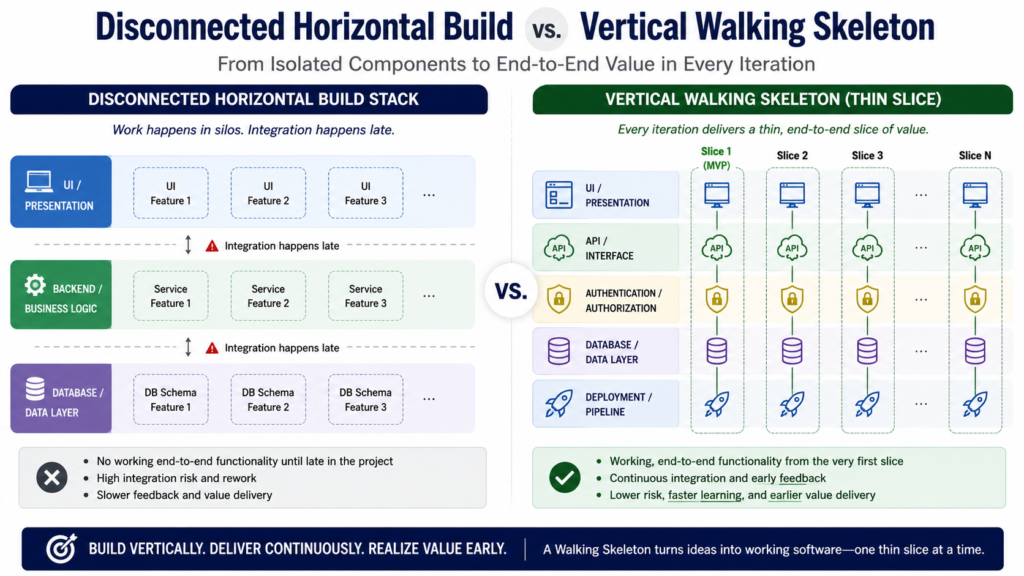
Think of it as a skeleton that can actually walk. It does not have skin, muscles, or styling yet, but its structural joints are permanently locked into place and functional.
Why the Walking Skeleton Changes Everything
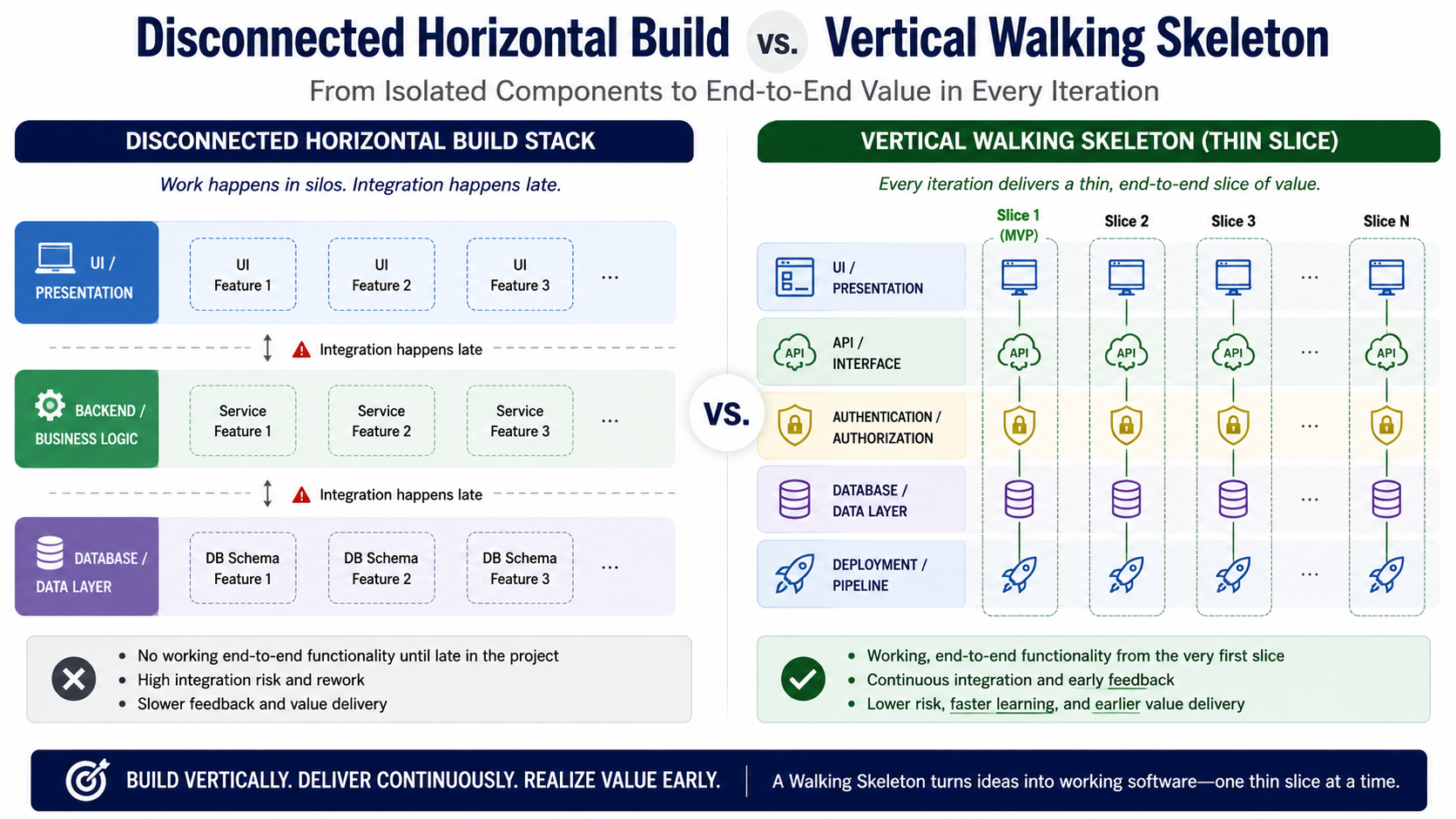
Traditional software development often falls into the trap of horizontal slicing. The frontend team spends six weeks building beautiful screens using dummy data. The backend team spends six weeks designing database schemas and endpoints. Neither team talks until week twelve, when they try to wire everything together. The result? Total integration collapse, unexpected architectural bottlenecks, and delayed launch dates.
The Walking Skeleton introduces thin vertical slicing. It forces engineering and product teams to connect the full plumbing of an application on day one.
It Proves Technical Feasibility Early: Instead of assuming third-party APIs, authentication protocols, and databases will talk to each other, you prove they can transmit real data instantly.
It Establishes the CI/CD Pipeline: A Walking Skeleton is built with real production coding standards and deployed through a live continuous integration/continuous deployment (CI/CD) pipeline. If you can deploy a bare-bones framework to a production environment during sprint one, deploying future features becomes routine.
It Eliminates “Last-Minute Integration” Panic: By integrating all system layers immediately, architectural misalignments and security bottlenecks surface when they are cheapest and easiest to fix.
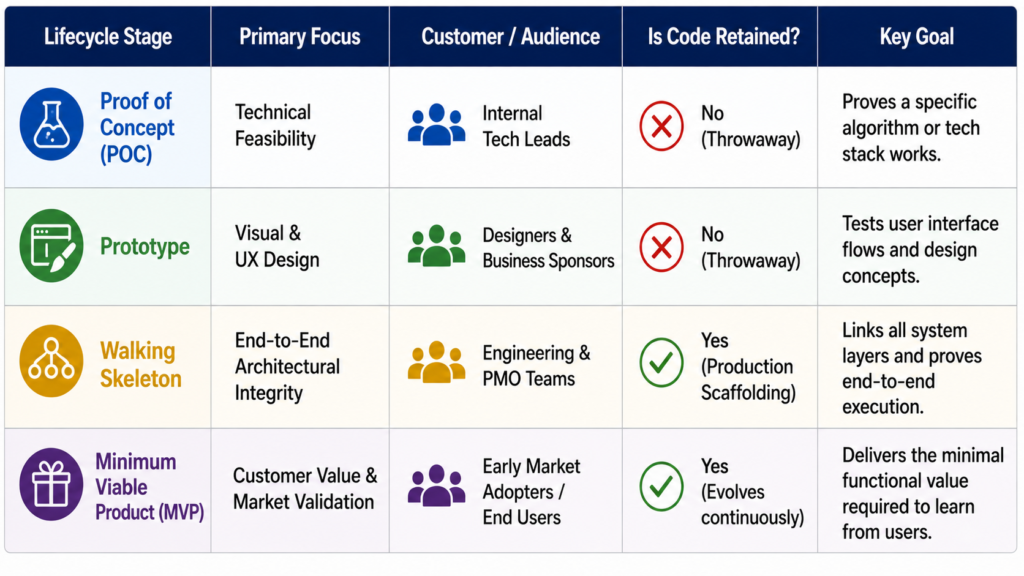
Walking Skeleton vs. POC vs. Prototype vs. MVP
To lead digital initiatives effectively, project managers must understand where the Walking Skeleton sits within the product evolution lifecycle:
Step-by-Step Implementation Framework for Project Leaders
Building a Walking Skeleton requires extreme restraint. The biggest temptation for engineering and design teams is to add “just one more feature” or polish a screen before the core architecture is verified.
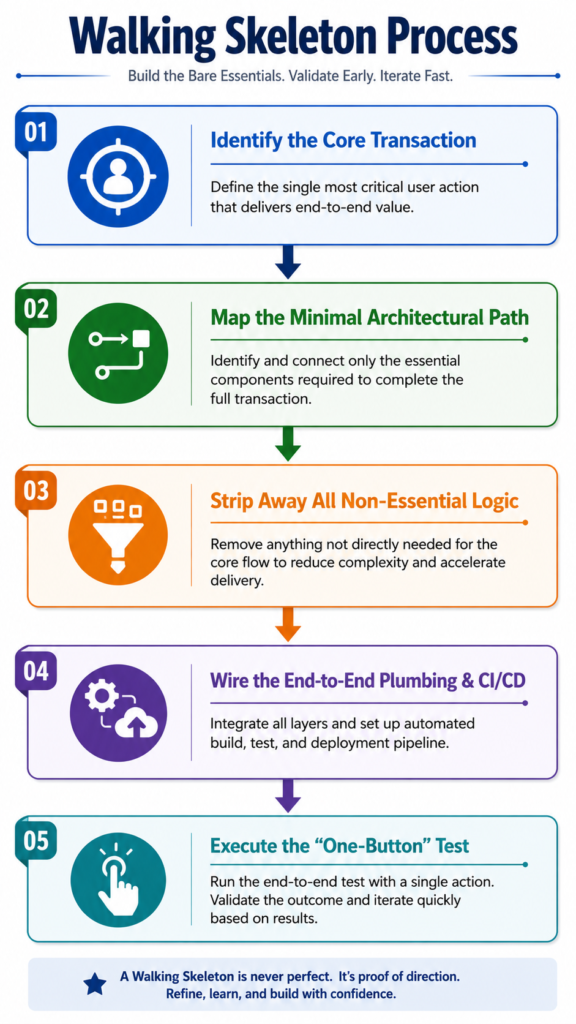
Use this repeatable five-step framework to execute a flawless Walking Skeleton in your next initiative.
Step 1: Identify the Single Core Transaction
Select the absolute minimum user flow that defines the core purpose of your system. Ask yourself: If this system could only perform one single action, what would it be?
E-Commerce App: A user clicks a button, a $1 transaction processes, and a order record appears in the database.
SaaS Analytics Tool: A raw CSV file uploads, passes through a parsing script, and updates a database dashboard count.
Healthcare Portal: A patient submits a form, and a record is created in the electronic health record (EHR) backend.
Step 2: Map the Minimal Architectural Path
Map out every architectural layer that this single transaction must touch:
Frontend Interface: Plain HTML or unstyled web/mobile view.
API Gateway / Middleware: One active endpoint routing requests.
Authentication Layer: Simple hardcoded or basic OAuth connection.
Database: A single table capable of receiving and reading data.
External Integrations: Mock or real sandbox connections to critical third-party APIs.
Step 3: Strip Away All Non-Essential Logic
Enforce strict boundaries. Strip out input validations, CSS styling, complex error states, user preferences, multi-role permissions, and secondary navigational links. If a element does not directly prevent the end-to-end signal from traveling from the UI to the database and back, remove it.
Step 4: Wire the End-to-End Plumbing & Deploy
Instruct developers to write real, production-quality code to connect the layers. Set up automated unit testing and a production-like cloud deployment pipeline immediately.
Step 5: Execute the "One-Button" Test
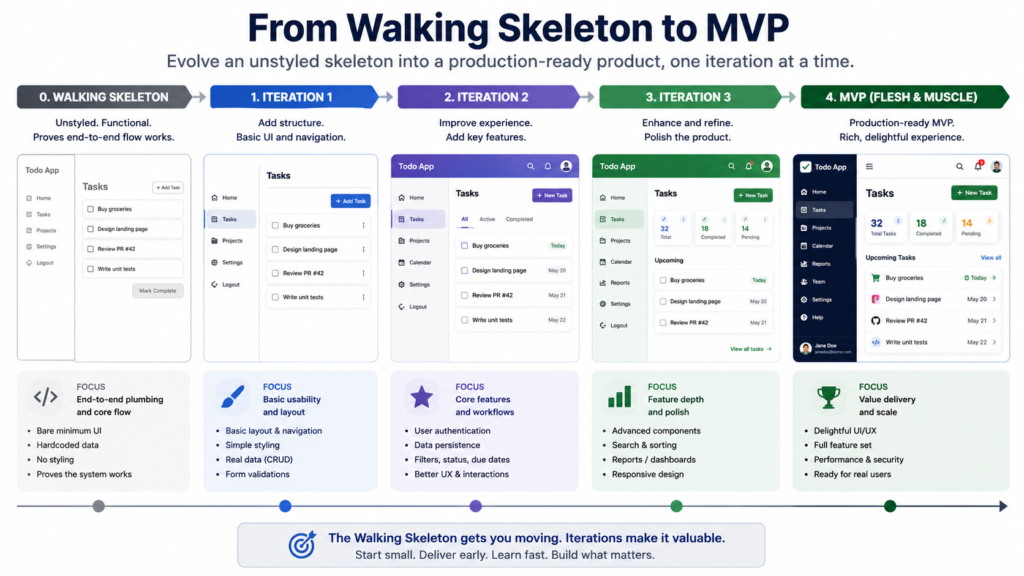
Test the system end-to-end. Click the unstyled frontend button. Verify that the request passes through the API, hits the authentication gate, updates the database, and returns a successful response message back to the screen. Once the skeleton “walks,” you have proven your system architecture. Now, you can safely begin layering on UX design, feature sets, and business logic iteration by iteration.
From Architectural Chaos to Predictable Delivery
When you implement the Walking Skeleton methodology, the entire dynamic of your product organization shifts.
You no longer suffer from phantom progress, where teams report being “90% done” based solely on isolated UI builds or backend models, only to spend months debugging during integration. Instead, your progress is measured by running, deployable code that works end-to-end from sprint one.
Scope creep is halted in its tracks because stakeholders can visually and functionally verify the core system before expensive secondary features are built. Engineering teams work with lower anxiety and higher burnout resilience because deployment pipelines and architectural contracts are stabilized early in the lifecycle.
Learning project and product management the right way means building products on a foundation of structural integrity. When you demonstrate the ability to mitigate technical risk, align cross-functional architecture early, and ensure predictable releases, executive leadership stops treating you as an administrative scheduler and starts relying on you as a strategic delivery partner.
Transform Your Strategic Leadership with Skillsetify
If you are ready to stop guessing, move up the corporate ladder, and learn project management the right way, reach out to Skillsetify. We do not just teach frameworks: we show you your exact career growth trajectory.
Mastering advanced product lifecycle stages, technical execution strategies, and enterprise delivery methods is the fastest way to accelerate your career. Contact Skillsetify today to master elite project leadership and drive successful, high-impact product launches with total confidence.