Why 80% of Product Releases Fail (And How Elite PMs Engineer MVPs That Win)
The $2.5 Million Executive Disaster
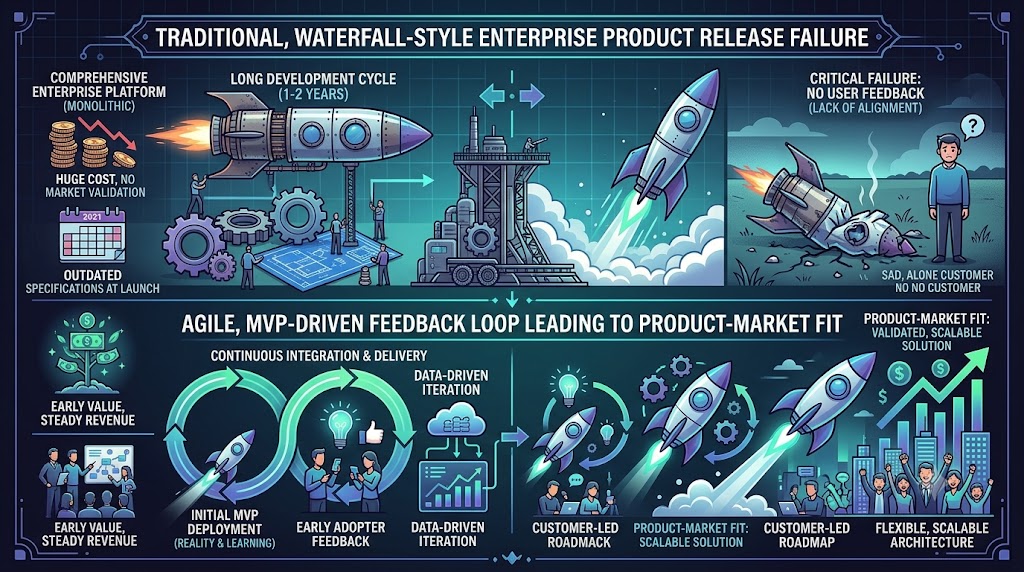
Picture this: It is 8:00 AM on a Monday morning. The executive team sits around a mahogany boardroom table, staring at a dashboard flashing red metrics. Eighteen months ago, the leadership team approved a flagship software initiative. The scope grew month after month as stakeholders demanded “just one more essential feature.” The budget expanded from $800,000 to $2.5 million. The engineering team burned the midnight oil, suffering massive burnout to deliver what was supposed to be a flawless, fully featured enterprise launch.
The application went live last Thursday. The market response? Crickets.
User onboarding stalled, churn spiked within 48 hours, and the few users who logged in ignored 90% of the heavily funded features. The team spent millions perfecting a product that solved a problem nobody actually had. This scenario is a corporate nightmare, yet it unfolds across enterprise organizations every single week.
The Great Corporate Myth: Most business leaders believe that a Minimum Viable Product (MVP) is simply a buggy, half-baked, or stripped-down version of a final product rushed out the door to save money.
This myth destroys projects before they even launch. An MVP is not a compromised final product. It is a precision-engineered learning instrument designed to test core business hypotheses in live market conditions with minimal wasted capital.

Deconstructing the Product Life Cycle
To execute a Minimum Viable Product correctly, project leaders must first understand where the MVP sits within the overarching product life cycle continuum. Skipping foundational stages or confusing an MVP with earlier testing artifacts will derail your delivery schedule and alienate your market.
The Product Evolution Continuum
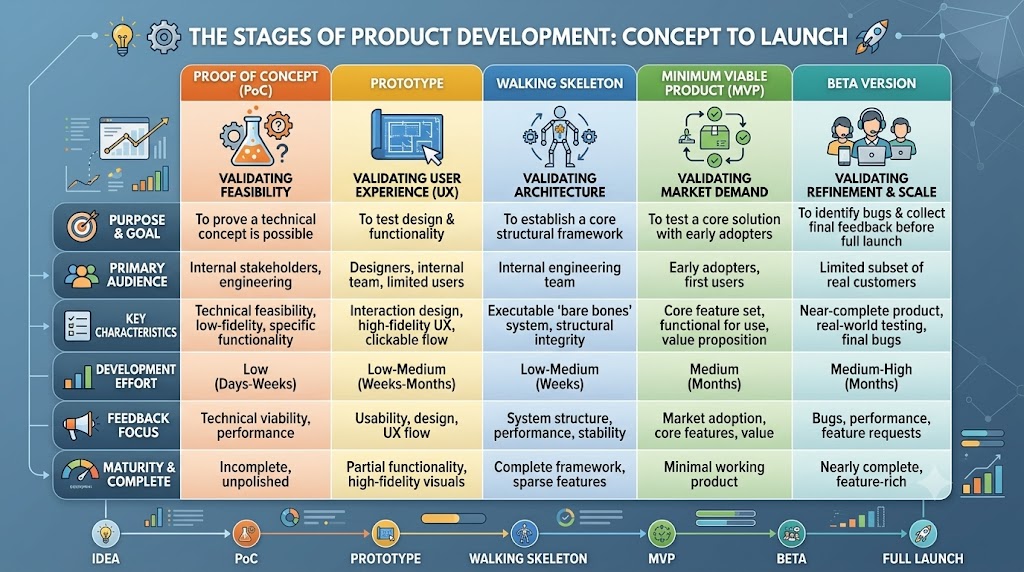
Every initiative moves through distinct maturity gates, moving from abstract ideas to long-term operational maintenance:
Idea Generation: Identifying a market gap, operational friction, or strategic opportunity.
Business Case Development: Evaluating technical feasibility and financial viability to justify initial investment.
Proof of Concept (POC): A small-scale technical test to answer a single question: Is this technically possible?
Prototype: A visual or clickable mockup used to demonstrate layout, user interface (UI), and interaction flows.
Walking Skeleton: A bare-bones, end-to-end functional architecture containing zero visual polish, built solely to verify system connectivity from start to finish.
Minimum Viable Product (MVP): A basic, fully functional product containing the bare minimum features required to deploy to real users for accelerated market learning.
Beta Version: A refined product release distributed to a selected subset of target users to uncover edge-case bugs, performance bottlenecks, and system instability prior to public launch.
Fully Featured Product: The stable, comprehensive release deployed at scale to the broader marketplace.
Business-as-Usual (BAU) Operations: Transitioning the mature product to operational teams for ongoing maintenance and support.
Enhancements or Sunset: Continuous iteration cycles for upgrades, or eventual decommissioning when the product reaches the end of its operational life.
Differentiating Testing Artifacts: POC vs. Prototype vs. Skeleton vs. MVP vs. Beta
Project Managers frequently confuse these core concepts. To maintain strategic clarity, refer to the methodological breakdown below:
| Stage | Primary Purpose | Functional Depth | Target Audience | Key Outcome |
| Proof of Concept (POC) | Validate technical feasibility | Minimal or non-existent | Internal stakeholders & architects | Risk reduction & feasibility approval |
| Prototype | Test design layout & user experience | Visual/clickable mockup | Design teams & test users | UI/UX feedback & design iteration |
| Walking Skeleton | Test end-to-end system architecture | Core framework with zero polish | Engineering & technical leads | Structural validation |
| Minimum Viable Product (MVP) | Validate market demand & value hypothesis | Bare minimum functional features | Early adopters & real consumers | Accelerated feedback & validated learning |
| Beta Version | Uncover operational bugs & performance limits | Near-complete product functionality | Sample group of target users | System stability & defect resolution |
The Core Mechanics of the MVP Methodology
The primary driver behind crafting an MVP is the acceleration of the Build-Measure-Learn feedback cycle. Rather than spending months refining secondary features, project teams deploy a functional core to real users immediately.
Why is this accelerated learning loop vital? Because real-world user behavior constantly disproves theoretical boardroom assumptions. When real users interact with an MVP, their activity reveals true user intent, friction points, and value drivers.
The Step-by-Step Implementation Framework for Project Managers
When tasked with leading an MVP initiative, top-tier Project Managers follow a structured execution framework to prevent scope inflation while maximizing empirical learning.
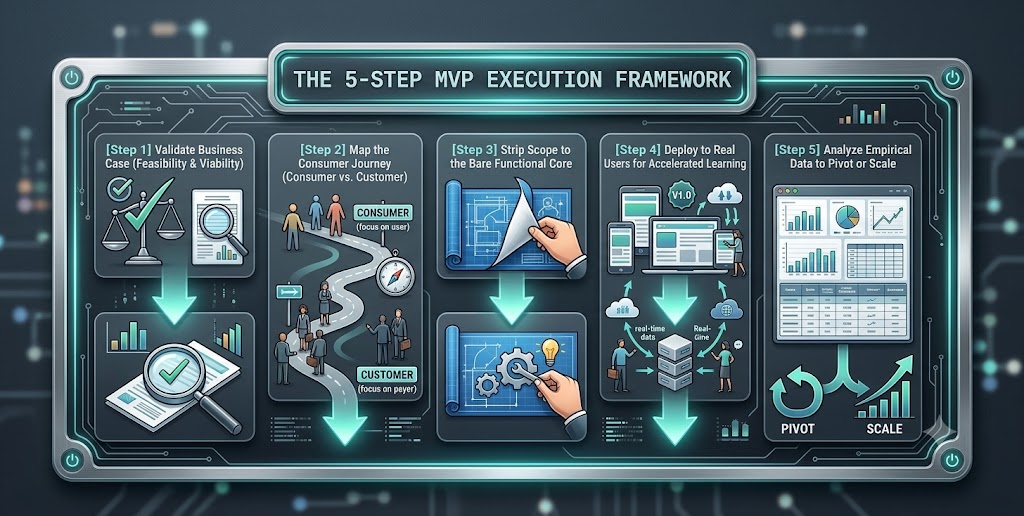
Step 1: Validate the Business Case & Core Hypotheses
Before writing a single line of code or designing a framework, the Project Manager must establish the initiative’s foundational business case. This requires getting definitive answers to two non-negotiable questions:
Is it technically feasible? Can the team physically build this solution using available technology within acceptable risk parameters?
Is it financially viable? Will the projected return on investment (ROI), payback period, or strategic value justify the capital expenditure required?
Step 2: Map the Essential Consumer Journey
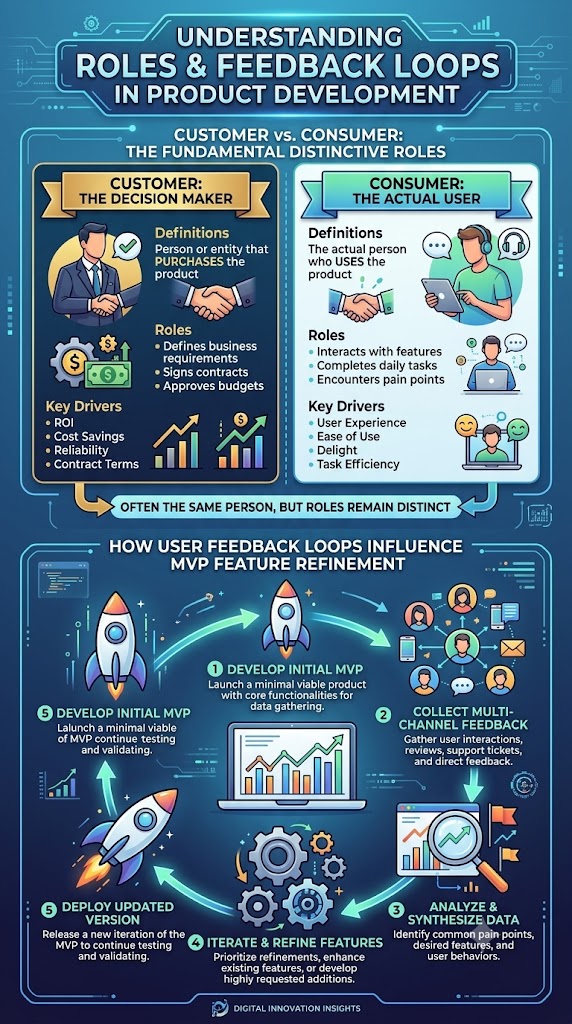
A major trap in MVP development is failing to distinguish between the Customer and the Consumer:
The Customer: The individual or entity paying for the product (e.g., a corporate procurement department or a parent).
The Consumer: The end-user who actually interacts with the product daily (e.g., an operational staff member or a student).
While sales teams focus on the customer, an MVP must prioritize the consumer. If the consumer finds the core functionality painful or ineffective, adoption collapses, leading to churn. Project Managers must map the primary user journey, focusing exclusively on the specific workflow the consumer must complete to extract value.
Step 3: Strip Scope Down to the Functional Core
Once the consumer journey is mapped, project teams must ruthless prune features. Every proposed feature must pass a simple test: If we remove this feature, does the core product cease to function for the user?
If the answer is no, the feature is immediately moved out of the MVP scope and placed into the long-term product backlog. The goal is to build just enough functional capability to allow real-world usage while eliminating unnecessary polish.
Step 4: Deploy and Instrument Accelerated Learning Loops
Deploying the MVP to early adopters or real consumers is only half the battle. The environment must be heavily instrumented with telemetric tracking and direct feedback channels. Track real user behavior, including drop-off rates, feature engagement, completion speed, and user complaints. The core objective of this stage is rapid empirical discovery
Step 5: Pivot, Preserve, or Scale Based on Empirical Feedback
With real-world user data in hand, project leaders evaluate performance against original assumptions. This leads to three strategic decisions:
Persevere: The core hypothesis is validated; double down on refining the existing feature set and move toward a broader Beta release.
Pivot: The fundamental concept has merit, but the workflow or value delivery requires a major strategic shift based on actual consumer usage.
Stop: The market feedback proves the solution is unnecessary, preserving company capital before millions are wasted on full-scale development.
Strategic Considerations: Vaporware vs. Validated MVPs
In corporate environments, product strategy occasionally crosses into alternative tactics, such as Vaporware.
Vaporware Definition: The practice of publicly announcing, advertising, or hyping a product that is not currently built, nor actively in development.
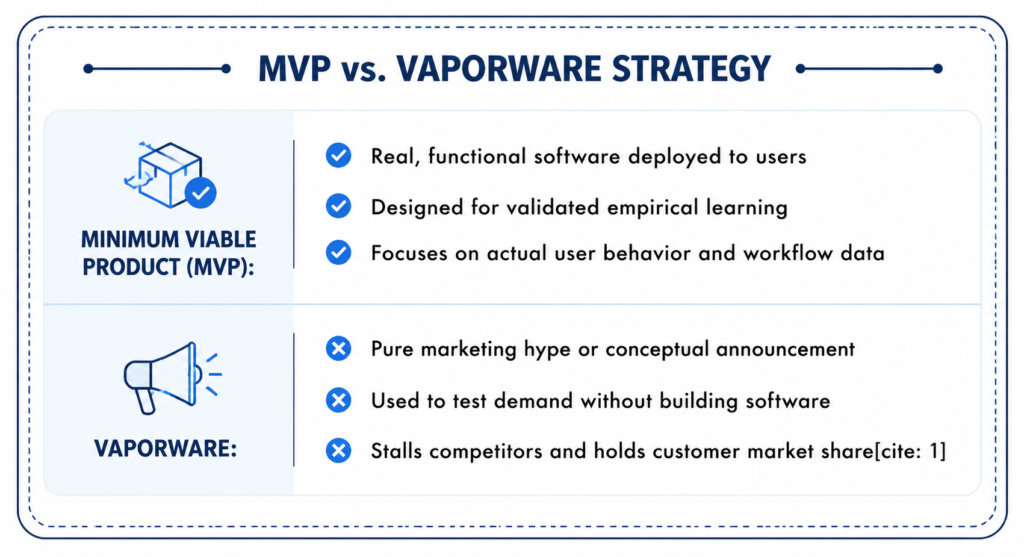
While Vaporware carries reputational risk if mismanaged, enterprise organizations sometimes deploy it as a deliberate strategic move[cite: 1]:
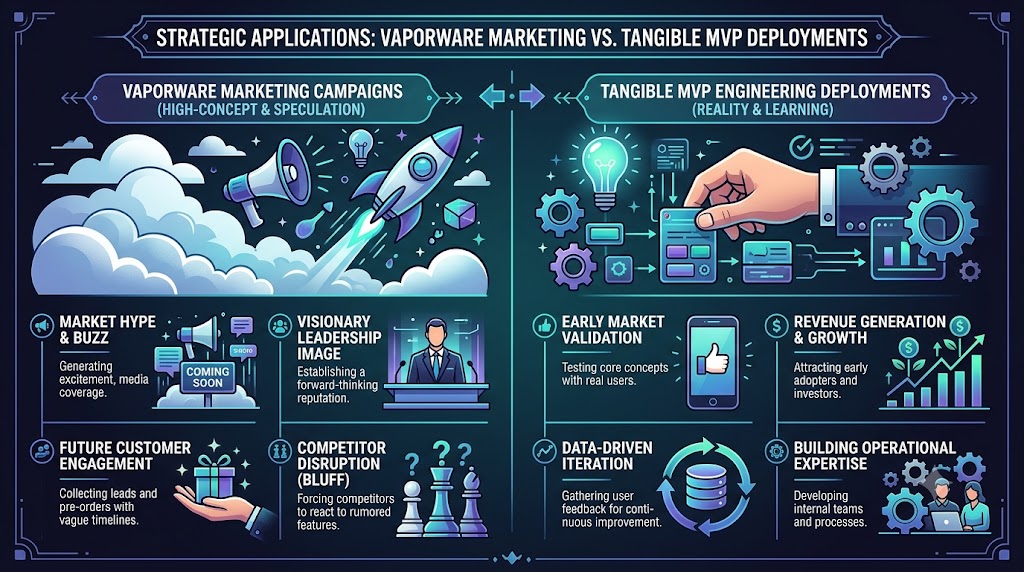
Market Sentiment Testing: Gauging market interest and pre-orders through public announcements before committing capital to a full business case[cite: 1].
Competitor Stalling: Announcing an upcoming technological solution to encourage current enterprise clients to hold off on switching to a competitor’s newly launched tool[cite: 1].
While Vaporware relies on marketing hype to gauge interest, an MVP relies on functional deployment to measure actual operational behavior[cite: 1]. Elite Project Managers understand when leadership is deploying Vaporware strategically and ensure it is not mistaken for a true MVP development cycle[cite: 1].
The Elite Project Manager’s Transformation
Mastering the MVP methodology fundamentally changes a Project Manager’s career trajectory.
When you shift from traditional, rigid delivery models to strategic, lean execution, the chaotic environment of endless scope creep, blown budgets, and team burnout disappears. You no longer manage projects by simply tracking task checklists or policing timesheets. Instead, you operate as a strategic business leader who protects corporate capital, streamlines delivery pipelines, and consistently drives measurable ROI.
Life Before vs. Life After MVP Mastery
Before Mastery: Constant scope inflation, unpredictable launch dates, high team stress, friction with business stakeholders, and launching products that fail to drive real adoption.
After Mastery: Clean scope management, predictable delivery schedules, high team morale, strong executive trust, and a track record of delivering targeted solutions that users love.
Executive leadership does not promote Project Managers simply for delivering projects on time. They promote leaders who drive business outcomes, eliminate operational waste, and master the strategy of product development.
Elevate Your Project Leadership with Skillsetify
Executing a Minimum Viable Product is just one component of modern, high-impact project management. To thrive in today’s rapid corporate landscape, professionals must master top-down strategic portfolio management, advanced agile frameworks, financial planning, and cross-functional leadership.
If you are ready to stop guessing, move up the corporate ladder, and learn project management the right way, reach out to Skillsetify. We do not just teach frameworks: we show you your exact career growth trajectory. Partner with Skillsetify today to master executive-level delivery and transform your career.