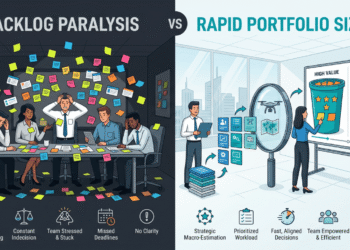
How to Validate a Business Case Before It Burns Your Budget
It is 11:45 PM on a Thursday night. You are staring at a cooling cup of coffee, surrounded by three exhausted senior developers and a frantic product marketing lead. On the screen is the real-time launch dashboard for the enterprise’s highly anticipated new product module, a feature born six months ago from a “brilliant spark of inspiration” during an executive offsite. The dashboard is screaming in red text. Server latency is skyrocketing because the architecture cannot handle real-world concurrent queries, and the customer acquisition cost has already outpaced the lifetime value of the few users who signed up.
Millions of dollars in capital expenditure have been vaporized. The engineering team is facing acute burnout, and tomorrow morning you have to stand before the executive steering committee to explain how a project that looked so beautiful on a slide deck crumbled under the weight of reality.
This nightmare is not an isolated incident. It happens every day in mid-market organizations and Fortune 500 enterprises alike. The root cause is almost always the same: a profound, systemic failure in business case validation at the absolute genesis of the product life cycle.
A dangerous myth persists within modern corporate cultures: the romantic illusion that visionary innovation requires bypassing standard corporate filters. Ambitious leaders frequently fall into the trap of believing that if an idea is compelling enough, the market will naturally figure out how to adopt it, and the engineering team will magically figure out how to build it. They view the business case validation stage as a bureaucratic roadblock, a generic checkbox exercise required by finance to release funds.
This mindset is entirely false. True, world-class project management does not treat validation as a hurdle to clear: it treats validation as the ultimate shield against enterprise waste. Every successful product must start with a rigorous filter that interrogates an idea from two distinct, uncompromising viewpoints: technical feasibility and financial viability. Without this dual confirmation, you are not managing a project: you are gambling with corporate capital.
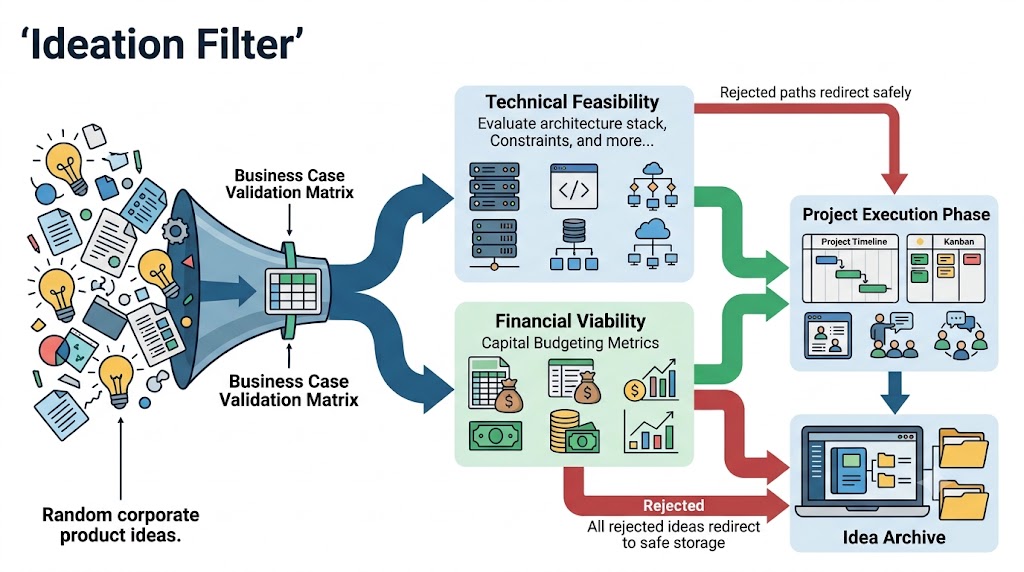
To understand how elite organizations stop bad projects before they start, we must look at the mechanics of the Product Life Cycle initiation phase. Every product begins as a raw concept, but an idea is not a project. An idea is merely an unverified hypothesis.
The validation phase acts as a governance gate. If the concept satisfies both sides of the validation equation, it is formally funded and transformed into a structured project. If it fails either side, it is systematically archived, preserving precious engineering resources and corporate focus. For existing products in the market, this rule applies with equal strictness: any major enhancement, architectural pivot, or functional increment must return to the beginning of the validation cycle to justify its strain on the organizational ecosystem.
Technical Feasibility: Can We Build It Safely and Sustainably?
Technical feasibility goes far beyond asking your lead engineer if a feature is hypothetically possible to code. In an enterprise environment, technical validation requires analyzing how the proposed product will interact with current organizational constraints, systemic interdependencies, and long-term architectural health.
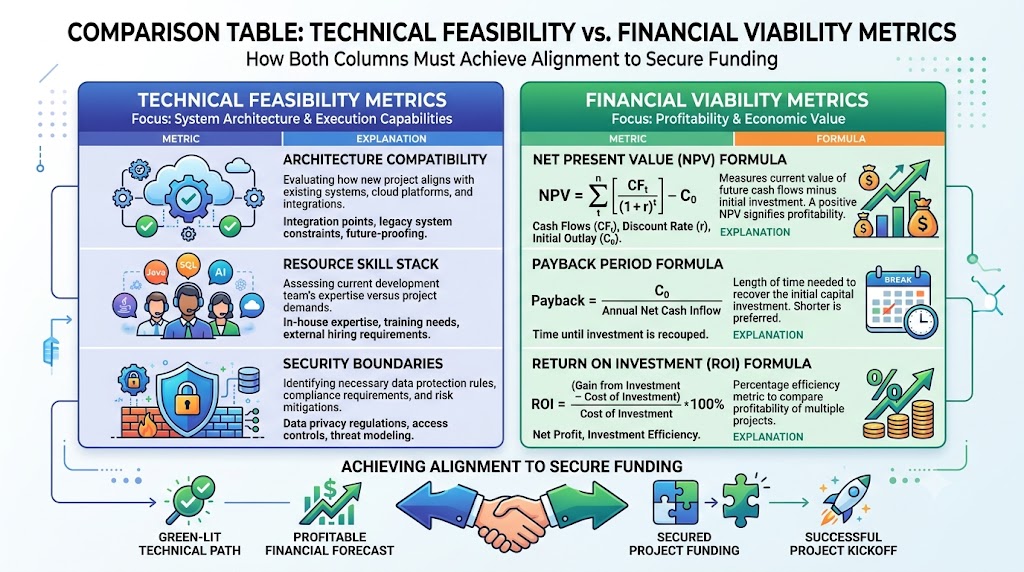
When analyzing technical feasibility, a Project Manager must cross-examine the concept using three baseline metrics:
Architecture Runway Integration: Does the proposed solution fit cleanly within our existing infrastructure stack, or will it require a massive, unplanned modernization effort?
Resource Stack Capacity: Do our internal teams possess the specialized skills required to maintain this technology safely over the next five years, or will it create extreme dependencies on expensive external contractors?
Systemic Interdependencies: How will this product affect the data flows, security compliance boundaries, and performance baselines of adjacent corporate platforms?
Financial Viability: Will It Generate True Enterprise Value?
An idea can be technically elegant, but if it fails to generate economic value, it represents an opportunity cost that steals resources from genuinely profitable ventures. Financial validation removes emotion from product development by applying hard data to market forecasts. Elite project leaders do this by utilizing rigorous capital budgeting techniques to calculate precisely when and how the initial investment will return value to the firm.
To assess whether a business case makes long-term economic sense, organizations rely on standard capital budgeting formulations. The most critical metric is Net Present Value (NPV), which discounts all future cash inflows and outflows to the present day while accounting for the time value of money and project risk. The formula is expressed as follows:
Where:
- Rt represents the net cash inflow or outflow during a single period t.
- i represents the corporate discount rate or the organization's cost of capital.
- t represents the number of time periods.
- C0 represents the initial monetary investment required to initiate the project.
A positive Net Present Value (NPV) indicates that the project is expected to generate value beyond its cost of capital, making it a financially attractive candidate for initiation.
Alongside NPV, project leaders should establish clear financial baselines for the following investment metrics:
- Internal Rate of Return (IRR): The discount rate at which the project's Net Present Value becomes zero.
- Return on Investment (ROI): The percentage gain generated relative to the total investment cost.
- Payback Period: The chronological time required for cumulative cash inflows to completely recover the initial investment cost (C0).
The Step-by-Step Business Case Validation Framework
For project professionals looking to implement a bulletproof validation process immediately, this framework provides a repeatable blueprint designed to screen concepts ruthlessly.
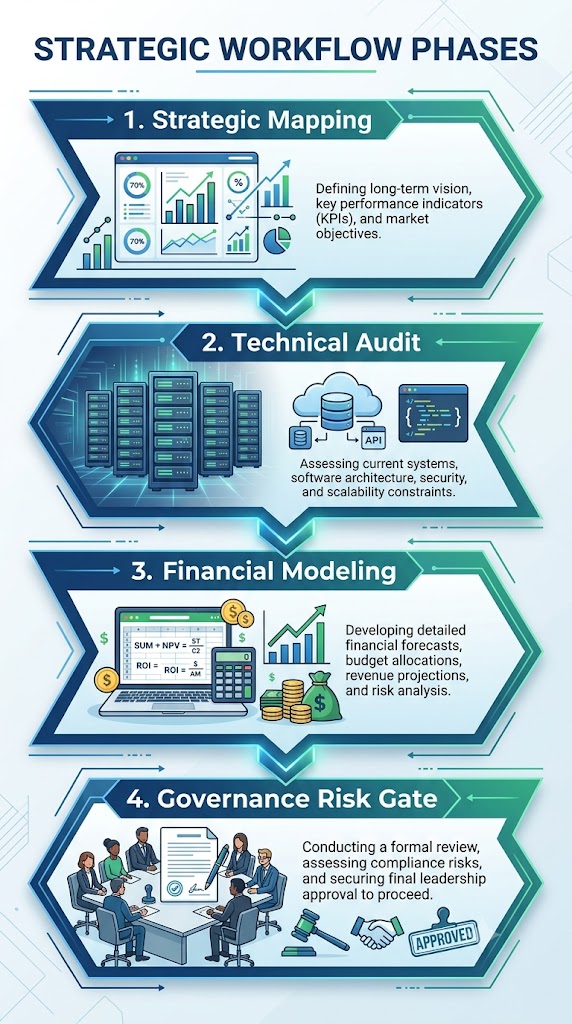
| Phase | Strategic Goal | Core Activities | Deliverable Output |
| 1. Strategic Mapping | Ensure alignment with broader corporate strategies. | Assess problem-market fit; audit adjacent portfolio dependencies; identify core cross-functional stakeholders. | Strategic Alignment Brief |
| 2. Technical Audit | Interrogate the engineering feasibility and risks. | Define architectural limits; evaluate internal skills stack; map security and compliance boundaries. | Technical Feasibility Report |
| 3. Financial Modeling | Quantify the economic return of the project. | Estimate total cost of ownership; model cash inflows; calculate $NPV$, $ROI$, and Break-Even Point. | Capital Budgeting Dossier |
| 4. Risk Gate Review | Secure executive approval based on concrete metrics. | Present validation data to the governance board; run constraint analysis; sign off or archive. | Formal Project Charter |
Phase 1: Strategic Mapping & Problem Auditing
Before spending time on deep financial calculations, you must verify that the product solves an actual market problem that aligns with your organization’s core focus. You must determine if this product complements the existing portfolio or if it will cannibalize resources from more critical cross-functional initiatives.
Phase 2: Technical Constraint Analysis
Conduct deliberate technical discovery sessions with architecture leads. Instead of asking if the feature can be built, force the team to outline exactly what will break if it is built. Document the technical debt that will be incurred and define the structural constraints that must be accounted for in the initial scope.
Phase 3: Financial Capital Modeling
Work alongside finance partners to build a realistic cost model. Do not simply look at the initial development costs: look at the total cost of ownership, including hosting infrastructure, ongoing operations, customer support training, and depreciation metrics. Run sensitivity analyses on your NPV calculations to see how the project performs if adoption is 30% lower than originally forecasted.
Phase 4: The Governance Risk Gate
Bring the collective data to a formal, metrics-driven review board. At this stage, the project must be judged strictly on its data baselines, completely separate from the corporate status or enthusiasm of the original idea sponsor. If the numbers hold up and the technical risks are managed, the business case is approved and transitions cleanly into a funded project baseline. If not, it is closed permanently.
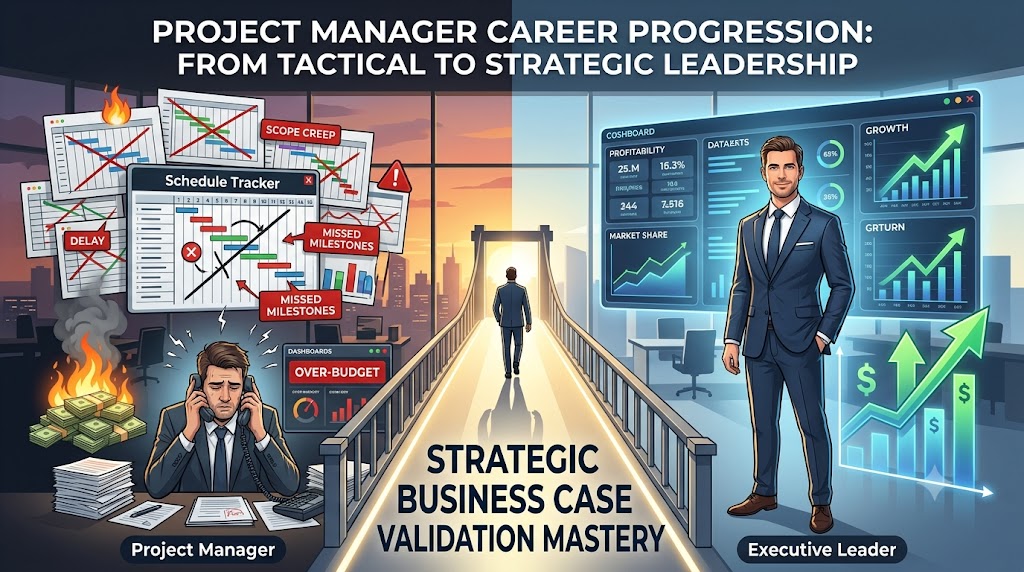
When you master the art of business case validation, an extraordinary transformation occurs within your professional ecosystem. You completely step away from the endless firefighting loop of project chaos, runaway scope creep, and compounding team burnout. You no longer find yourself stuck in desperate midnight meetings trying to rescue a structurally flawed product feature that should never have been funded in the first place.
Instead, your delivery pipeline becomes an environment of predictable, elite execution. Your engineering teams remain highly motivated because they know their labor is being funneled into projects that are architecturally sound and deeply aligned with market demands. Your executive leadership views you with immense trust because your projects consistently hit milestones without unexpected budget overruns.
Traditional PM Environment
- Reactive firefighting
- Uncontrolled scope creep
- Severe engineering burnout
- Unpredictable corporate ROI
Elite Validation Environment
- Proactive governance gates
- Strict technical alignment
- Predictable resource capacity
- Defensible financial delivery
This structural shift directly changes your value proposition as a corporate leader. By developing the skills to manage complex technical alignment, run sophisticated capital budgeting models, and enforce strict governance filters, you separate yourself from the vast sea of tactical task managers who merely track schedules. You establish yourself as a rare, highly strategic business asset: a professional who understands exactly how to safeguard organizational capital and direct human resources toward elite corporate growth. This deep business acumen is precisely what accelerates an ambitious professional’s path into senior, director-level, and executive leadership roles.
Building a career marked by elite delivery requires a deliberate departure from old habits. The era of accepting ill-defined, unvalidated passion projects from well-meaning stakeholders must come to an end. By instituting a rigorous validation structure that demands both technical feasibility and financial viability before a single line of code is written or a dollar is spent, you protect your organization’s resources, insulate your team from burnout, and solidify your reputation as a high-value strategic leader.
The landscape of corporate delivery is shifting rapidly, and organizations can no longer afford to fund unverified hypotheses. The path to the executive level belongs exclusively to project leaders who know how to bridge the gap between engineering reality and corporate finance strategy.
If you are ready to stop guessing, move up the corporate ladder, and learn project management the right way, reach out to Skillsetify. We do not just teach frameworks: we show you your exact career growth trajectory. Let us transform you from a tactical coordinator into an elite strategic leader.