How Mini-Biodatas Defeat Scope Creep in Agile Analysis
Picture this: It is 11:45 PM on a Thursday night. Your core delivery sprint team is locked in a heated, circular debate over a single JIRA ticket. The requirement text reads: “As a system user, I want a comprehensive reporting dashboard so that I can analyze financial data.”
The lead developer argues that “comprehensive” means real-time data streaming via Kafka pipelines with fully dynamic, custom-configured data visualizations. The Product Owner counters that it simply requires a static monthly download button via a basic CSV generation script. Meanwhile, scope creep has expanded the engineering estimate from two story points to thirty, sprint velocity is crashing, and your delivery timeline is rapidly collapsing.
This corporate crisis stems from a pervasive, systemic myth in Agile project delivery: the illusion that general user stories provide adequate operational clarity. When you build products for everyone, you build them for no one. Elite Project Managers do not build software for generic “system users.” They engineering delivery pipelines around hyper-targeted User Persona Profiles structured as practical, high-impact mini-biodatas.
The Strategic Blueprint of Agile User Persona Profiles
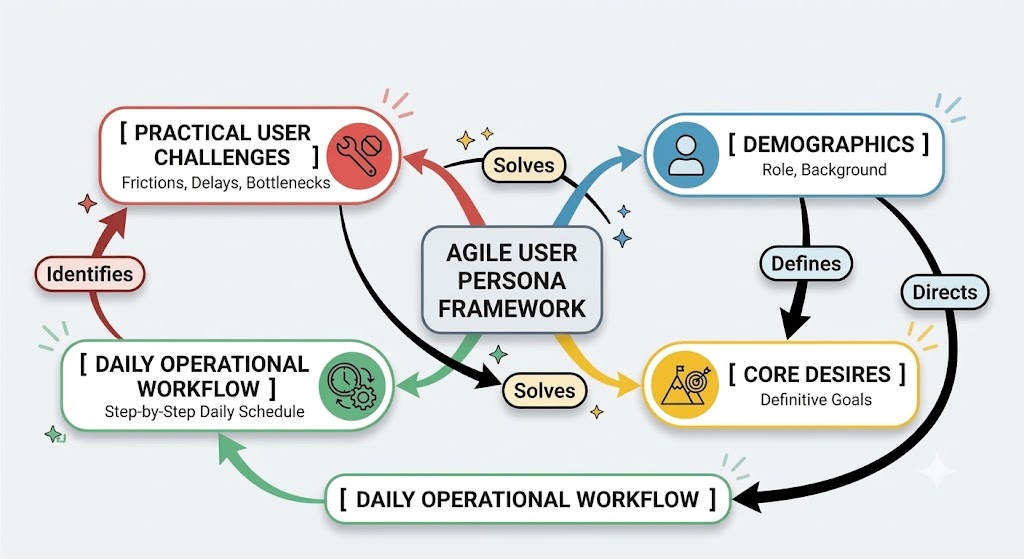
In Agile requirement analysis, a user persona is a semi-fictional, deeply researched representation of an ideal end-user. Rather than focusing on abstract demographic data like age or location, an effective Agile persona captures concrete behavioral traits, daily operational workflows, and specific software interaction patterns.
The "What" and "Why" of the Mini-Biodata Methodology
A mini-biodata is an operational snapshot designed to shift a project team’s perspective away from purely technical architecture and toward the user’s day-to-day realities. It acts as a realistic character sketch detailing the user’s operating environment, their technical comfort levels, and the precise business triggers that drive them to interact with your system.
Without this granular foundational baseline, requirement analysis shifts toward technical bias. Engineers build overly complex technical architecture because they lack context regarding the end-user’s limitations. Conversely, product owners under-engineer critical features because they fail to visualize the user’s operational constraints. Mini-biodatas bridge this communication gap, serving as an objective source of truth that guides the scope of your entire product backlog.
The Step-by-Step User Persona Implementation Framework
Building and deploying targeted user profiles requires a structured, empirical framework. Project Managers can utilize this four-stage methodology to establish, refine, and apply micro-targeted user profiles immediately.
Stage 1: Field-Level Data Collection
Stop guessing what your users need. Instead, conduct targeted context investigations using the following active observation methods:
-
Contextual Inquiries: Shadow real users in their actual working environments to observe how they navigate existing systems, document workarounds, and encounter errors.
-
Operational Logs and Support Audits: Analyze the past six months of system error logs, customer support tickets, and system exit rates to identify where users experience severe operational friction.
-
Stakeholder Deep-Dives: Conduct unstructured, recorded user interviews with cross-functional users across regions to capture specific operational challenges.
Stage 2: Synthesis and Core Segmentation
Once your raw observation data is collected, group the findings by operational commonalities. Look for patterns in system access frequency, data consumption needs, and workflow complexity. Avoid creating too many distinct profiles: target three to five highly defined personas that represent at least eighty percent of your active user base.
Stage 3: Structuring the Master Profile Template
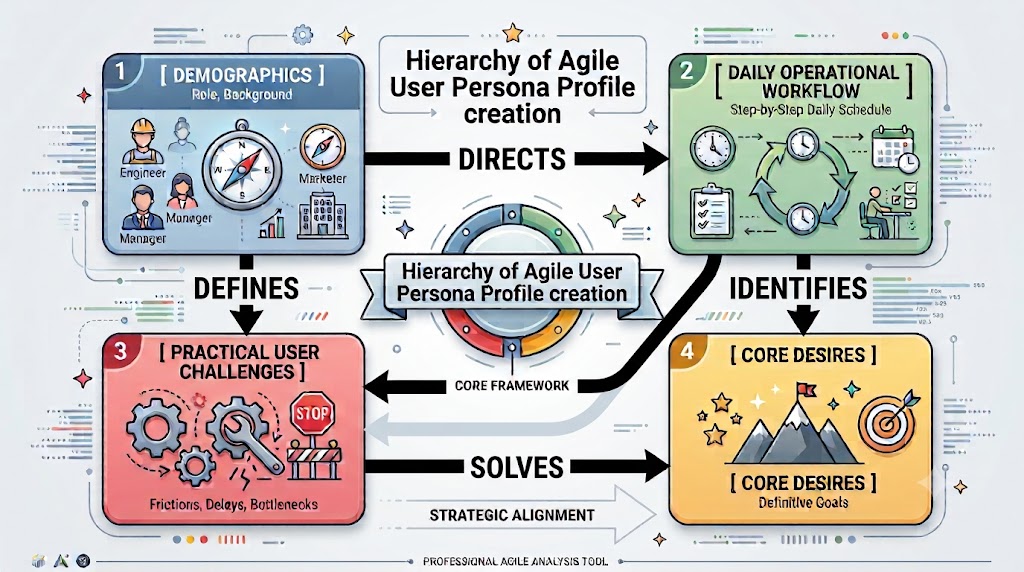
Every functional Agile profile must contain four distinct quadrants, formatted cleanly to ensure maximum utility for engineering teams:
| Quadrant | Title | Tactical Elements Included |
| Quadrant 1 | The Identity Context | Job title, operational domain, technical competency tier, and system access device constraints. |
| Quadrant 2 | The Daily Micro-Workflow | A chronological summary detailing exactly when, why, and how the user logs into the software system throughout their shift. |
| Quadrant 3 | Practical Challenges | Definitive operational frictions, current system workarounds, manual data transformations, and immediate time sinks. |
| Quadrant 4 | The Target Acceptance Metrics | Clear parameters defining what constitutes a successful system interaction from this user’s unique perspective. |
Stage 4: Injecting Personas into Your JIRA Backlog
To operationalize these profiles, completely remove ambiguous terminology like “system user” from your user stories. Replace generic headers with your persona names to anchor your team’s development focus.
Anti-Pattern User Story: As a system user, I want an exportable account ledger so I can review transactional history.
Persona-Driven Agile User Story: As Accountant Arthur, I want a one-click CSV account ledger export tool so that I can automatically reconcile mismatched transaction lines within my daily thirty-minute morning accounting window.
Case Study: Rebalancing a Legacy Enterprise Infrastructure Pipeline
To understand the practical impact of this methodology, look at a real-world enterprise management scenario involving an international software service provider. The company’s IT operations team was facing severe complaints from global business units across regions regarding software delivery velocity and vendor support quality.
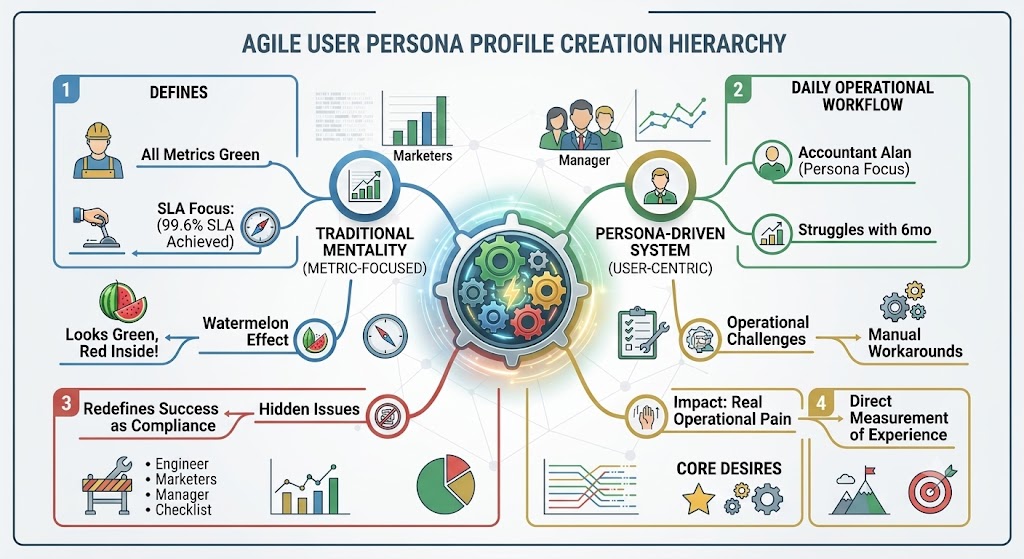
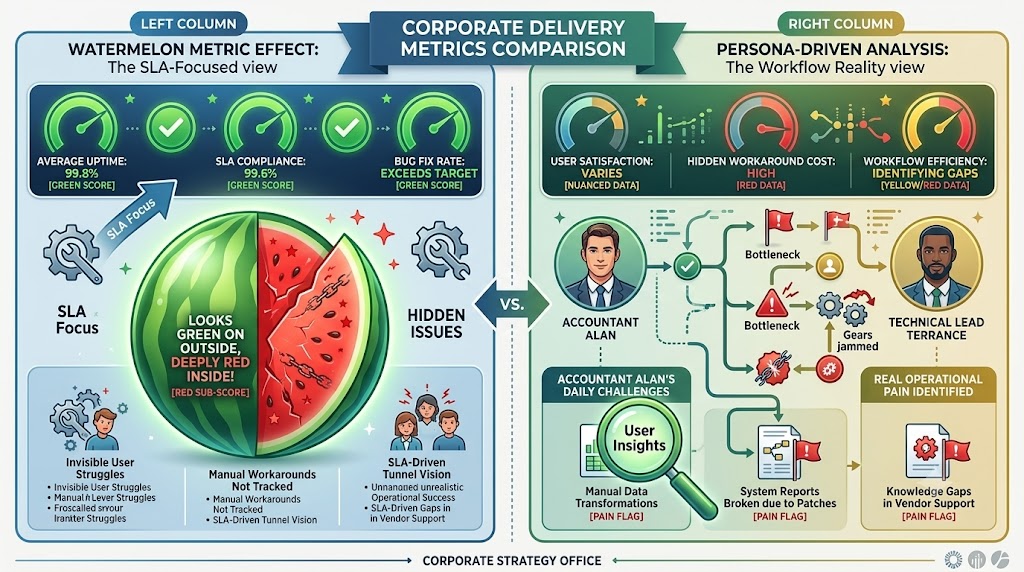
The existing vendor performance metrics were completely green, showing an average Service Level Agreement compliance rate of over ninety-nine percent. Yet, the business users were deeply dissatisfied, suffering through severe hidden operational delays. This disconnect represented a classic “watermelon effect”: green and smooth on the outside, but deeply red and troubled on the inside.
To resolve this issue, the project manager launched an active user persona analysis, interviewing over forty global technical and functional stakeholders. The team discovered that while the vendor was resolving tickets quickly to meet their metrics, they were doing so without addressing systemic usability issues. By synthesizing these interviews, the project management office established two distinct user profiles:
Persona Profile A: Functional Manager Fiona
-
Operational Context: Manages regional business operations, possesses low technical coding literacy, and relies heavily on accurate data reporting dashboards.
-
Daily Workflow: Accesses the system twice daily to extract regional performance updates and compile reports for executive leadership.
-
Practical Challenge: System report updates frequently stall due to unannounced software patches introduced by vendor engineers. Fiona is forced to spend two hours manually converting broken data strings in Excel because the system lacks automated formatting validation.
Persona Profile B: Technical Lead Terrance
-
Operational Context: Senior systems engineer with fifteen years of experience managing complex legacy software integrations.
-
Daily Workflow: Monitored system architecture alerts continuously throughout his shift, directly coordinating with vendor technical support teams.
-
Practical Challenge: Critical developer departures within the vendor’s team frequently left the account without qualified subject matter experts. Terrance spent months explaining basic software dependencies to junior vendor support staff, causing project backlogs to swell.
The Transformation Strategy
By anchoring requirements to Fiona and Terrance, the project team completely reshaped their delivery roadmap. Instead of tracking generic ticket resolution speeds, the team restructured their engineering priorities around fixing the root causes of user frustration.
They introduced automated data-validation frameworks to protect Fiona from broken Excel layouts and established strict knowledge-management protocols to ensure junior vendor staff understood system dependencies before stepping onto Terrance’s account. Within five months, this persona-driven approach eliminated hidden workarounds, stabilized delivery velocity, and transformed user satisfaction from an all-time low into a predictable baseline of elite delivery.
The Professional Transformation: Shifting from Chaos to Elite Delivery
When you implement targeted user profiles, your daily operational reality as a Project Manager undergoes a powerful shift:
-
Scope Creep Neutralized: Engineering teams immediately stop over-engineering features because the user’s technical constraints are explicitly defined right in the ticket.
-
Circular Debates Eliminated: Disagreements regarding feature design are resolved instantly by asking an objective question: “Does this development track serve the specific goals detailed in our user profile?”
-
Sprint Predictability Unlocked: Velocity stabilizes as ambiguous user stories are replaced by concrete requirements, reducing unexpected roadblocks mid-sprint.
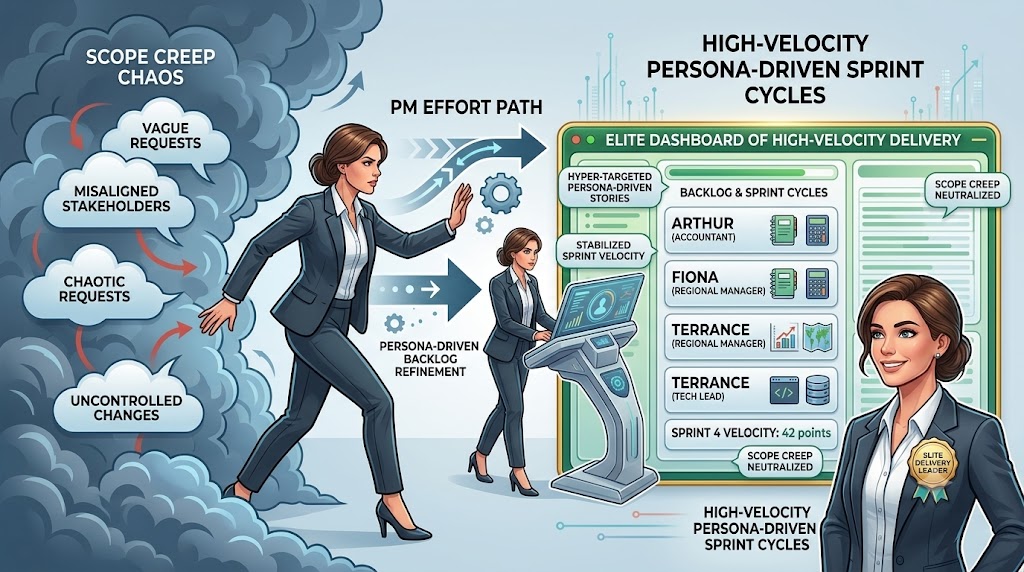
Mastering user-centric analysis does more than just optimize your software development lifecycle. It changes your career trajectory. Transitioning from a tactical coordinator who simply shuffles vague tickets to a strategic project leader who maps software engineering to real human workflows signals to executive leadership that you are ready for senior roles. You stop managing tasks and start driving high-value organizational capability.
Elevate Your Project Leadership with Skillsetify
Outstanding project delivery is never an accident. It requires moving past basic buzzwords and mastering deep, data-driven execution frameworks that keep complex teams aligned.
If you are ready to stop guessing at requirements, eliminate scope creep on your accounts, and accelerate your climb up the corporate ladder, it is time to learn project management the right way. At Skillsetify, we do not just teach you how to memorize rigid frameworks for an exam. We partner with you to refine your practical executive execution skills, map out your precise professional growth trajectory, and prepare you to lead high-stakes enterprise projects with complete confidence.
Turn your project management capability into your ultimate career competitive advantage. Reach out to the Skillsetify team today to unlock your next leadership transition.