How the Book Analogy Rescues B2B Projects from Scope Creep and Execution Chaos
The Multi-Million Dollar Blindspot: Why Technical Backlogs Kill Software Deliveries
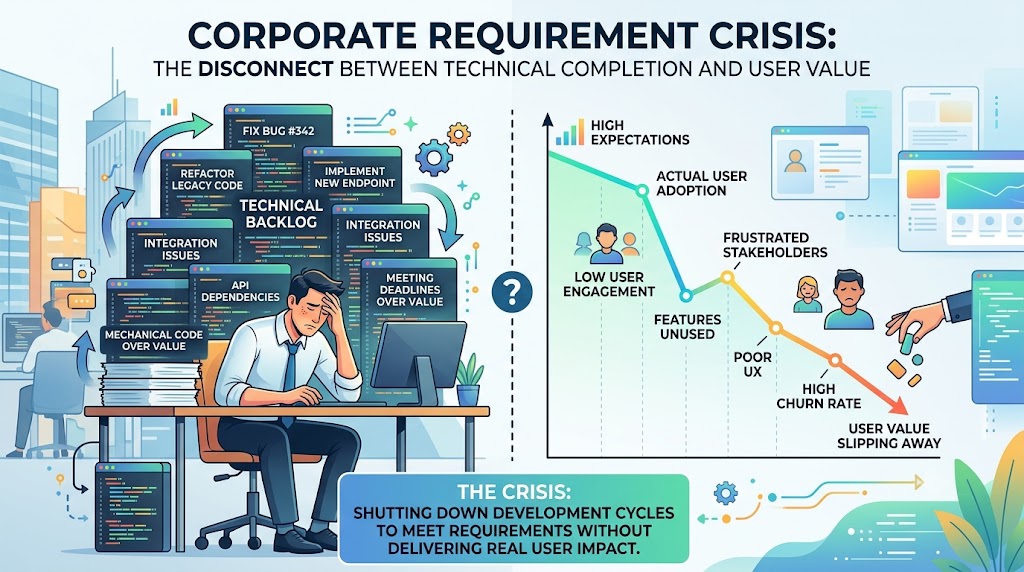
Imagine this scenario: It is 2:00 AM on a Sunday morning. Your enterprise software product launch is scheduled for Monday at 9:00 AM. For the past six months, your engineering group has worked around the clock, successfully closing hundreds of tickets in the development pipeline. The burn down charts look flawless. The velocity metrics indicate peak performance. Yet, as you run the final staging environment demonstration for your enterprise client, a cold realization sets in: the application is completely unusable.
The software works mechanically, but it fails to address the operational workflow of the human being using it. The login screen forces administrative loops, the database triggers technical error codes directly to the interface, and the core reporting system requires a multi step query process just to pull a basic transaction list. The engineering team built exactly what was documented in the backlog, but the backlog was written by engineers, for engineers.
This is the classic B2B project management crisis: an entire delivery lifecycle derailed not by a lack of technical capability, but by a systemic breakdown in requirement architecture.
For years, a pervasive myth has dominated corporate product development: the belief that the more technically exhaustive a requirement is, the less likely a project is to fail. Product managers routinely spend weeks compiling dense, system centric specifications filled with architectural conditions and database mappings. They mistake technical complexity for clarity.
The reality is quite the opposite. When requirements are documented as isolated technical tasks rather than human experiences, your development squad loses sight of the end objective. You do not build products to satisfy databases: you build products to solve human problems. To build elite, highly predictable delivery systems, enterprise product leaders must master the art of requirement hierarchy: transforming ambiguous business visions into small, simple feature descriptions written strictly from the perspective of the end user.
Introducing the Backlog Book Analogy: The Definitive Requirement Hierarchy
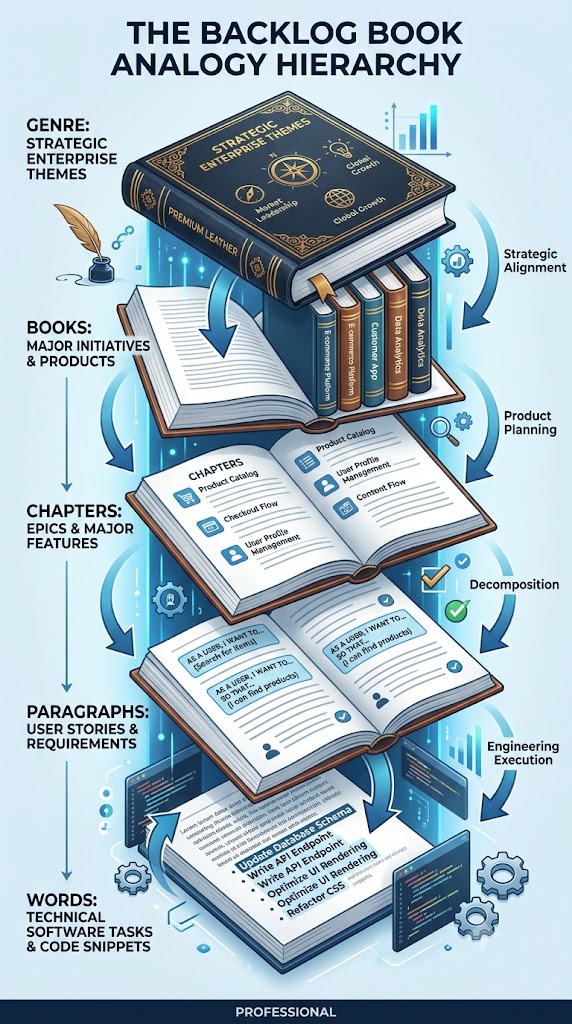
To prevent execution chaos, elite project managers utilize an organized framework to break down complex enterprise scopes. Think of your product backlog not as a chaotic pile of system features, but as a structured library. By applying the Backlog Book Analogy, you can map your entire requirement hierarchy using a clear classification shortcut: Genre → Book → Chapter → Paragraph → Word.
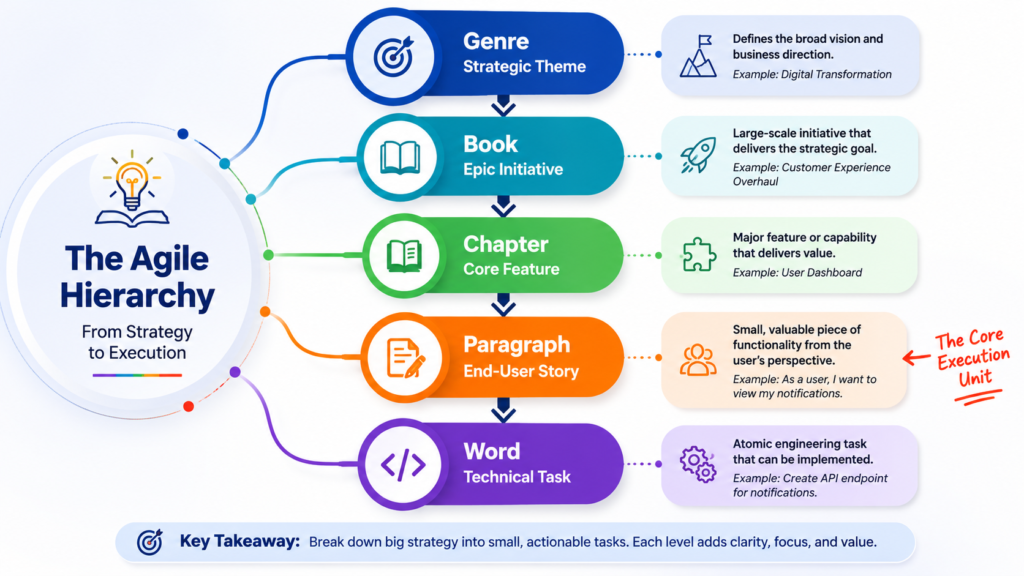
This structural methodology ensures that every technical task completed at the ground level remains directly tied to a high level corporate objective. Let us dissect each tier of this framework to understand how a master product roadmap functions.
1. The Genre: Strategic Themes
In this framework, the Genre represents the broadest operational track or corporate objective. A genre defines the overarching strategy of the business unit. For example, if you are building an enterprise financial platform, your genres might include tracks such as Vendor Performance Optimization, Regulatory Compliance, or Frictionless Core Workflows. The genre does not specify features: it establishes the strategic arena and answers the fundamental corporate question: Why are we investing resource capital here?
2. The Book: Epic Initiatives
Within a specific genre, you discover individual Books. In standard product management terminology, these are your Epics. An epic is a substantial business initiative that cannot be delivered in a single deployment cycle. It represents a major pillar of value. If your genre is Vendor Performance Optimization, a corresponding book might be Automated Service Level Agreement Monitoring. It is a comprehensive body of work that requires significant coordination but focuses on a distinct functional outcome.
3. The Chapter: Core Features
As you open an epic initiative, it naturally divides into Chapters. These chapters represent distinct, tangible features or functional capabilities within the system. A feature is a component of the application that delivers a specific, recognizable package of utility to the stakeholder. Under the Automated Service Level Agreement Monitoring epic, a chapter might be the Real Time Performance Dashboard or the Automated Infractions Notification Engine.
4. The Paragraph: End User Stories
This brings us to the most critical layer of execution: the Paragraph, which maps directly to the User Story. Just as a paragraph delivers a singular, focused narrative thought within a chapter, a user story describes a small, simple piece of functional utility written strictly from the viewpoint of the end user.
The user story is the absolute core of the requirement hierarchy. It is the exact boundary where business requirements transform into software execution blocks. If your paragraph layer is broken, vague, or overly technical, the entire structure above it collapses into misalignment.
5. The Word: Technical Tasks
At the absolute base of the architecture are the Words. These are the granular, day to day technical tasks executed by engineers, quality assurance analysts, and database specialists to fulfill the user story. Tasks include technical activities such as database index configuration, API endpoint routing, or user interface CSS styling.
The Anatomy of the Paragraph: Slicing Backlogs strictly from the User Perspective
The primary point of failure in most B2B project lifecycles occurs when product managers write their user stories as if they were technical tasks. They fill the paragraph layer with phrases like * Configure the database to accept string values up to 256 characters * or * Establish an OAuth connection with the single sign-on provider. *
These are not user stories: they are engineering tasks disguised as requirements. When you write requirements from a technical architecture perspective, you disconnect the developer from the user experience. The engineering team stops asking if the feature is intuitive: they only care if the endpoint returns a successful status code.
To execute at an elite level, every single user story must be crafted strictly from the user viewpoint. This requires adopting a disciplined narrative structure that defines three distinct elements: the user persona, the functional action, and the realized value.
The Elite Persona Framework
Never use the generic term * The User * when documenting requirements. In enterprise software, there is no single user. There are system administrators, compliance auditors, line managers, and customer support analysts. Each persona possesses distinct technical fluencies, operational pressures, and cognitive constraints.
For instance, consider an enterprise accountant. Their daily routine is structured around highly repetitive, data intense processes. They value data density, keyboard shortcuts, and transaction validation. Contrast this persona with a regional operations director, who only accesses the platform once a week via a mobile device to approve spending limits. Their persona requires high visual contrast, minimal data entry, and rapid approval flows.
By detailing the specific persona at the start of your user story paragraph, you instantly provide the engineering team with context regarding the user’s environments, cognitive load, and ultimate expectations.
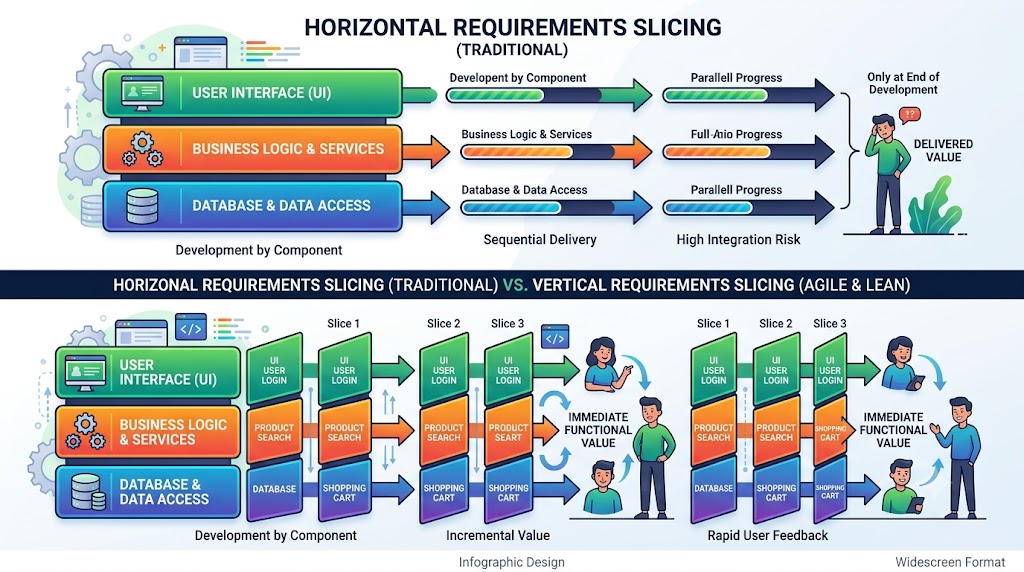
Slicing the Value: The Thin Slice Methodology
One of the hardest skills for a B2B project manager to master is the process of decomposing large, complex features into small, independent user stories. Elite teams use the Thin Slice Methodology.
Instead of slicing a feature horizontally by technical layers (e.g., building the database layer in Sprint 1, the API layer in Sprint 2, and the user interface in Sprint 3), you must slice the feature vertically. A vertical slice means that every individual user story contains a tiny piece of the database, a tiny piece of the API, and a tiny piece of the user interface: delivering a complete end to end functional loop that the user can actually interact with, no matter how small.
| Slicing Vector | Method | Core Focus | Project Outcome |
| Horizontal Slicing | Architectural / System Layers | Component based engineering (Database first, UI last) | Extended delivery cycles, high integration risk, delayed feedback loops |
| Vertical Slicing | End User Functionality | Thin slices of value across the entire software stack | Continuous validation, rapid value realization, minimized integration risk |
The 5 Step Operational Guide to Transforming Your Enterprise Requirements
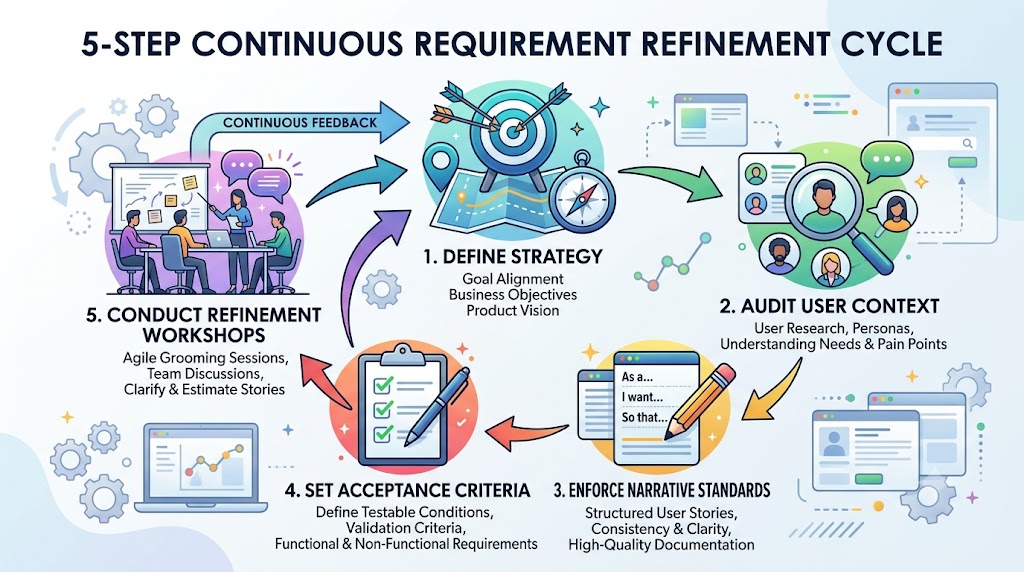
To deploy this requirement architecture within your organization, you must implement a structured, repeatable refinement process. Follow this step by step playbook to clean your backlog and align your delivery teams.
Step 1: Establish Your Structural Library
Before writing another user story, define the strategic taxonomy of your project. Map your current corporate roadmap directly to the Backlog Book Analogy.
Identify your core Genres based on executive KPIs.
Group your major developmental initiatives into distinct Books.
Define the functional Chapters that compose each initiative.
Document this structure inside your project management software tool (such as Jira or Azure DevOps) using a clear parent child hierarchy.
Step 2: Conduct User Context Audits
You cannot write from the end user’s viewpoint if you have never observed their operational environment. Spend time shadowing the individuals who will use the application. Document their daily workflows, their frustrations with legacy tools, and their physical limitations. Build deep user personas for every major role inside the enterprise system, noting their background, goals, and core system interaction times.
Step 3: Enforce the Narrative Standard
Mandate a strict linguistic framework for every requirement entry at the paragraph layer. Every user story must follow a user centric structure:
As a [Highly Specific Enterprise Persona]
I want to [Perform a Simple, Clear Functional Action]
So that [I Can Realize a Measurable Operational Value]
If a story is submitted that specifies system architecture, database changes, or coding languages in the main narrative description, reject it immediately and return it to refinement.
Step 4: Define True Acceptance Criteria
Every user story paragraph must be bound by clear, user testing boundaries. Implement the Given When Then framework to ensure clarity:
Given the system is in a specific operational state
When the user performs a distinct action
Then the system must deliver a visible, user verifiable outcome
This approach ensures that your quality assurance engineers can test the requirement based on human behaviors rather than abstract code functions.
Step 5: Execute Collaborative Refinement Workshops
Never write user stories in isolation. Conduct weekly refinement sessions with your lead developer, your quality assurance lead, and your business analyst. Review each slice of the backlog together. Read each story aloud and ask the team: * Does this description focus entirely on what the user experiences, or have we let engineering assumptions slip into our requirements? *
The Professional Shift: Transitioning from Delivery Chaos to Elite Project Execution
When you successfully transition your enterprise backlog from a technical tracking sheet to a highly structured requirement library, the transformation across your organization is profound.
Scope creep, the primary driver of enterprise project delay, is systematically minimized. Because every requirement must be written as a small, simple description from the user’s viewpoint, it becomes impossible for developers to slip unauthorized architectural experiments into the development pipeline. If a feature does not directly serve the end user persona, it stands out as an unnecessary addition.
Furthermore, your engineering team undergoes a fundamental cultural shift. They stop viewing their work as merely closing out isolated tickets or writing abstract blocks of code. Instead, they begin to see themselves as experience architects. They understand the direct connection between the line of code they write in the morning and the operational relief experienced by a business user in the afternoon.
Your delivery schedules become highly predictable. By utilizing vertical slicing, you eliminate the catastrophic integration failures that typically occur at the tail end of traditional software projects. You test complete functional loops early and often, identifying architectural flaws long before you reach the deployment deadline.
For the ambitious corporate professional, mastering this level of requirement engineering is an absolute game changer for your career trajectory. The business world is filled with project managers who can run a basic status meeting or update a timeline chart. Those are administrative skills.
True project leadership lies in the ability to step into a chaotic corporate environment, look at an ambiguous multi million dollar business objective, and translate it into an execution system that delivers continuous value without friction. When you possess that capability, you become indispensable to executive leadership. You stop guessing at delivery dates and start driving strategic business growth.
Mastering the Trajectory: The Skillsetify Commitment
Enterprise project management is not about memorizing textbook terms or collecting decorative certifications. It is about understanding the mechanics of human communication, organizational architecture, and value delivery systems. If you are ready to stop guessing at your implementation strategies, move up the corporate ladder, and learn project management the right way, reach out to Skillsetify.
At Skillsetify, we go far beyond teaching standard corporate frameworks. We work directly alongside you to analyze your current professional capabilities, eliminate execution weaknesses, and define your exact career growth trajectory. Connect with our strategy team today, and discover how our advanced executive programs can transform you from a standard project manager into an elite enterprise leader. Your path to corporate mastery begins here.