Why Your Perfect Technical Requirements Are Killing Product Adoption
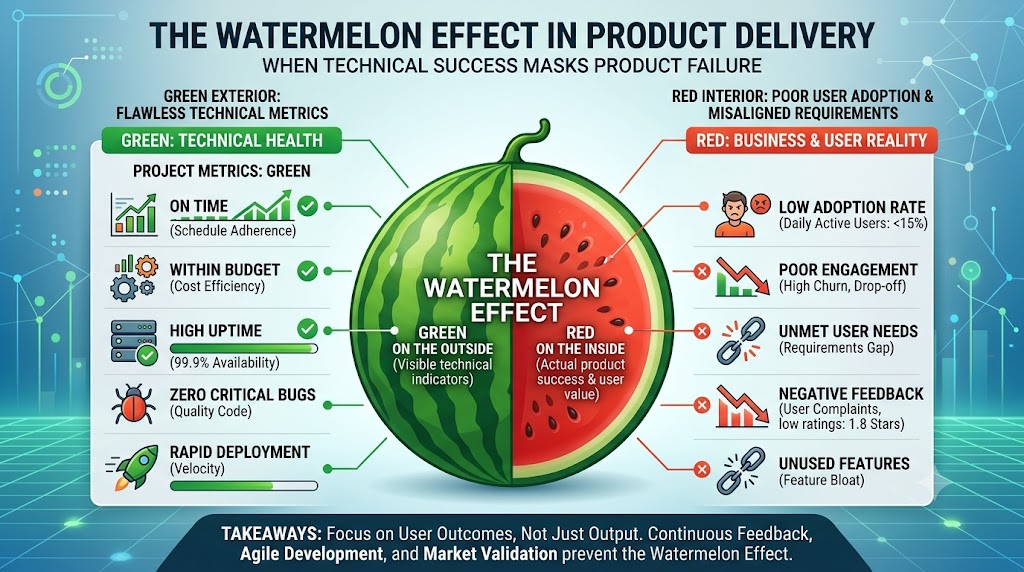
It is Monday morning, 8:00 AM. After a grueling six-month development cycle, your enterprise project finally goes live. The engineering team is celebrating: the deployment was seamless, the system architecture is pristine, and the code contains zero critical bugs. By 2:00 PM, however, the atmosphere shifts from triumph to absolute dread. Customer support queues are overflowing, user engagement metrics are dropping sharply, and customer churn metrics spike.
The application works perfectly from a technical standpoint, yet it is failing completely in the market. Why? Because the requirements were written as a technical checklist rather than from the end-user’s actual worldview. The product team built exactly what the developers thought they needed, completely missing what the user actually required to complete their daily workflow.
This nightmare scenario highlights a toxic, deep-seated corporate myth: the belief that a user story is merely a breakdown of technical tasks designed to tell developers how to build a system component.
When project managers treat user stories as functional specification documents disguised in Agile terminology, they introduce massive scope creep, alienate engineering teams, and deliver software that users actively dislike. True Agile requirement analysis demands a complete psychological shift: writing small, simple feature descriptions strictly from an end-user viewpoint.
The Anatomy of a Flawless User Story
To execute elite Agile requirement analysis, project leaders must master user story formatting. A user story is not a technical specification, it is a lightweight tool designed to facilitate continuous collaboration and shift the focus from engineering constraints to human value.
The Core Mechanics: The Three Cs
Every expertly formatted user story relies on a classic framework that balances concise documentation with collaborative discovery:
The Card: The physical or digital token representing the requirement. It must remain small and concise, forcing the author to distill the feature down to its raw essence without getting bogged down in implementation details.
The Conversation: The continuous dialogue between product owners, business stakeholders, and engineering teams. The card does not replace communication: it acts as an explicit invitation to discuss alternative solutions, technical feasibility, and business value.
The Confirmation: The objective acceptance criteria that define success. This ensures that the development team and business stakeholders share an identical definition of done before a single line of code is written.
The Classic User Story Template
The industry standard format for a user story follows a specific three-part architecture:
While this template appears deceptively simple, minor missteps in formatting can distort the entire development lifecycle. The statement must strictly reflect the user's perspective, avoiding technical jargon or internal project goals.
❌ POORLY FORMATTED STORY
This poor example describes a technical implementation mechanism rather than an end-user capability. It dictates the exact architectural solution (SQL database schema optimization) and fails to capture a human user story.
✅ EXCELLENTLY FORMATTED STORY
This high-quality format focuses entirely on the persona, the immediate business capability, and the underlying motivation. It allows the engineering team to determine the best technical path forward, whether that involves database indexing, caching strategies, or API modifications.
The Step-by-Step User Story Formatting Framework
Consistently writing small, simple feature descriptions strictly from an end-user viewpoint requires an disciplined, repeatable framework. Project managers can immediately adopt this step-by-step methodology to format their backlogs for elite performance.
Step 1: Establish Authentic User Personas
Never begin formatting a story with a generic user role. A vague user archetype leads to ambiguous software design. Project leaders must construct detailed, research-backed user personas that capture the daily realities, technical competencies, and frustrations of their target audience.
Before drafting a requirement, ask: What does this person’s morning look like? What specific operational goal keeps them motivated? When you understand their specific workflow, you can compose user-centric stories that fit seamlessly into their routine.
Step 2: Ruthlessly Enforce the INVEST Criteria
Every user story formatted within your backlog must pass the strict INVEST quality test:
| Criterion | Definition | Tactical Application for Project Managers |
| Independent | The story stands alone without requiring the completion of adjacent tickets. | Avoid ordering stories in rigid, sequential technical layers. Split stories vertically by feature slice rather than horizontally by technology tier. |
| Negotiable | The requirement leaves room for developer input and technical trade-offs. | Describe the business problem, not the code solution. Allow engineers to suggest simpler alternative implementations during sprint planning. |
| Valuable | The feature delivers clear, measurable utility directly to the end-user. | If a story only provides internal architectural value, reframe it to highlight how it improves system performance or reliability for the end-user. |
| Estimable | The team understands the scope well enough to assign a rough sizing estimate. | Break down ambiguous user stories into smaller parts or run a time-boxed technical spike to resolve core architectural unknowns. |
| Small | The story can be completely developed, tested, and verified within a single sprint cycle. | Keep stories focused on a single interaction or target workflow path to prevent scope creep from delaying delivery. |
| Testable | The story can be objectively verified through clear automated or manual validation checks. | Write explicit, unambiguous acceptance criteria that leave no room for subjective interpretation by the quality assurance team. |
Step 3: Deconstruct Requirements Vertically
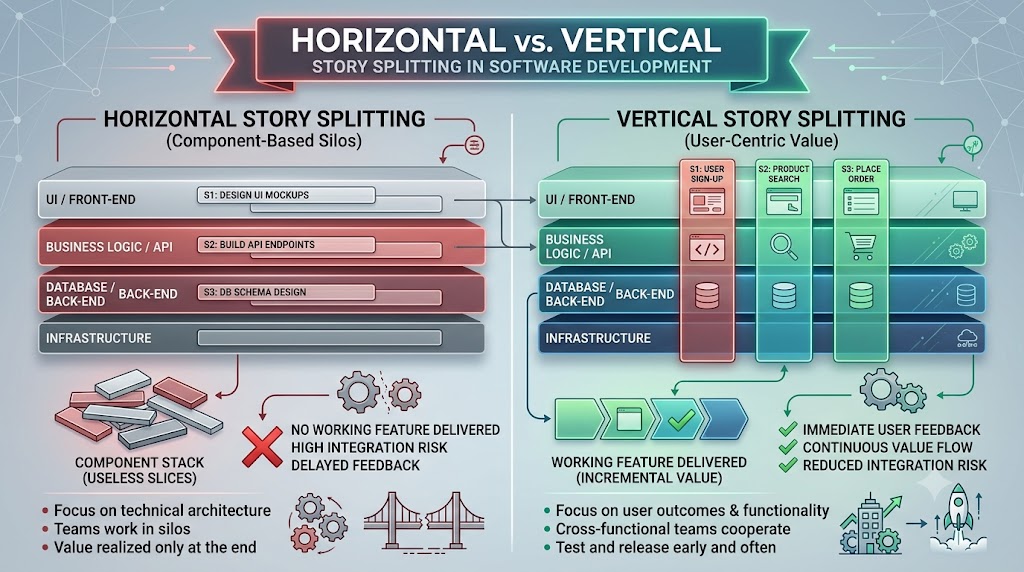
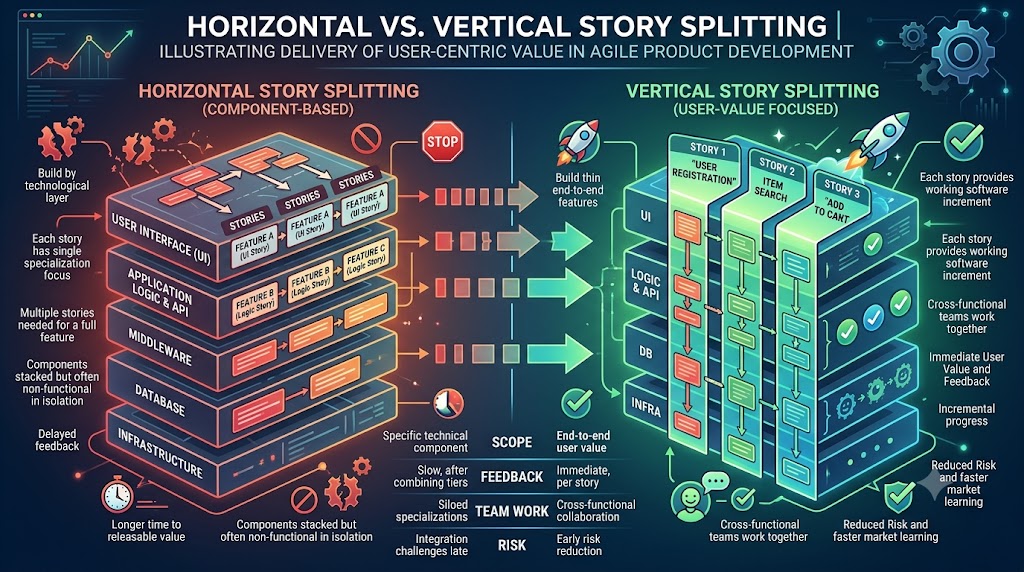
The most common mistake in requirement analysis is splitting stories horizontally by technical architectural layers, such as creating one ticket for the database schema, one for the API endpoints, and another for the user interface layout. This approach breaks the core value loop because no single component delivers real utility to the user on its own.
Instead, slice stories vertically. Format each story to represent a complete, functional slice of the system that travels through all technical layers, providing an end-to-end user experience.
For instance, rather than scheduling a large sprint to build an expansive, multi-field customer search engine, format the initial iteration to allow searching exclusively by a single field: a unique customer ID number. This small, vertical slice allows the team to test the entire system integration instantly, gather direct customer usage feedback, and iteratively deliver advanced search parameters in subsequent development cycles.
Mastering Precision with Advanced Acceptance Criteria
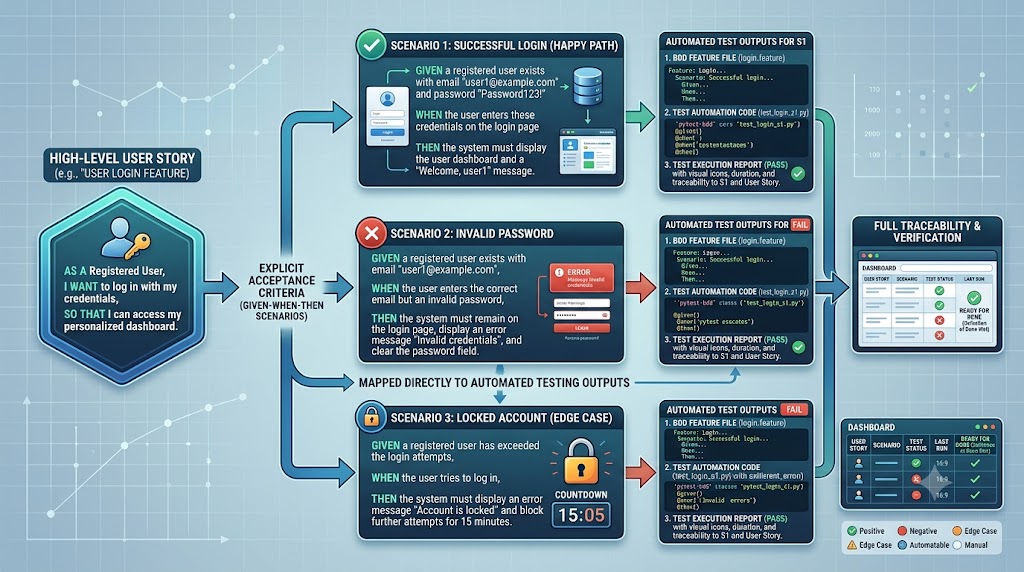
A user story states the high-level human intent, but the acceptance criteria establish the boundaries of execution. To prevent misunderstandings between business stakeholders and engineering teams, elite project managers utilize the automated BDD framework, also known as the Gherkin format.
The Gherkin framework structures acceptance criteria using an objective, chronological sequence:
Given [An Initial Context] → When [A Specific Action Occurs] → Then [The Expected Measurable Outcome]
Using this format provides explicit clarity for developers and quality assurance teams, eliminating assumptions and ensuring alignment across the board:
SCENARIO: Successful credit card checkout with standard profile data

GIVEN a customer has accumulated items in their digital shopping cart

AND the customer has navigated to the secure checkout review page

WHEN the customer submits a valid enterprise corporate credit card number

THEN the system processes the authorized payment immediately

AND a confirmation email is automatically sent to the customer profile address

AND the digital cart is reset to empty.
Formatting acceptance criteria this way provides immense value to project teams:
It Automates Validation: These structured statements can be fed directly into automated testing tools, allowing software to check its own compliance against business rules.
It Forces Deep Requirements Analysis: Writing out these explicit scenarios reveals missing edge cases, complex logic loops, and hidden assumptions long before development begins.
It Minimizes Rework: Developers understand the boundary conditions up front, eliminating the frustrating cycle of building features only to have them rejected during stakeholder reviews.
Shifting from Project Chaos to Elite Delivery
When you transform your user story formatting to focus strictly on the end-user’s viewpoint, the impact on your operational environment is immediate.
Eliminating the Friction of Scope Creep
Traditional technical requirements act as magnets for scope creep. When a ticket reads like a system architecture plan, stakeholders look for opportunities to add complex features and engineering teams get caught up in optimization loops.
Formatting stories around simple, discrete user goals eliminates this ambiguity. If a proposed feature addition does not directly serve the immediate user persona or match the defined motivation clause, it belongs in the product backlog for future consideration.
Ending Engineering Team Burnout
Engineering burnout rarely stems from working long hours: it is driven by the frustration of building software that shifts in definition or misses the mark entirely. When developers receive system-centric checklists, they operate blindly, disconnected from the human impact of their work.
Providing user-centric stories empowers engineering teams. They understand the exact human context of the feature, fostering creative problem-solving and shared ownership of the end product.
Accelerating Professional Influence
For project managers, mastering requirement analysis is the ultimate career accelerator. It marks the transition from a traditional coordinator who simply tracks schedules to a strategic leader who owns the value delivery engine.
When you consistently translate complex corporate strategies into small, actionable, user-focused development increments, you become an indispensable bridge across engineering, design, and business leadership teams.
Elevating Your Project Leadership Trajectory
Elite product delivery is built on clear communication, collective focus, and a deep empathy for the person using the application. Writing small, simple feature descriptions strictly from an end-user viewpoint is the fundamental mechanism that connects your engineering velocity directly to business success. By implementing a user-centric structure, utilizing vertical story splitting, and enforcing clear acceptance criteria, you transform your development environment from a chaotic feature factory into a high-impact delivery engine.
If you are ready to stop guessing, move up the corporate ladder, and learn project management the right way, reach out to Skillsetify. We do not just teach frameworks: we show you your exact career growth trajectory