Elevating Agile Delivery from Command-and-Control to High-Performing Impact
The Silent Productivity Killer in Modern Agile
A high-stakes Sprint is sliding off a cliff: critical user stories remain incomplete, cross-functional dependencies are stalled in bureaucracy, and senior leadership demands a daily micro-status update. In response, a Project Manager sets up a mandatory two-hour “all-hands call” to demand daily task assignments, dictate technical fixes, and micro-manage individual workflows.
The result? Morale plunges, velocity bottoms out, key developers update their LinkedIn profiles, and delivery stalls further.
The core issue stems from a persistent corporate misconception: the belief that an Agile leader must maintain absolute command and control to guarantee project outcomes.
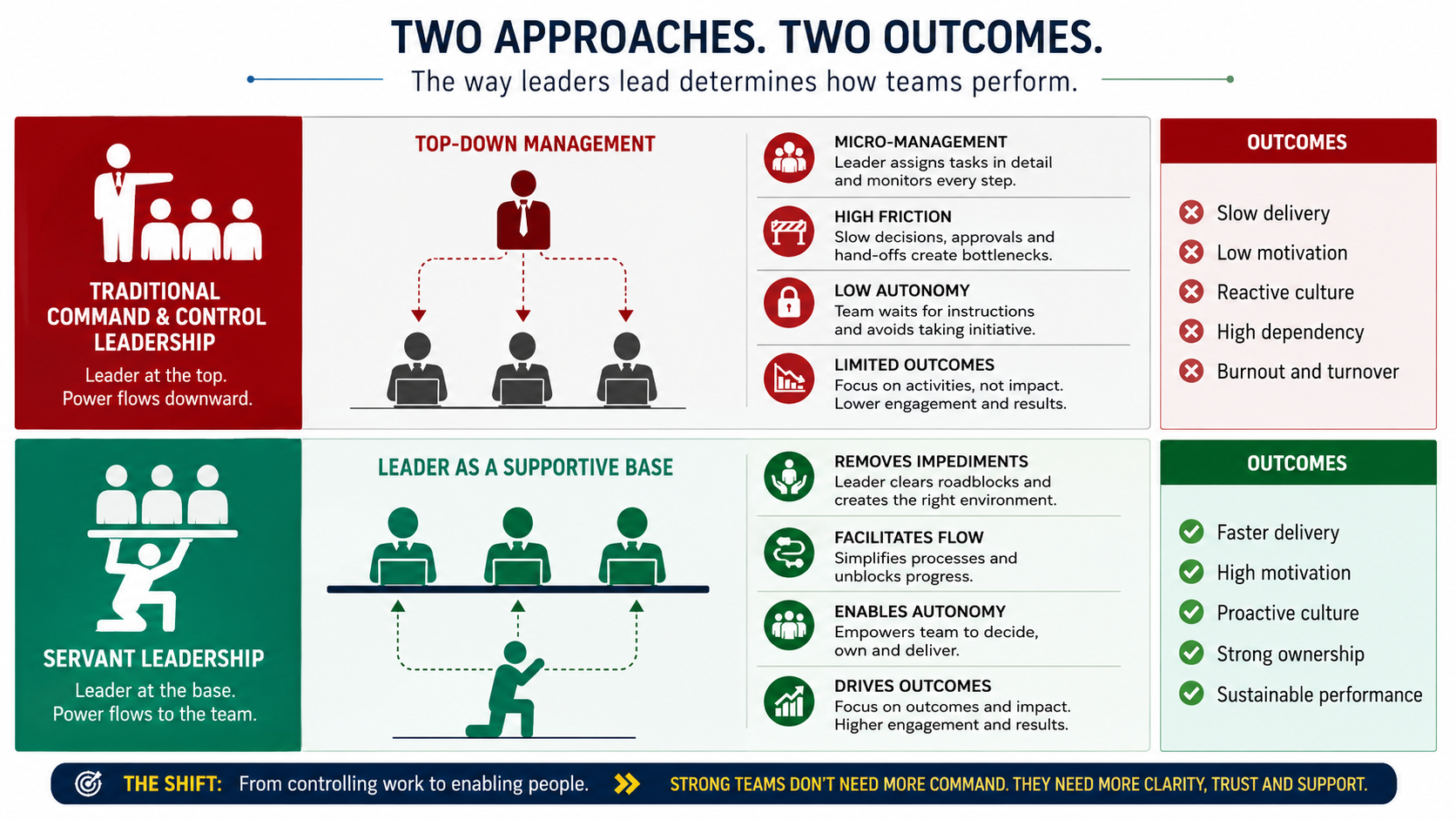
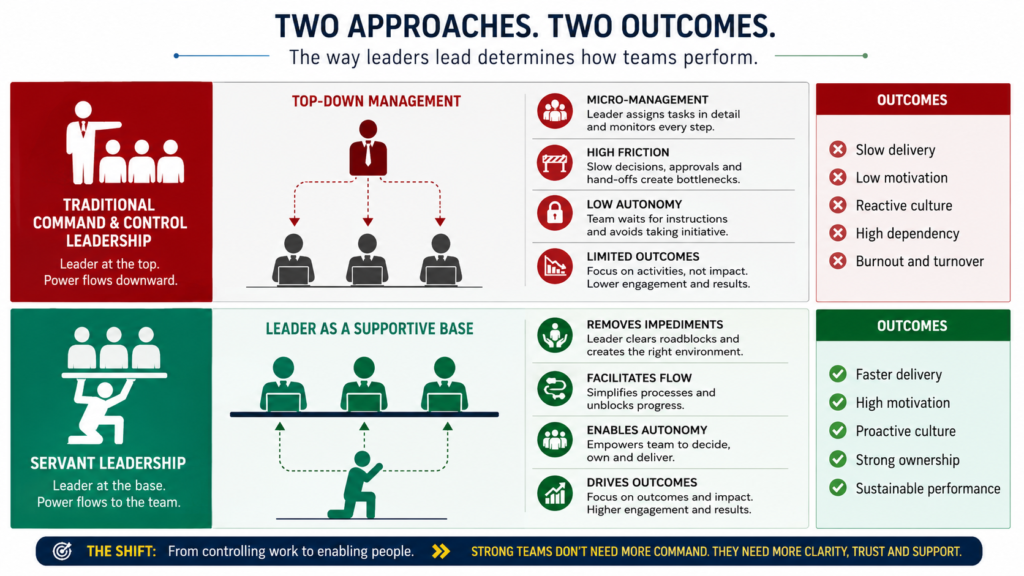
In modern, complex software development and enterprise transformation, traditional micromanagement operates as a direct bottleneck to delivery. The true catalyst of team velocity is not dictation: it is service. Servant leadership is not an abstract concept or a soft-skills luxury; it is a disciplined, operational leadership strategy designed to maximize team throughput by placing the engineering unit at the center of the operational environment.
Deconstructing Servant Leadership Mechanics
Servant leadership fundamentally shifts the role of project management. Instead of telling cross-functional teams how to build, a servant leader prioritizes the team, facilitates delivery processes, and systematically removes external obstacles
The Core Mechanics: Enablement over Command
A servant leader acts as an operational foundation rather than a top-down manager. This transition relies on three distinct operational pillars:
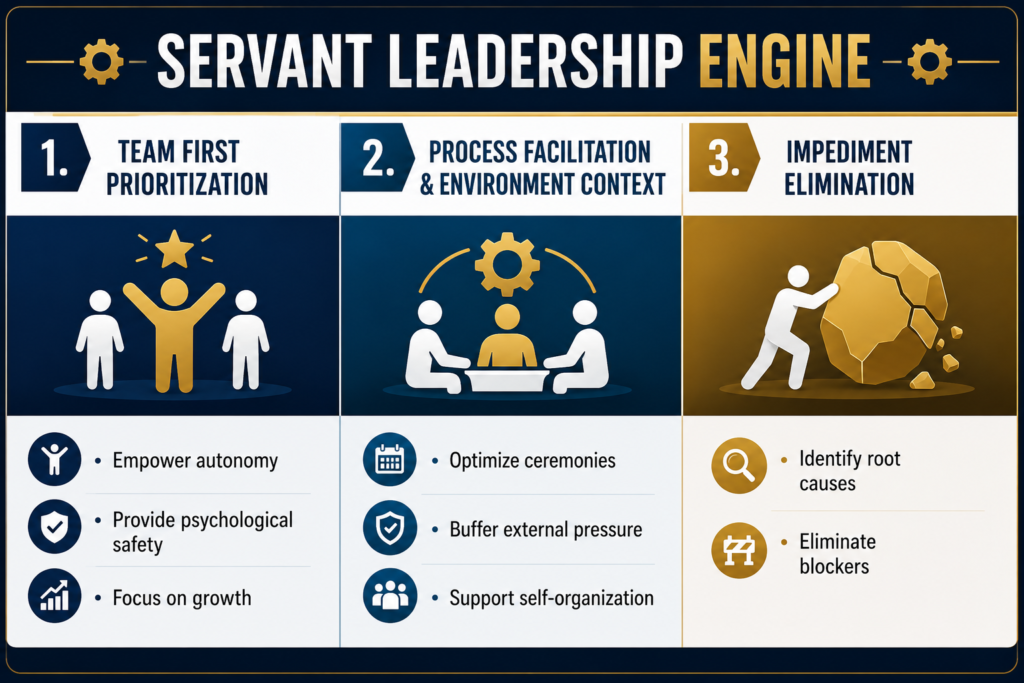
Prioritizing Team Autonomy: Shifting ownership of execution directly to the implementation specialists. The team determines technical feasibility and capacity, while the leader provides the tools and environment necessary for execution.
Facilitating the Operational Environment: Creating structured ceremonies, shielding developers from political friction, and ensuring alignment with organizational goals without dictating tactical implementation.
Systematic Impediment Elimination: Identifying operational blockers early, distinguishing between surface-level delays and structural bottlenecks, and taking direct ownership of their resolution.
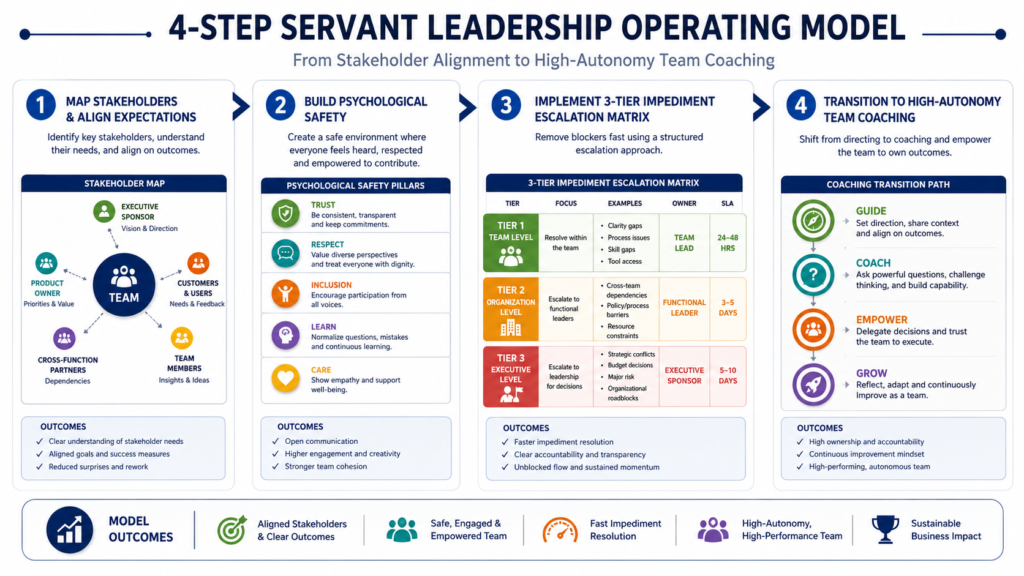
Architectural Framework: The 4-Step Servant Leadership Operating Model
To apply servant leadership systematically across enterprise projects, project managers can leverage this four-step implementation model:
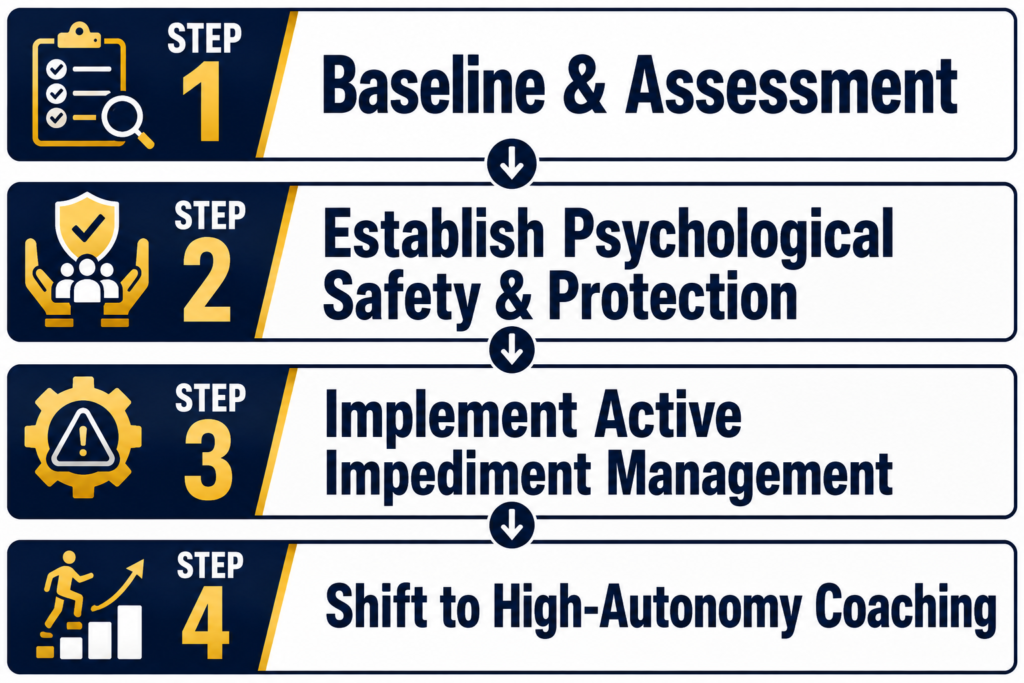
Step 1: Baseline Context and Stakeholder Mapping
Before clearing obstacles, determine where organizational power and friction reside.
Perform a Stakeholder Power/Interest Mapping exercise to identify high-impact decision-makers.
Define team capabilities and establish clear team agreements (e.g., Working Agreements, Definition of Ready, Definition of Done).
Measure initial baseline metrics: Sprint Velocity, Cycle Time, and Blocked Task Hours.
Step 2: Establish Psychological Safety and Protective Buffers
Teams cannot innovate or surface impediments early if failure carries immediate retribution.
Act as a protective buffer between upper management pressure and technical delivery units.
Translate aggressive executive demands into clear, actionable sprint objectives without passing down chaotic stakeholder anxiety.
Encourage early escalation of blockers by treating surfaced risks as system vulnerabilities rather than personal failures.
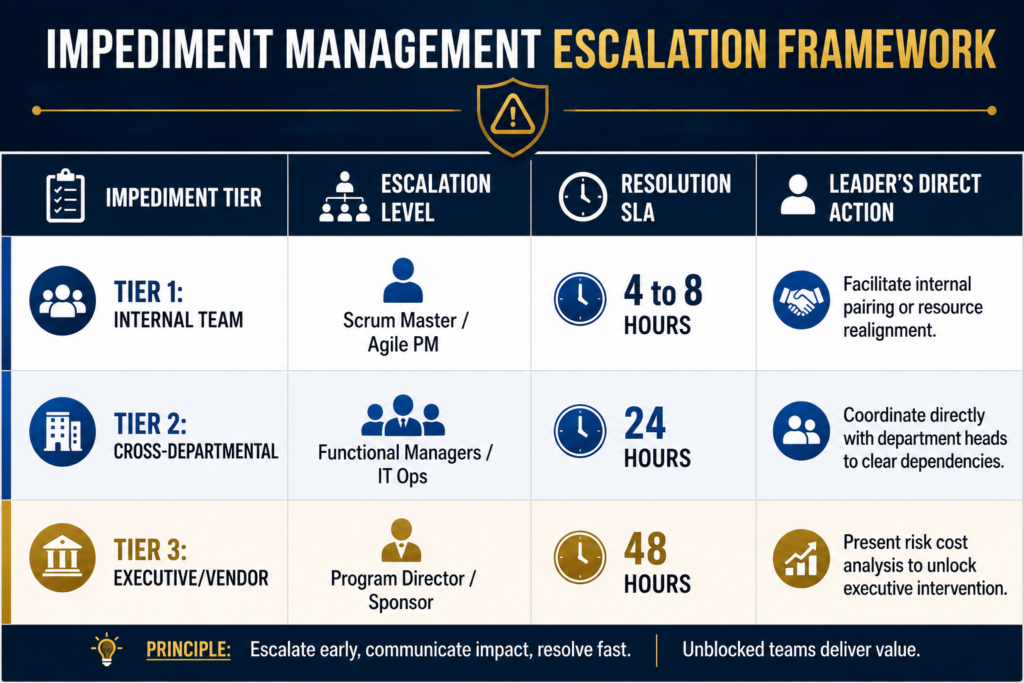
Step 3: Implement Active Impediment Resolution Protocols
Not all impediments are equal; structured categorization accelerates resolution.
Classify impediments into three categories: Technical (tooling/environments), Process (approvals/governance), and Behavioral (communication bottlenecks).
- Establish an Impediment Escalation Matrix:
Step 4: Shift from Directing to Coaching and Growth Facilitation
Empower individuals to develop autonomous problem-solving capabilities over time.
Frame directives as strategic questions: Replace “Do task X this way” with “What structural barrier is preventing us from completing task X, and how can I help remove it?”
Conduct targeted 1-on-1 coaching sessions focused on continuous professional improvement.
Incrementally increase team ownership over sprint commitments and architecture planning.
The Career Transformation of the Modern Project Leader
Adopting a servant leadership model transforms both project performance and your leadership trajectory:
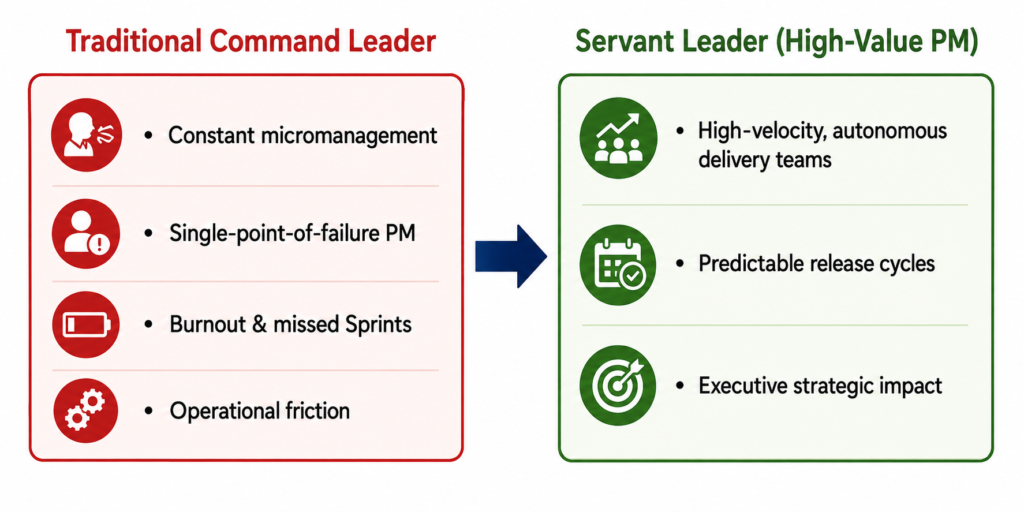
When you transition from taskmaster to enabler, your profile as a leader changes fundamentally:
Predictable Delivery & Higher Throughput: Teams that operate with high autonomy and minimal external friction consistently outperform micromanaged units in cycle time and code quality.
Low Churn & High Morale: Psychological safety and active blocker resolution drastically reduce team burnout and costly turnover.
Elevated Strategic Standing: By handing execution management over to self-organizing teams, you free up bandwidth to focus on portfolio alignment, business value optimization, and executive communication.
Leading projects successfully requires moving past outdated, top-down tactics and building expertise in modern, high-impact management frameworks. Mastering these leadership models is the fastest way to transition from managing tactical tasks to driving enterprise-level strategy.
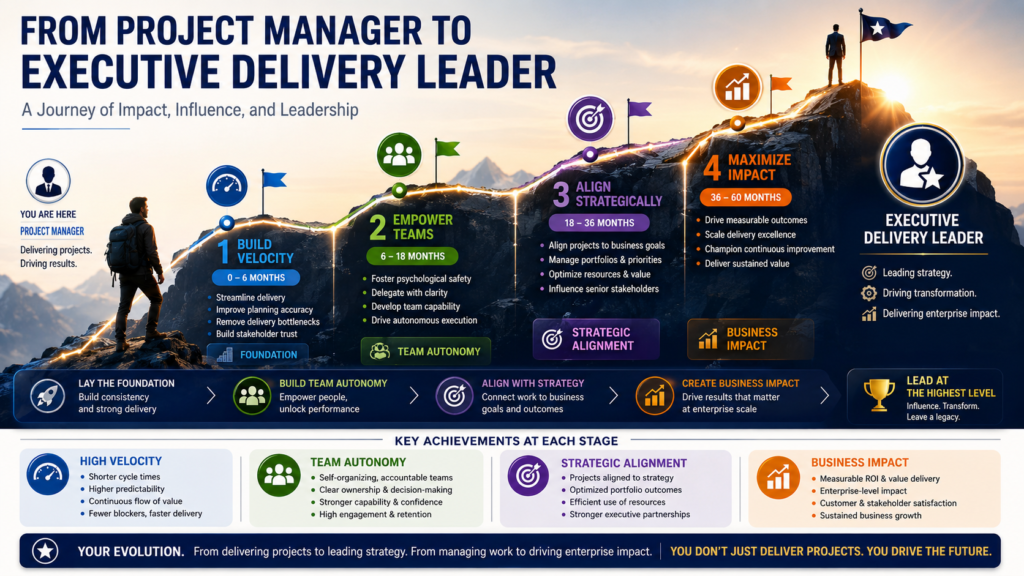
Master High-Impact Delivery with Skillsetify
Adopting servant leadership requires more than understanding theory; it demands tactical application, structured frameworks, and real-world execution strategy.
If you are ready to stop guessing, move up the corporate ladder, and learn project management the right way, reach out to Skillsetify. We do not just teach frameworks: we show you your exact career growth trajectory.
Connect with our program advisors today to gain access to enterprise-grade project management mentorship, hands-on leadership toolkits, and career acceleration tracks designed for modern professionals.
Key Takeaways for Project Leaders
Prioritize the Team: Focus on enabling autonomous delivery units rather than issuing command-and-control directives.
Systematize Blocker Removal: Implement clear escalation SLAs to clear organizational dependencies quickly.
Protect and Buffer: Shield delivery teams from political friction and stakeholder anxiety to maintain sprint focus.
Drive Strategic Value: Use the bandwidth gained from team autonomy to focus on business outcomes and enterprise alignment.