The Millions Lost When You Confuse the Customer with the Consumer
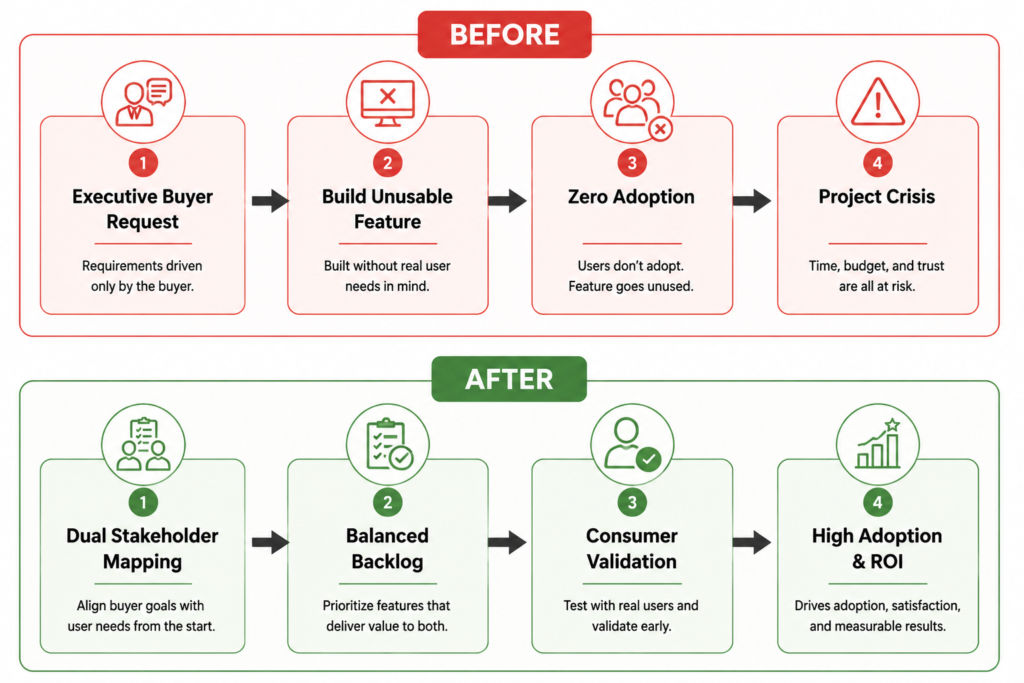
picture a scenario that plays out in corporate boardrooms every single quarter: A major enterprise software launch, backed by two years of development and a $10 million capital expenditure budget, officially hits the market. The Chief Information Officer who signed the procurement check is thrilled. The features align perfectly with corporate governance, security compliance, and financial reporting guidelines.
Six months post-launch, the internal telemetry data arrives, and it is a complete disaster.
Daily Active Usage (DAU) sits at a dismal 4%. The actual employees responsible for operating the platform on a daily basis find the user interface clunky, confusing, and completely disconnected from their day-to-day workflow. To bypass the tool, floor workers have reverted to using shadow IT, external spreadsheets, and manual workarounds. The executive buyer feels burned, user friction is at an all-time high, and the project team is buried under a mountain of emergency change requests.
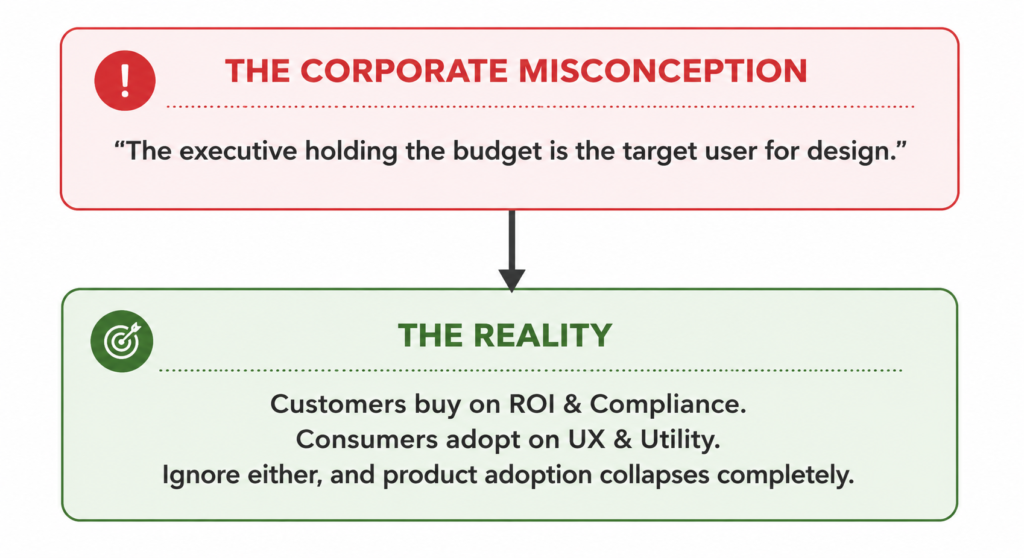
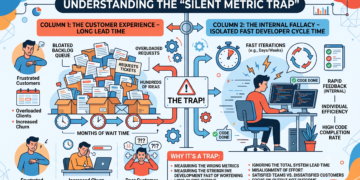
This corporate tragedy stems from a single, pervasive myth: The entity paying the check is the entity you are building for.
In elite project management and product development, failing to differentiate between the customer (the economic buyer) and the consumer (the true end-user) is the single fastest way to guarantee scope creep, budget overruns, and zero operational adoption.
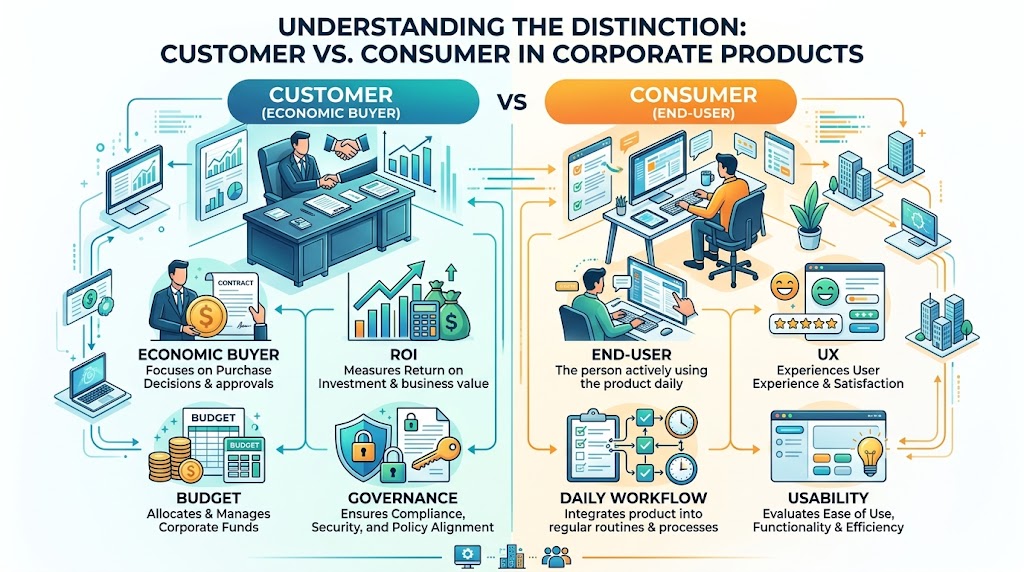
Deconstructing the Divide: Customer vs. Consumer in the Product Life Cycle
To build products that scale predictably, a Project Manager must decouple financial purchasing power from functional end-user requirements. While these two roles can occasionally overlap in simple direct-to-consumer (D2C) transactions, they are almost universally split in enterprise, B2B, and complex productThe Customer (Economic Buyer): This is the person or entity that financially purchases the product. Their decision-making criteria are driven by business cases, return on investment (ROI), total cost of ownership (TCO), risk mitigation, regulatory compliance, and contractual service-level agreements (SLAs).
The Customer (Economic Buyer): This is the person or entity that financially purchases the product. Their decision-making criteria are driven by business cases, return on investment (ROI), total cost of ownership (TCO), risk mitigation, regulatory compliance, and contractual service-level agreements (SLAs).
The Consumer (End-User): This is the person who directly interacts with the product to accomplish a operational task. Their decision-making criteria are driven by user experience (UX), interface speed, workflow efficiency, pain point resolution, and overall ergonomics.
| Lifecycle Dimension | The Customer (Economic Buyer) | The Consumer (End-User) |
| Primary Metric | ROI, TCO, Compliance, Security | Usability, Speed, Task Completion |
| Feedback Focus | Business Outcomes, Financial Value | Workflow Friction, UI Bugs, Feature Utility |
| Lifecycle Impact | Go/No-Go Funding, Renewal Decisions | Daily Active Usage, Feature Adoption |
| Risk Profile | Financial Loss, Regulatory Penalties | Operational Frustration, Wasted Time |
| Engagement Phase | Business Case, Procurement, QBRs | POC, MVP Testing, Daily Usage |
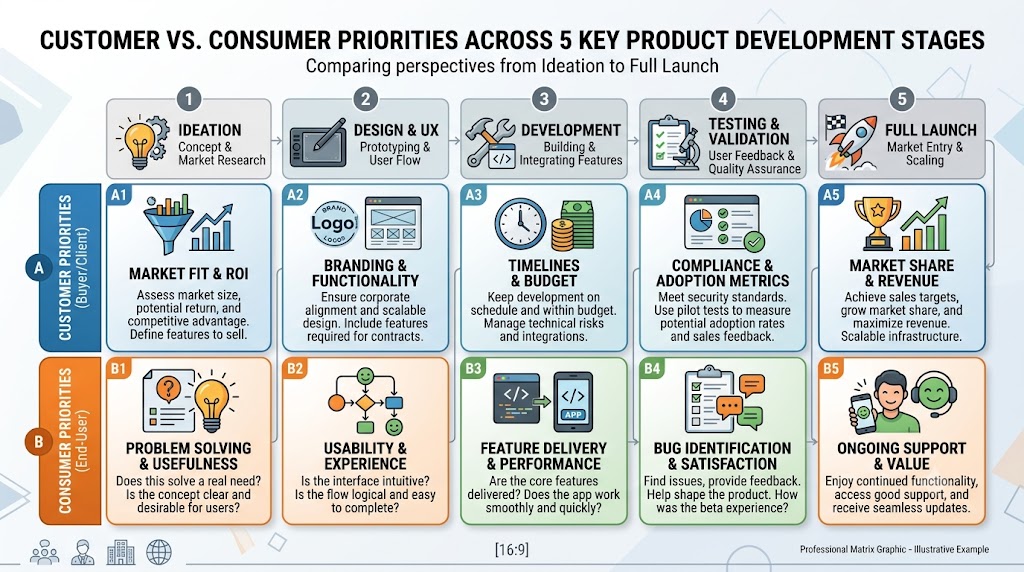
Mapping Dual Dynamics Across Product Development Stages
A seasoned Project Manager must manage both personas simultaneously at every single phase of the Product Life Cycle (PLC).
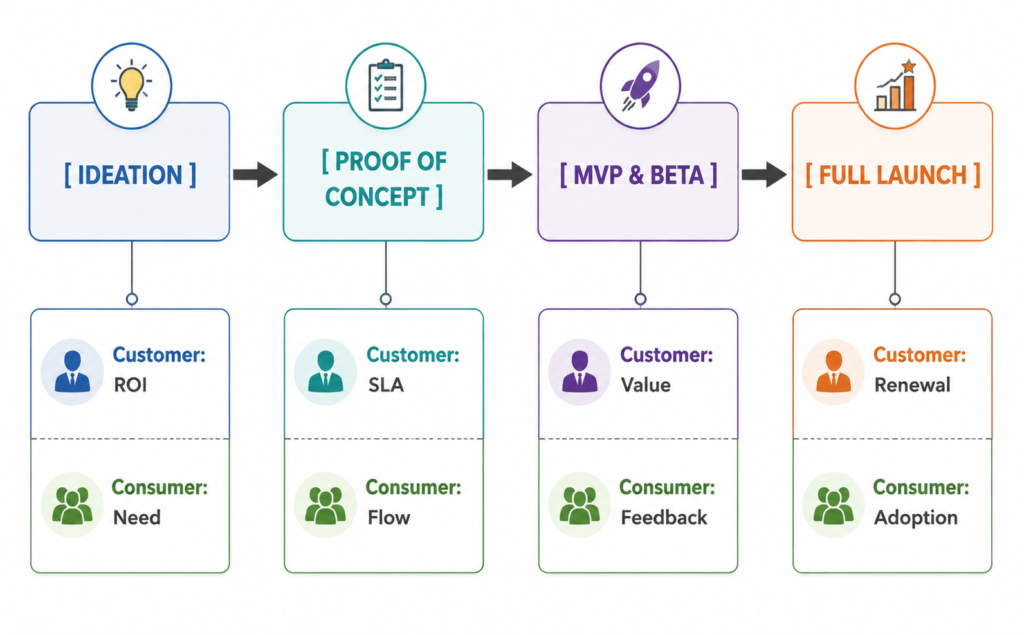
1. Ideation & Business Case Stage:
Customer Role: Validates financial viability. Is this project technically feasible and financially viable?
Consumer Role: Validates problem reality. Does this idea actually solve an acute, daily pain point?
2. Proof of Concept (POC) & Prototyping Stage:
Customer Role: Evaluates high-level alignment with corporate architecture, budget caps, and security standards.
Consumer Role: Evaluates functional user flows. Can the core tasks be completed intuitively without extensive training manuals?
3. Minimum Viable Product (MVP) & Beta Testing Stage:
Customer Role: Looks for evidence of initial risk reduction and milestones that justify continued capital expenditure.
Consumer Role: Hands-on testing. The consumer generates the qualitative feedback and telemetry data needed to refine the backlog.
4. Full Feature Launch & Business-as-Usual (BAU) Operations:
Customer Role: Assesses contractual value realization during Quarterly Business Reviews (QBRs).
Consumer Role: Drives organic usage metrics. If consumers hate the product, the customer will non-renew when the contract expires.
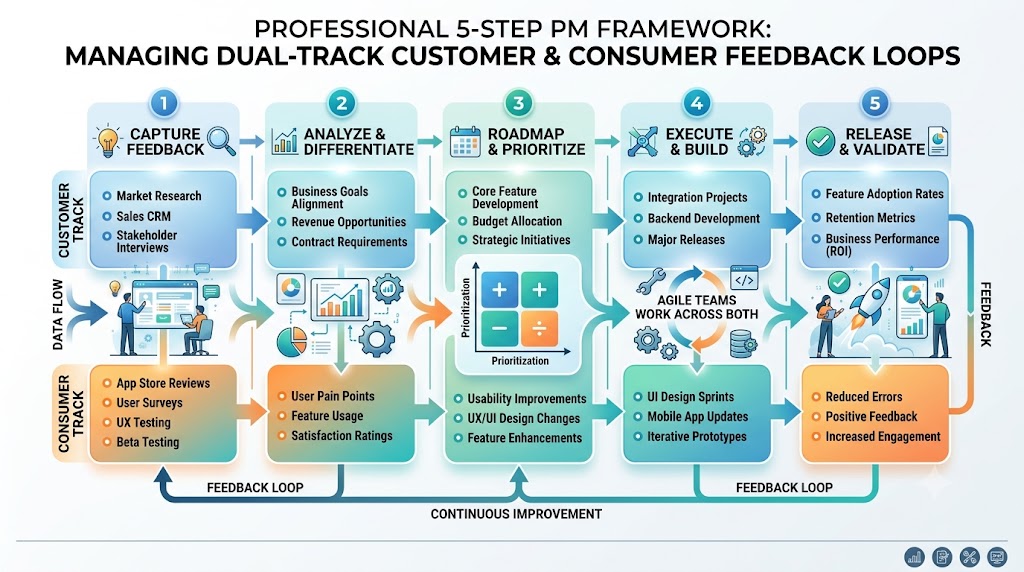
The PM Implementation Framework: Managing Dual Stakeholder Loops
Managing a dual-track stakeholder environment requires a tactical framework. When a Project Manager treats customer requests and consumer feedback as a single, homogenous backlog, the product becomes bloated with executive vanity features that end-users ignore.
Here is the step-by-step framework to decouple and balance customer and consumer needs throughout project execution.
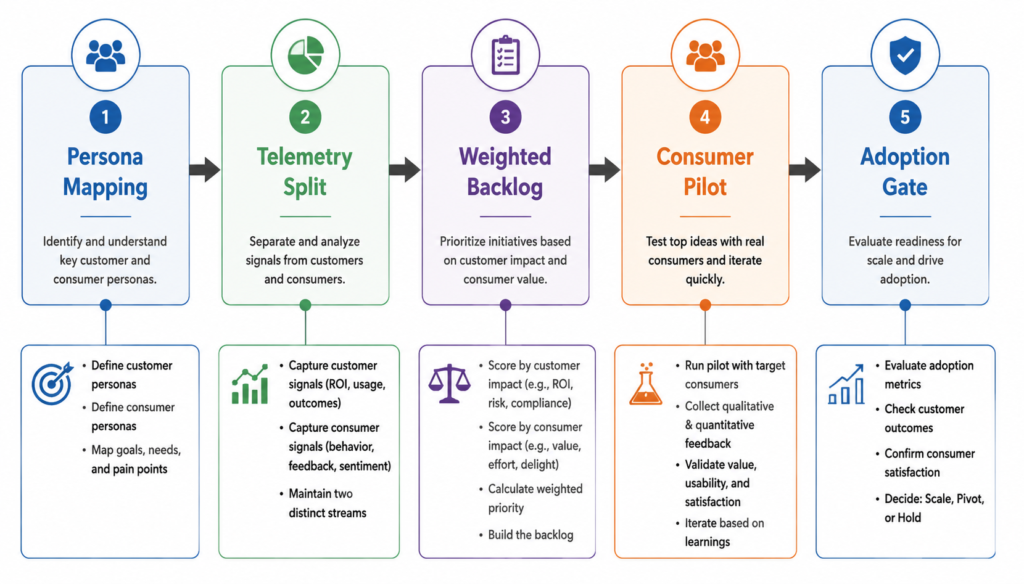
Step 1: Explicit Persona Mapping in the Project Charter
At project kickoff, do not list “Stakeholders” as a single column. Split your stakeholder matrix explicitly into Economic Buyers (Customers) and Operational Users (Consumers). Document their conflicting priorities upfront.
Example: The Customer wants a mandatory 10-step security approval log. The Consumer wants a one-click submission process. Identifying this tension in Stage 1 prevents architectural rework in Stage 4.
Step 2: Establish Dual-Track Feedback Systems
Never rely on executive status meetings to understand user sentiment, and never rely on user feedback to prove financial ROI. Build two distinct communication channels:
The Customer Track: Focuses on milestone delivery, governance compliance, budget burn rates, and financial benefit realization.
The Consumer Track: Focuses on sprint retrospectives, usability testing, heatmaps, task-completion velocity, and Net Promoter Scores (NPS).
Step 3: Implement Weighted Backlog Prioritization
When building user stories and prioritizing the product backlog, evaluate items using a dual-impact matrix. Assign weight to both Buyer Value and User Value.
| Buyer Value vs. User Value Prioritization Matrix | ||
|---|---|---|
| Low User Value | High User Value | |
| High Buyer Value |
Compliance Dashboards Build for Governance |
Automated Core Workflows PRIORITIZE IMMEDIATELY |
| Low Buyer Value |
Cosmetic UI Customization DEPRIORITIZE OR ELIMINATE |
Keyboard Shortcuts / Macros Build for Consumer Delight |
| User Value → | ||
Step 4: Run Consumer-Driven Beta Pilots Before Customer Sign-Off
Before presenting a release to the economic buyer for formal sign-off, run a localized “Walking Skeleton” or MVP pilot strictly with end-users. Validate that the product functions smoothly in a live operational environment. Gather raw consumer feedback to fix usability bugs before presenting the solution to executive leadership.
Step 5: Establish Adoption-Based Definition of Done (DoD)
Redefine project completion. A feature is not “Done” when the code is pushed to production or when the customer signs the acceptance certificate. A feature is “Done” when the consumer base reaches a pre-defined threshold of active adoption without critical workflow failure.
From Scope Creep Chaos to Strategic Leadership
When you master the distinction between customer and consumer dynamics, the entire execution environment shifts.
Instead of fighting constant fires, dealing with unexpected change requests, and watching post-launch adoption plunge, your project delivery becomes structured, predictable, and resilient. You stop building products that look great in procurement slide decks but fail on the operational floor.
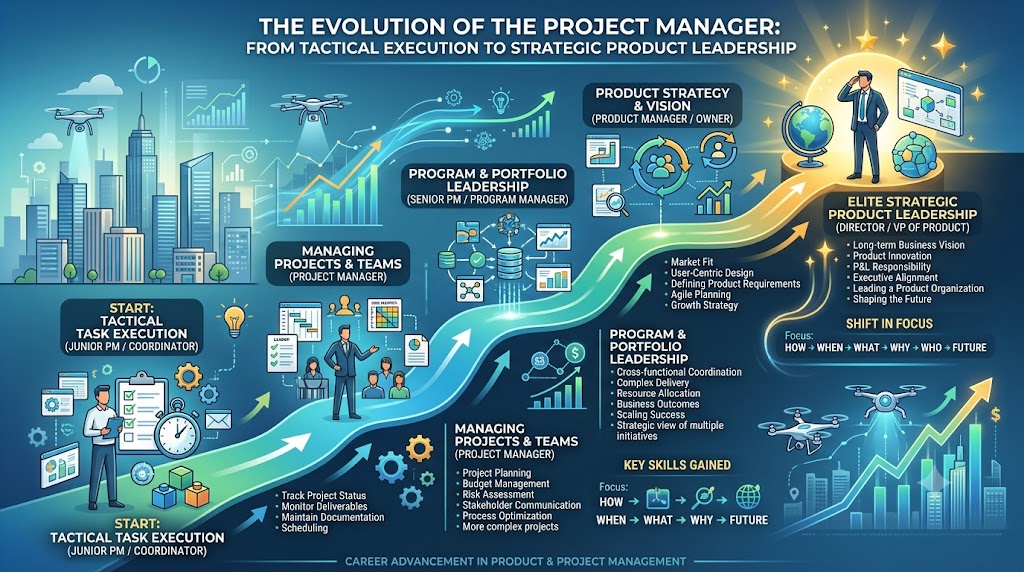
More importantly, this dual-focus perspective transforms your status as a professional. Tactical project managers simply track tasks, manage timelines, and report budget status. Strategic project leaders understand how human behavior, financial capital, and product design intersect. They manage the executive holding the wallet while advocating for the operator using the tool.
Mastering these advanced product management and project governance frameworks is what separates mid-level coordinators from high-earning, elite delivery leaders who consistently land executive roles.
Elevate Your Project Management Career
Differentiating the entity that pays for a product from the human being who relies on it is a core pillar of elite product development. By building dual-track feedback systems, aligning backlogs with consumer reality, and holding launches accountable to real adoption metrics, you protect corporate investments and deliver exceptional product experiences.
If you are ready to stop guessing, move up the corporate ladder, and learn project management the right way, reach out to Skillsetify. We do not just teach frameworks: we show you your exact career growth trajectory.